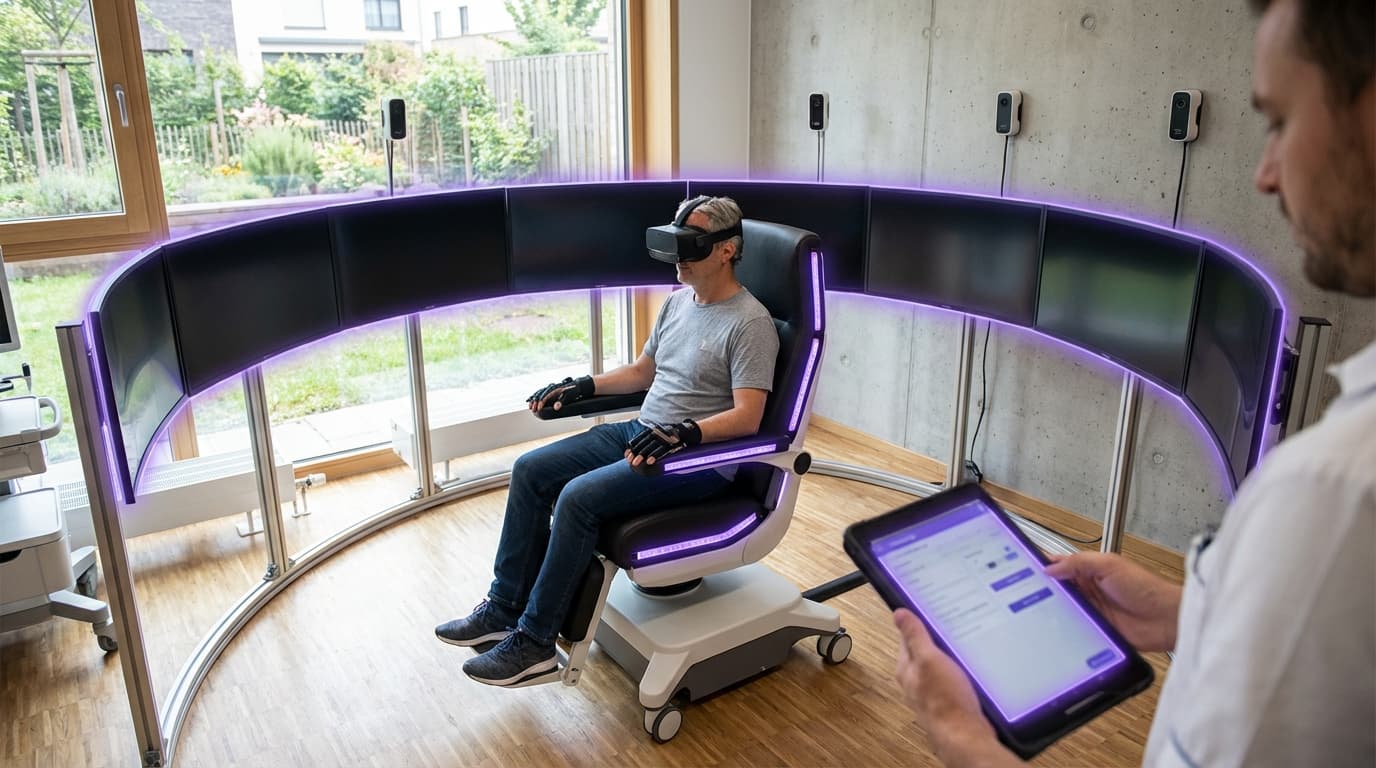
Immersive Therapy Environments
Immersive Therapy Environments leverage extended reality (XR) technologies—including virtual reality (VR), augmented reality (AR), and mixed reality (MR)—to create controlled, customizable therapeutic settings that address a wide range of clinical and wellness challenges. At their core, these systems combine head-mounted displays or projection environments with spatial audio, haptic feedback devices, and real-time biosignal monitoring to immerse patients in scenarios specifically designed for therapeutic intervention. The technology operates through sophisticated software platforms that allow clinicians to adjust environmental parameters such as visual complexity, stimulus intensity, spatial layout, and interactive elements during active sessions. Sensors track physiological responses including heart rate variability, galvanic skin response, eye movement patterns, and body positioning, providing therapists with objective data streams that complement traditional observational assessment. This integration of immersive presentation with biometric feedback creates a closed-loop system where therapeutic experiences can be dynamically calibrated to each patient's current state and progress trajectory.
The clinical applications of these environments address several persistent challenges in traditional therapeutic practice. Exposure therapy for anxiety disorders and phobias, for instance, has historically required either imagination-based techniques or real-world exposure scenarios that can be logistically complex, expensive, or ethically problematic to arrange. Immersive environments enable graduated exposure to feared stimuli—from heights and confined spaces to social situations and traumatic contexts—within safe, repeatable conditions where intensity can be precisely controlled. In physical rehabilitation settings, these systems overcome the motivational barriers and engagement difficulties that often limit recovery outcomes by transforming repetitive exercises into interactive experiences that provide immediate feedback and gamified progression. Pain management applications exploit the brain's limited attentional capacity, using immersive distraction techniques during wound care, physical therapy, or chronic pain episodes to reduce perceived discomfort without pharmaceutical intervention. Mental health practitioners are also exploring these environments for treating post-traumatic stress disorder, social anxiety, and cognitive rehabilitation following brain injury, where traditional talk therapy may prove insufficient.
Early clinical deployments have demonstrated promising outcomes across multiple therapeutic domains, with research institutions and specialized clinics beginning to integrate these systems into standard care protocols. Rehabilitation centers are incorporating VR-based motor training for stroke recovery and mobility restoration, while pain clinics report reduced medication requirements when immersive distraction is employed during procedures. The technology is particularly gaining traction in pediatric settings, where traditional therapeutic compliance can be challenging and where game-like immersive experiences significantly improve engagement. As hardware costs decline and evidence bases strengthen, these environments are transitioning from experimental interventions to established therapeutic modalities. The convergence of immersive therapy with artificial intelligence promises even more sophisticated systems capable of autonomous adaptation to patient responses, while integration with telehealth platforms could extend specialized therapeutic experiences to underserved populations. This trajectory positions immersive therapy environments as a fundamental component of next-generation healthcare delivery, where digital and physical treatment modalities work in concert to improve clinical outcomes and patient experiences.
Related Organizations

Creators of RelieVRx, an FDA-authorized VR therapeutic for chronic lower back pain.

Home to the 'Bravemind' project, a clinical VR exposure therapy tool for treating PTSD in veterans.

Develops gamified neurorehabilitation platforms for stroke and brain injury recovery.

Operates virtual clinics providing VR therapy for various conditions.

A leading VR platform for mental health professionals, offering a library of virtual environments for exposure therapy (phobias, anxiety).

Leverages Virtual Reality to teach social and life skills to individuals with Autism Spectrum Disorder (ASD).

A healthcare company that produces the REAL System, a VR rehabilitation platform for physical therapy.

Rocket VR Health
United States · Startup
Develops immersive therapy solutions specifically for oncology patients and palliative care.

A VR wellness platform that integrates with flow-state sensors and wearables to customize the visual journey based on user physiology.
Supporting Evidence
Research this in Signals
Signals turns a topic into a sourced research record you can inspect and rerun. Your first scan is free, and this one starts with Immersive Therapy Environments already loaded, so edit it or scan as is.