3D Bioprinting
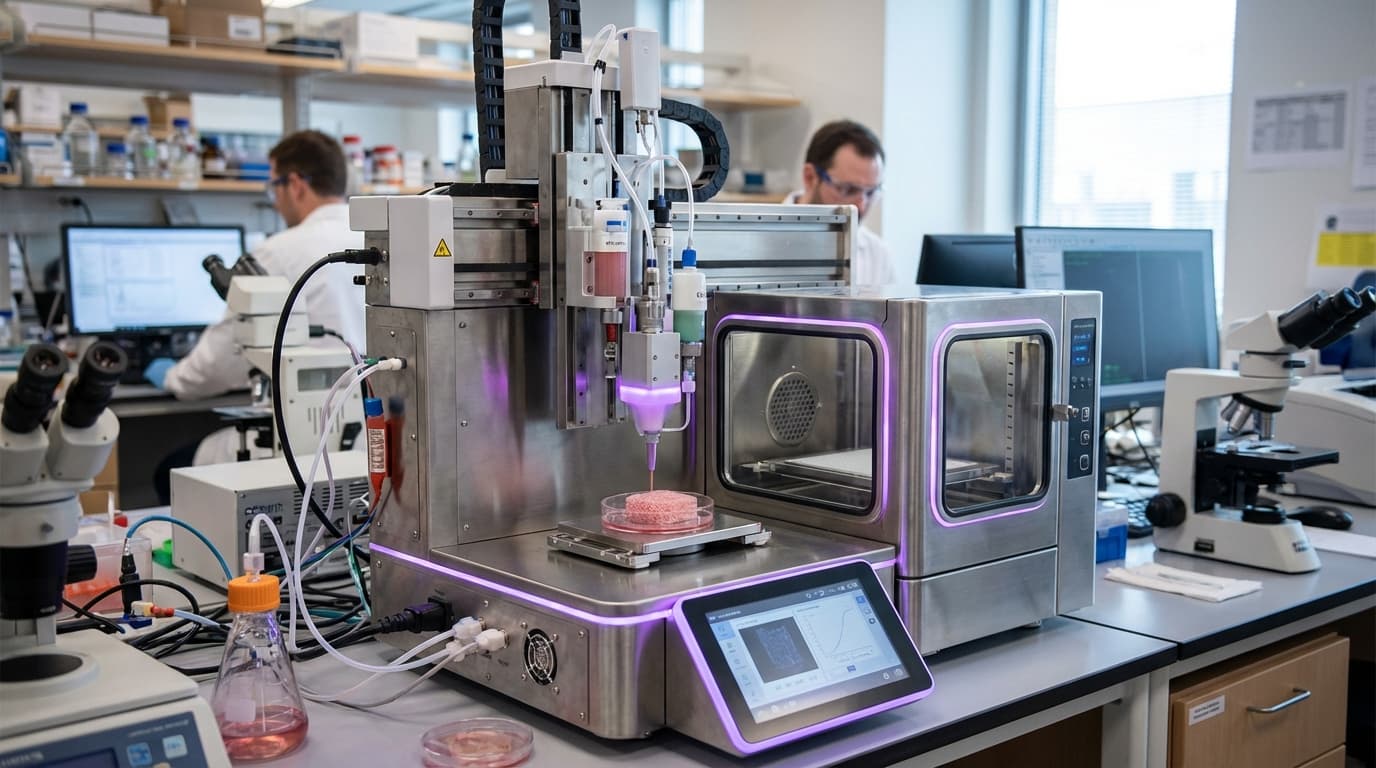
3D bioprinting extends additive manufacturing to living materials, using specialized printers to deposit layers of living cells, biomaterials, and growth factors to create three-dimensional tissue structures. The process typically involves creating a digital model of the desired tissue or organ, preparing bioinks containing cells and supportive materials, and printing layer by layer to build complex structures with multiple cell types and vascular networks. Advanced bioprinters can print at cellular resolution, creating structures that mimic the complexity of natural tissues.
The technology addresses critical challenges in regenerative medicine: the shortage of organ donors, the risk of organ rejection, and the need for patient-specific treatments. Bioprinted tissues can be used for drug testing, disease modeling, and eventually transplantation. Applications range from skin grafts and cartilage repair to the ultimate goal of printing functional organs like kidneys, livers, or hearts. Companies like Organovo, CELLINK, and various research institutions are advancing bioprinting technologies, with some products already used for research and drug testing.
At TRL 4, 3D bioprinting has successfully created simple tissues and organoids, with some applications in drug testing and research. The technology faces significant challenges including creating functional vascular networks for larger structures, ensuring long-term cell viability and function, integrating multiple cell types correctly, and scaling to full-size organs. However, as bioprinting techniques improve and our understanding of tissue engineering advances, the technology could eventually enable on-demand organ printing. If these challenges can be overcome, 3D bioprinting could transform medicine by eliminating organ donor shortages, enabling personalized organ replacement, and providing new tools for understanding and treating diseases.
Related Organizations
Sweden · Company
The market leader in bio-convergence, producing a wide range of 3D bioprinters and bio-inks for research.
United States · Company
A pioneer in bioprinting functional human tissues for drug discovery and development, specifically liver and kidney models.

A premier research institute led by Dr. Anthony Atala, famous for printing bladders and developing the ITOP printer.
United States · Company
Expanded into bioprinting by acquiring Allevi and Volumetric; partnering with United Therapeutics on lung scaffolds.

Uses microfluidic 3D bioprinting technology to create bioprinted therapeutics, partnering with Novo Nordisk.
United States · Startup
Specializes in holographic laser printing to create vascularized tissue scaffolds at high speed.
Japan · Company
Developed the 'Kenzan' method, a scaffold-free bioprinting technology using microneedle arrays.

Produces the RASTRUM platform, a drop-on-demand 3D bioprinter for high-throughput cell models.

Poietis
France · Company
Uses laser-assisted bioprinting (LAB) to print living cells with single-cell resolution.
Spain · Company
Provides customized bioprinting systems designed to adapt to specific tissue engineering research needs.
Supporting Evidence
Research this in Signals
Signals turns a topic into a sourced research record you can inspect and rerun. Your first scan is free, and this one starts with 3D Bioprinting already loaded, so edit it or scan as is.