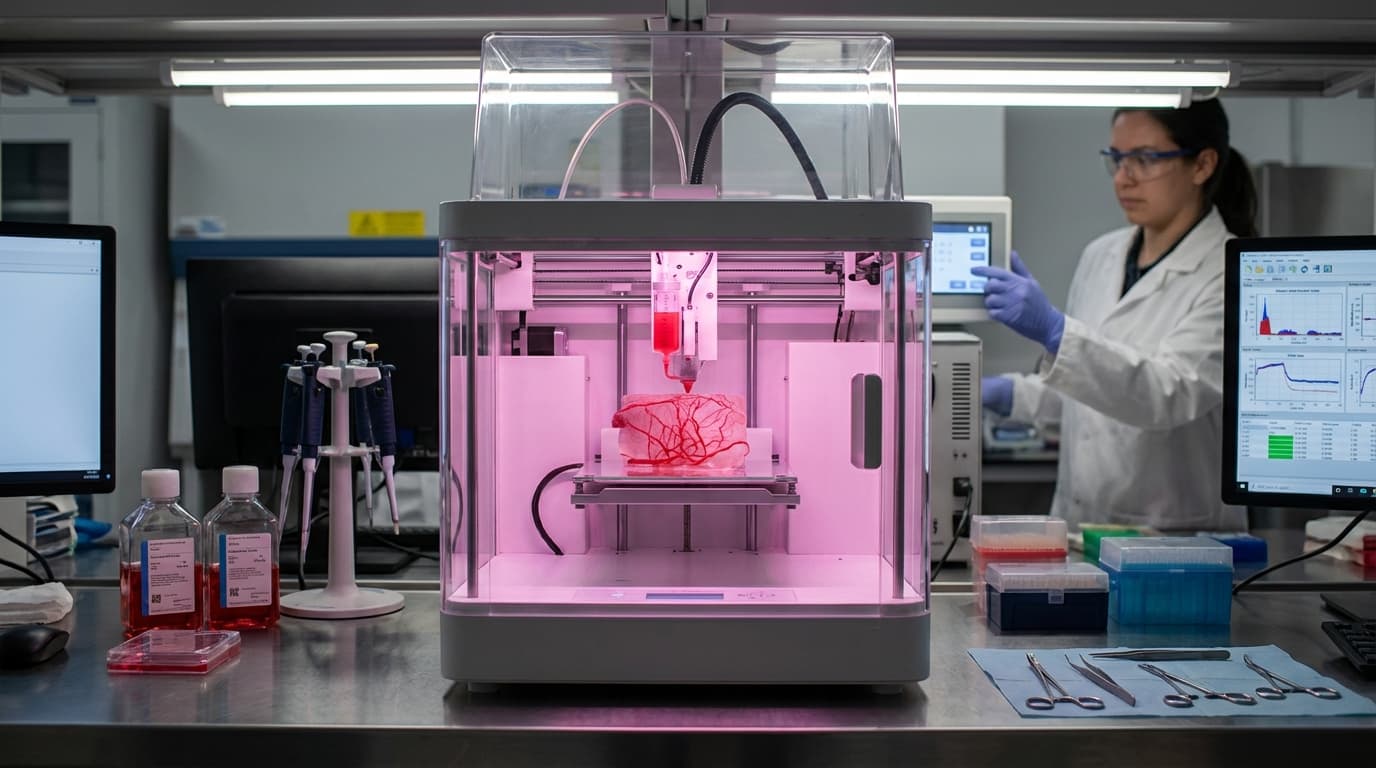
3D-Bioprinted Vascularized Tissue Constructs
3D-bioprinted vascularized tissue constructs use advanced bioprinters that can simultaneously deposit living cells and sacrificial materials (inks that are later removed) to create intricate, patent vascular networks within engineered tissues. This hardware breakthrough solves the fundamental diffusion limit problem in tissue engineering, where cells more than a few hundred micrometers from a blood supply cannot survive due to oxygen and nutrient limitations. By creating functional capillary networks, these systems enable the creation of thick, viable tissue grafts and pave the way for fully functional lab-grown organ replacements.
This innovation addresses the critical challenge in tissue engineering where creating large, thick tissues has been impossible without vascularization. Traditional tissue engineering approaches could only create thin layers of cells, limiting applications. By enabling vascularization, bioprinting can create tissues of meaningful size and complexity. Companies like Organovo, 3D Bioprinting Solutions, and research institutions are developing these capabilities.
The technology is essential for advancing toward functional organ replacement, where creating tissues with integrated blood supply is a fundamental requirement. As the technology improves, it could enable the creation of transplantable organs, addressing the critical shortage of donor organs. However, creating functional, long-lasting vascular networks, ensuring proper integration with host vasculature, and scaling to full-size organs remain significant challenges. The technology represents a major advance in tissue engineering capabilities, but requires continued development to achieve the complexity and functionality needed for organ replacement. Success could transform transplantation medicine by providing an unlimited supply of compatible organs, but the path from current capabilities to functional organ replacement is long and requires many additional advances.
Related Organizations
United States · Startup
Specializes in holographic laser printing to create vascularized tissue scaffolds at high speed.
Israel · University
Research lab that successfully 3D printed a vascularized engineered heart using a patient's own cells.
United States · Company
Developed the 'Print to Perfusion' technology for creating vascularized tissues; acquired by 3D Systems.

Developed the SWIFT (Sacrificial Writing into Functional Tissue) method for 3D printing vascular channels in living matrices.

Uses microfluidic 3D bioprinting technology to create bioprinted therapeutics, partnering with Novo Nordisk.
Sweden · Company
Provides single-cell bioprinting platforms (Biopixlar) capable of creating detailed tissue microenvironments.

Poietis
France · Company
Uses laser-assisted bioprinting (LAB) to print living cells with single-cell resolution.
United States · Company
Creators of the BioAssemblyBot, a robotic arm bioprinter capable of complex vascular workflows.
Supporting Evidence
Research this in Signals
Signals turns a topic into a sourced research record you can inspect and rerun. Your first scan is free, and this one starts with 3D-Bioprinted Vascularized Tissue Constructs already loaded, so edit it or scan as is.