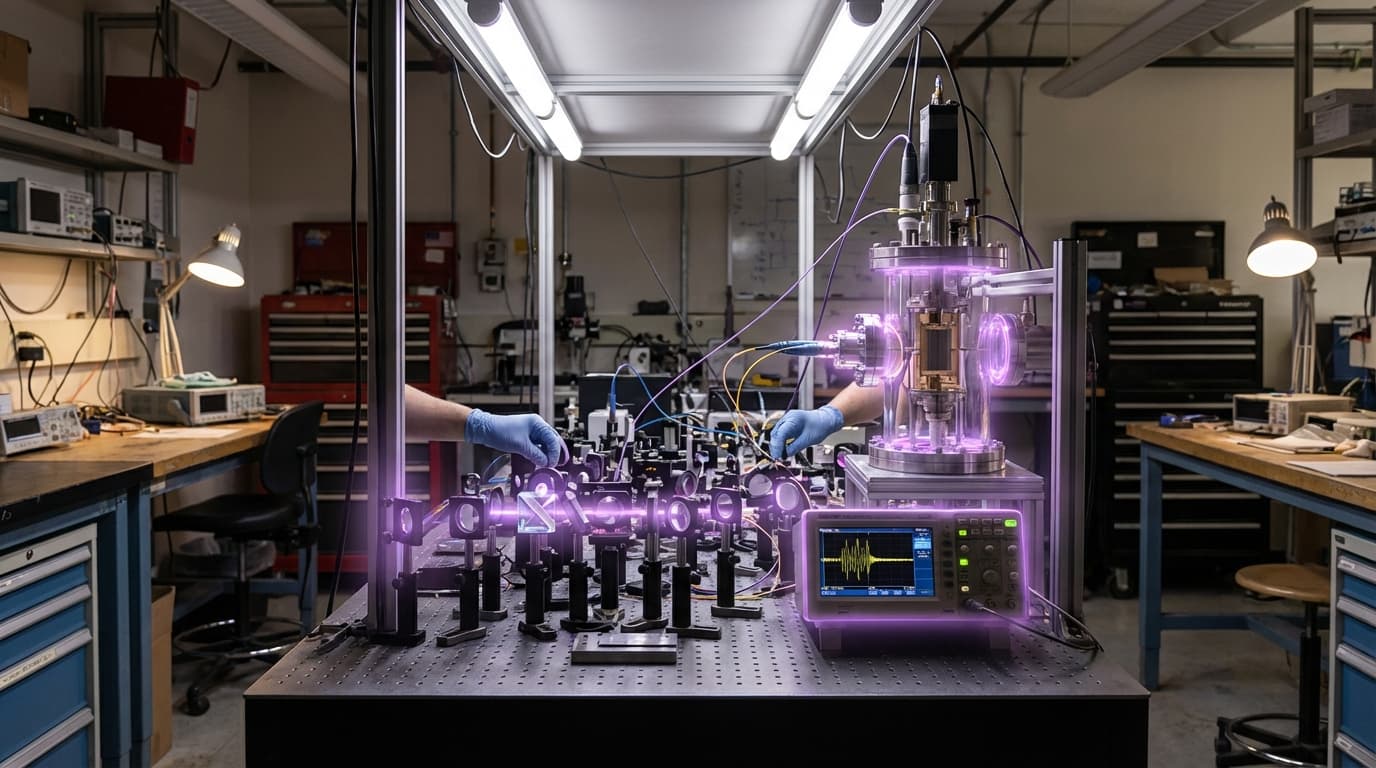
Quantum Optics
Quantum optics studies the quantum mechanical properties of light and its interactions with matter at the most fundamental level. The field explores phenomena like photon entanglement, quantum superposition of light states, and the quantum nature of light-matter interactions. These quantum effects enable technologies that are impossible with classical optics, including quantum computing using photons as qubits, quantum cryptography for unbreakable encryption, and quantum sensors with unprecedented precision.
The technology is foundational for multiple quantum technologies: quantum computers can use photons as information carriers, quantum communication networks can transmit information with perfect security, and quantum sensors can measure physical quantities with precision beyond classical limits. Research in quantum optics is advancing our ability to generate, manipulate, and detect individual photons and quantum states of light. Companies and research institutions worldwide are developing quantum optical systems for computing, communication, and sensing applications.
At TRL 4, quantum optics technologies are being demonstrated in laboratories and some early commercial applications, though most remain in research. The technology faces challenges including maintaining quantum coherence, scaling to larger systems, reducing error rates, and integrating quantum optical components into practical devices. However, as quantum technologies mature, quantum optics will be essential infrastructure. The field could enable quantum computers that solve problems intractable for classical computers, communication networks with perfect security, and sensors that detect gravitational waves, dark matter, or biological processes with unprecedented sensitivity, potentially transforming computing, security, and scientific measurement.
Related Organizations
Germany · Research Lab
One of the world's leading research institutes dedicated to the interaction of light and matter.
United States · Company
Building a utility-scale quantum computer using silicon photonics and fusion-based architecture.
Canada · Company
Canadian quantum company using squeezed light on photonic chips for their Borealis and future processors.
France · Startup
Develops high-efficiency single-photon sources and photonic quantum processors.
United Kingdom · Startup
Uses proprietary quantum memory technology to enable scalable photonic quantum computing.
Netherlands · Startup
Market leader in photonic quantum processors based on silicon nitride waveguides.
United Kingdom · Startup
Developing quantum networking hardware to interconnect quantum computing nodes.

A global leader in quantum cybersecurity solutions, specifically known for their Quantis QRNG chips and appliances.
United States · Company
A major manufacturer of photonics equipment, including specific lines for quantum optics research.

Leading manufacturer of optical sensors, light sources, and systems.
Supporting Evidence
Research this in Signals
Signals turns a topic into a sourced research record you can inspect and rerun. Your first scan is free, and this one starts with Quantum Optics already loaded, so edit it or scan as is.