Quantum Computing
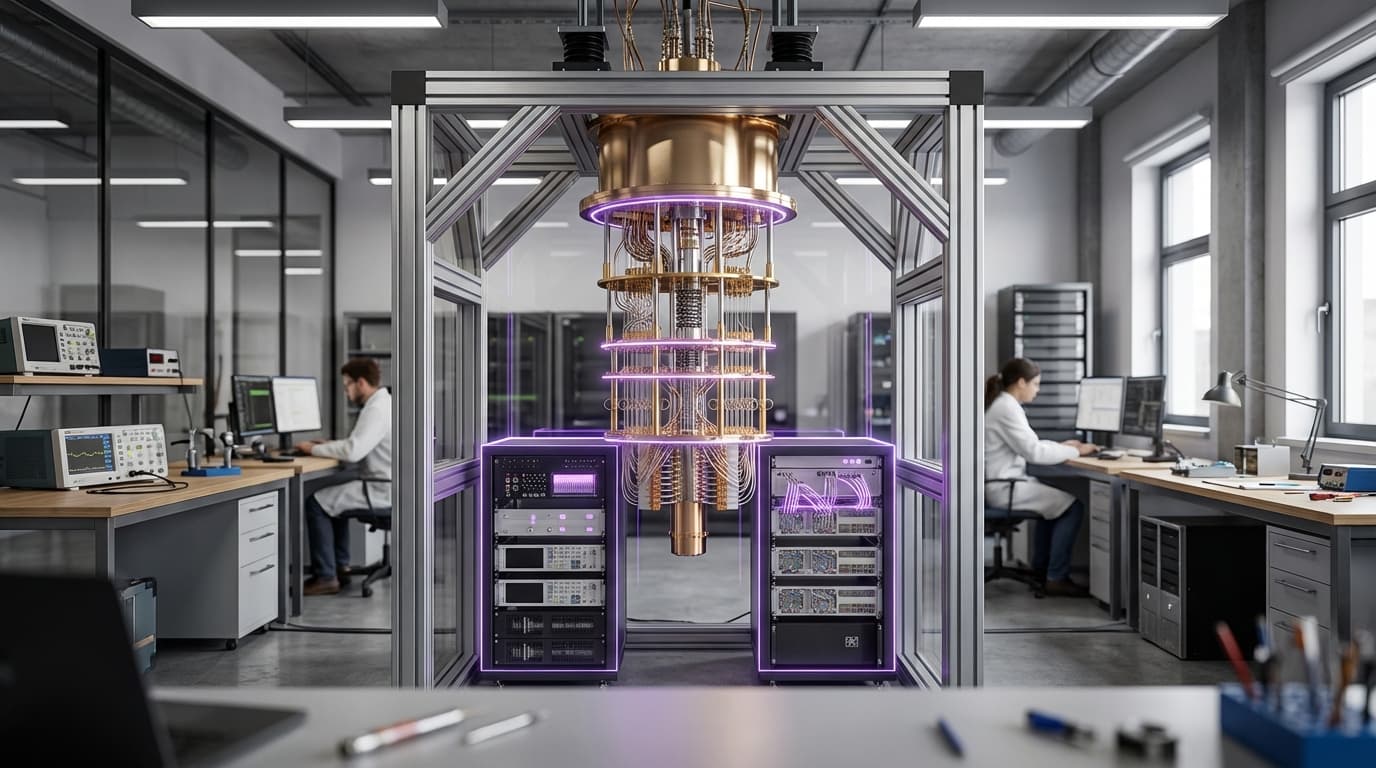
Quantum computing harnesses quantum mechanical phenomena—superposition, entanglement, and interference—to perform computations in ways that are fundamentally different from classical computers. While classical bits exist in either 0 or 1 states, quantum bits (qubits) can exist in superpositions of both states simultaneously, and multiple qubits can be entangled, creating correlations that enable parallel processing of exponentially many possibilities. This allows quantum computers to solve certain problems—like factoring large numbers, simulating quantum systems, or optimizing complex systems—exponentially faster than classical computers.
The technology promises breakthroughs in fields including cryptography (breaking current encryption and enabling quantum-safe alternatives), drug discovery (simulating molecular interactions), financial modeling (optimizing portfolios and risk analysis), and materials science (designing new materials with specific properties). Companies like IBM, Google, IonQ, and Rigetti are developing quantum computers using various approaches including superconducting circuits, trapped ions, and photonic systems. Cloud-based quantum computing services are making these systems accessible to researchers and businesses.
At TRL 5, quantum computers with hundreds of qubits are operational, though error rates and coherence times remain challenges. The technology faces fundamental obstacles including quantum decoherence (qubits losing their quantum state), error correction requirements, scaling to larger numbers of qubits, and developing algorithms that leverage quantum advantages. However, as error rates decrease and qubit counts increase, quantum computers are approaching practical utility for specific problems. The technology could eventually solve problems that are intractable for classical computers, potentially transforming fields from cryptography to drug discovery, though it will likely complement rather than replace classical computing for most applications.
Related Organizations
United States · Company
Maintains Cirq and publishes extensive research on the resource costs of surface codes and specific algorithms like Shor's.

Provides watsonx.governance for managing AI risk and compliance.

The first pure-play public quantum computing company, developing trapped-ion systems using Ytterbium ions.

Integrated quantum computing company formed by Honeywell and CQC.

Pioneer in quantum annealing and now developing gate-model quantum computers.

Full-stack superconducting quantum computing company.
Finland · Startup
The European leader in building superconducting quantum computers.
Develops neutral atom quantum processors and associated software for Quantum Evolution Kernel methods.

Japan's largest comprehensive research institution, with significant work in brain science and bio-hybrid systems.
France · Startup
Developing 'cat qubits' which are inherently protected against bit-flip errors, accelerating the path to fault tolerance.
Supporting Evidence
Research this in Signals
Signals turns a topic into a sourced research record you can inspect and rerun. Your first scan is free, and this one starts with Quantum Computing already loaded, so edit it or scan as is.