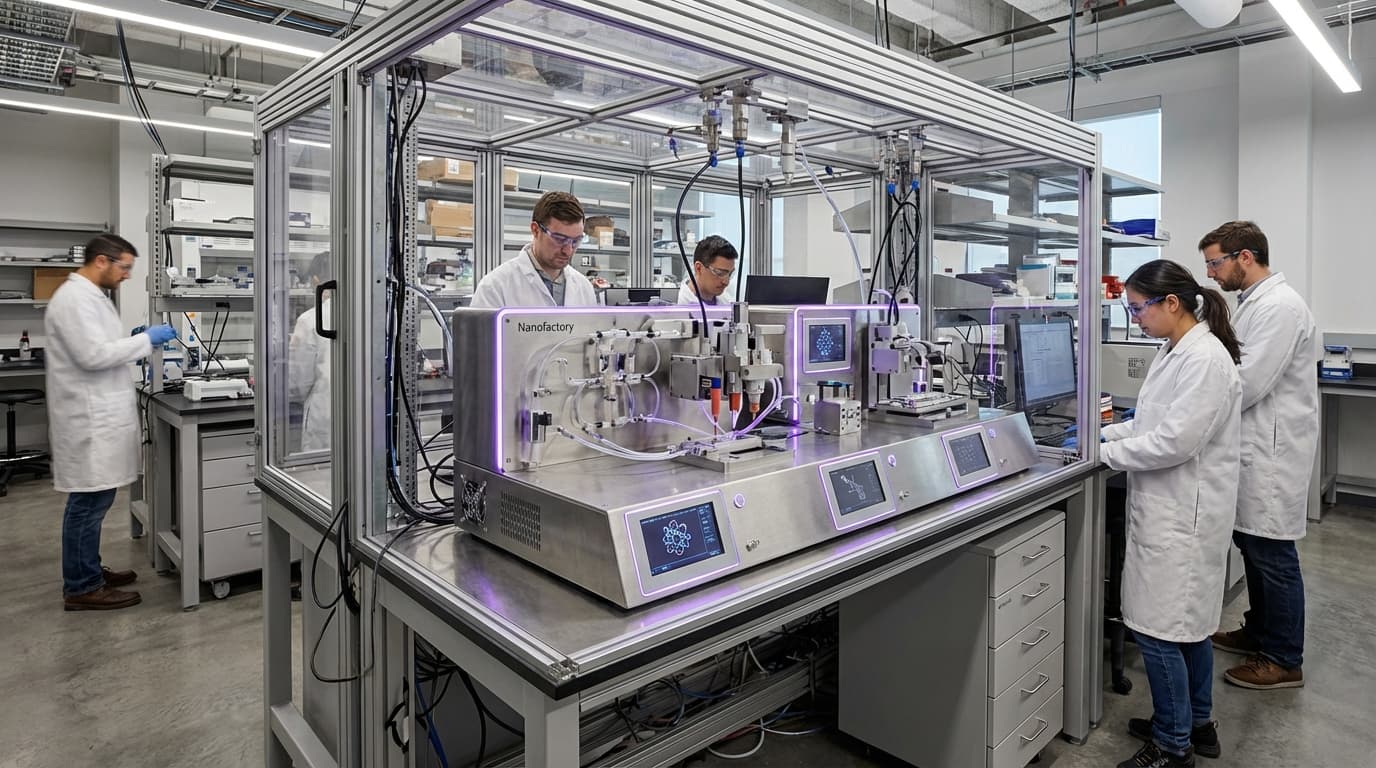
Nanofactory
Nanofactories represent a vision of manufacturing systems that use molecular-scale machines to build products with atomic precision through mechanosynthesis—the controlled manipulation of individual atoms and molecules using mechanical means. These systems would use arrays of nanoscale robotic arms or assemblers that position reactive molecules precisely to build complex structures atom by atom. The resulting components would have perfect atomic arrangements, enabling materials with theoretical maximum strength, perfect purity, and precisely engineered properties.
The technology promises revolutionary capabilities: manufacturing products with zero defects, creating materials with properties impossible through conventional methods, and enabling molecular-scale devices and systems. Nanofactories could produce everything from ultra-strong materials to molecular computers, potentially transforming manufacturing across all industries. Research in molecular nanotechnology, scanning probe microscopy, and DNA origami is exploring the fundamental principles, though full nanofactories remain far in the future.
At TRL 3, nanofactories are largely theoretical, with basic research demonstrating individual components like molecular manipulation and simple molecular assembly. The technology faces fundamental challenges including the complexity of controlling molecular-scale operations, the need for error correction at atomic scales, the enormous computational requirements for designing atomic structures, and the difficulty of scaling from individual molecules to macroscopic products. However, as nanotechnology advances and our ability to manipulate matter at atomic scales improves, nanofactories could eventually become reality. If these challenges can be overcome, the technology would represent a manufacturing revolution, enabling products with perfect precision and properties that approach theoretical limits, potentially transforming every aspect of material science and manufacturing.
Related Organizations
Nonprofit advancing beneficial nanotechnology and molecular manufacturing.
Focuses on atomically precise manufacturing, a prerequisite for constructing theoretical reversible mechanical computing systems.
United States · University
Home to Fraser Stoddart's research on molecular machines and mechanostereochemistry.
United States · Nonprofit
Organization founded to fund and promote the development of nanotechnology and molecular manufacturing.
United States · University
Research center dedicated to nanotechnology, including molecular machines (James Tour's work).

Long-standing leader in neuro-symbolic AI, combining neural networks with logical reasoning for enterprise applications.

World-leading center for 2D materials research and atomic manipulation.
Japan · Research Lab
Research into nano-architectonics and atomic switches.

Manufactures ultra-sharp probes for atomic force microscopy and atomic precision.
Supporting Evidence
Research this in Signals
Signals turns a topic into a sourced research record you can inspect and rerun. Your first scan is free, and this one starts with Nanofactory already loaded, so edit it or scan as is.