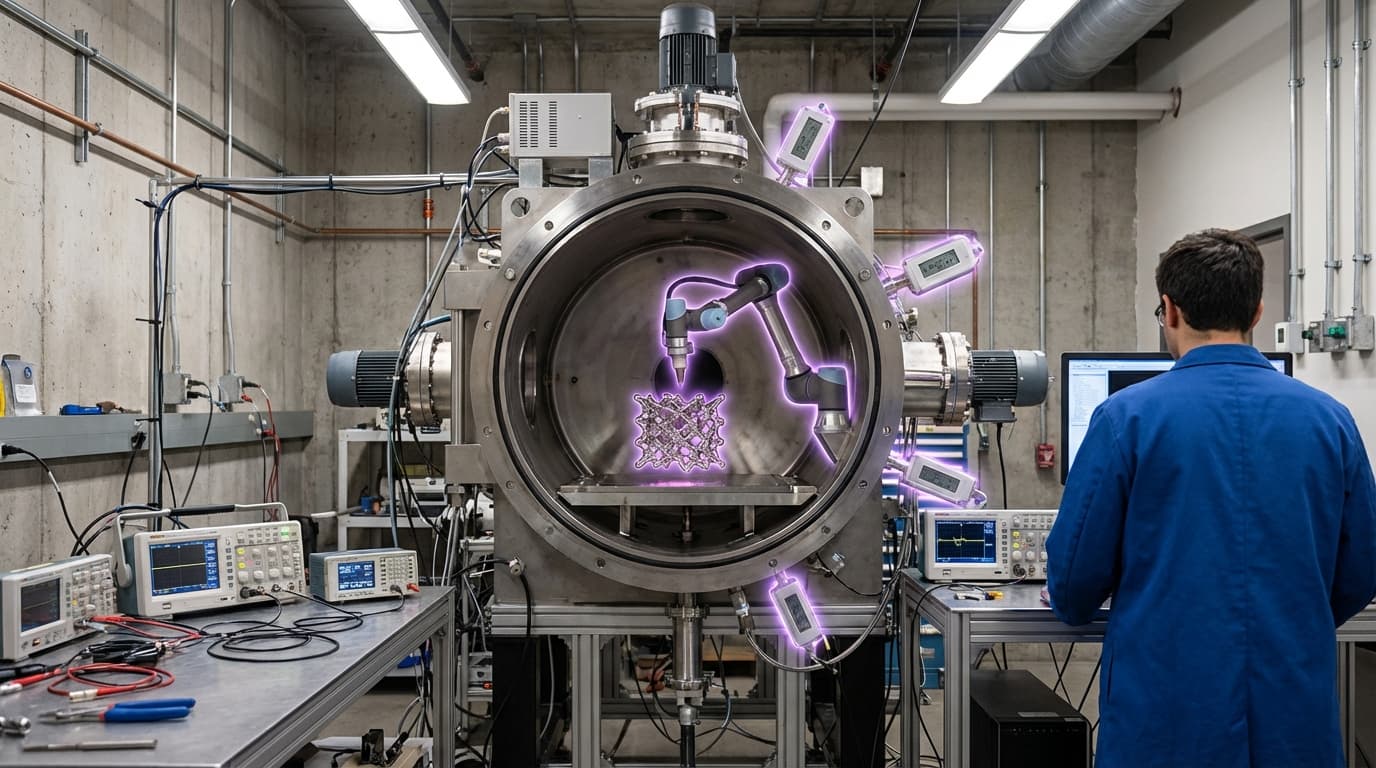
Zero-G Manufacturing
Zero-gravity (microgravity) manufacturing takes advantage of the unique conditions in space—specifically the near-absence of gravity and convection—to produce materials and components with properties impossible to achieve on Earth. In microgravity, materials can be processed without sedimentation, convection currents, or gravitational stresses, enabling the creation of perfectly spherical particles, uniform alloys, flawless crystals, and structures with precise internal architectures. The International Space Station and other orbital facilities are being used to demonstrate and develop these manufacturing capabilities.
The technology enables production of high-value materials including perfect semiconductor crystals for electronics, uniform pharmaceutical formulations, advanced alloys with precise microstructures, and optical fibers with superior clarity. Companies like Made In Space, Redwire Space, and Varda Space Industries are developing manufacturing systems for space, focusing on products where the microgravity advantage justifies the cost of space-based production. Applications range from fiber optics and pharmaceuticals to specialized materials for research and high-performance applications.
At TRL 5, zero-g manufacturing has been demonstrated on the International Space Station and other platforms, with some materials being produced and returned to Earth for analysis and use. The technology faces challenges including the high cost of space access, limited manufacturing volume, complexity of operating in space, and the need to return products to Earth. However, as launch costs decrease and commercial space infrastructure develops, space-based manufacturing becomes more economically viable. The technology is particularly valuable for materials where even small improvements in quality or purity provide significant value, potentially enabling new classes of high-performance materials and products that leverage the unique properties achievable only in microgravity.
Related Organizations

Developing the ForgeStar platform, a returnable satellite for in-space manufacturing of next-generation materials.

Develops orbital manufacturing capsules designed to produce pharmaceuticals in microgravity and return them to Earth.

Developing protein-based artificial retinas manufactured in microgravity to improve layering quality.

Provides in-space 3D printing and bioprinting capabilities, having acquired Made In Space and Techshot.


Provides modular bioreactors and services for microgravity research and manufacturing.

Conducts research on protein crystallization (specifically Keytruda) in microgravity to improve drug delivery.

Developing the Dream Chaser spaceplane and LIFE habitats to support commercial space activities including manufacturing.
Supporting Evidence
Research this in Signals
Signals turns a topic into a sourced research record you can inspect and rerun. Your first scan is free, and this one starts with Zero-G Manufacturing already loaded, so edit it or scan as is.