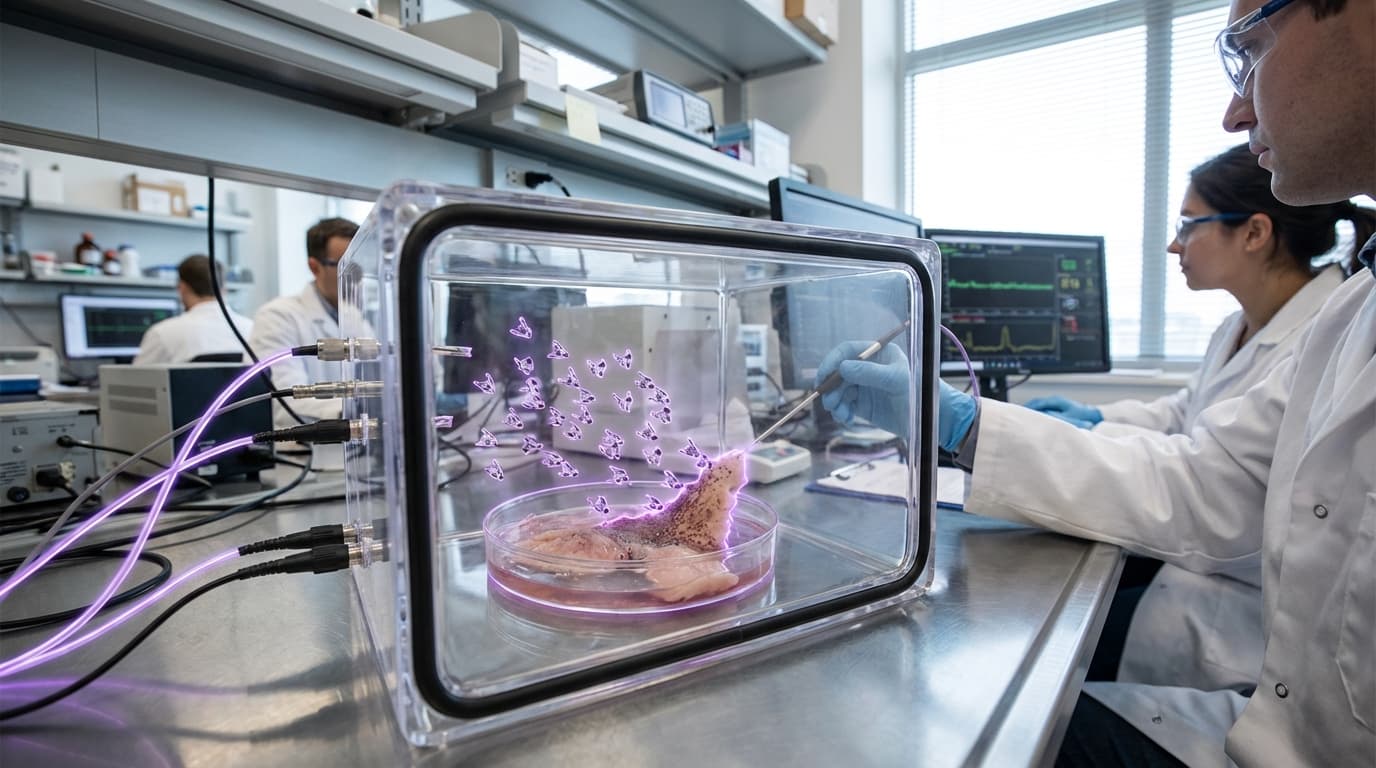
Nanobot
Nanobots are microscopic robotic systems—typically ranging from nanometers to micrometers in size—designed to perform specific tasks at the molecular or cellular scale. These systems can be powered by chemical reactions, external magnetic fields, or light, and can navigate through complex environments like the human bloodstream, tissues, or contaminated areas. Nanobots are being designed to perform diverse functions including targeted drug delivery, disease diagnosis, tissue repair, and environmental cleanup at the molecular level.
The technology promises revolutionary capabilities in medicine, where nanobots could deliver drugs precisely to diseased cells, perform microsurgery, or monitor health from within the body. In environmental applications, nanobots could break down pollutants, clean up oil spills, or remove contaminants from water. Research is exploring various approaches including DNA origami robots, magnetic nanoparticles controlled by external fields, and biohybrid systems that combine synthetic and biological components. Companies and research institutions worldwide are developing nanobot technologies, though most remain in early research stages.
At TRL 4, nanobots are primarily in laboratory research, with some demonstrations of basic navigation, drug delivery, and sensing capabilities in controlled environments. The technology faces enormous challenges including power supply at nanoscale, precise control and navigation in complex environments, biocompatibility and safety, removal from the body after use, and manufacturing at scale. However, as nanotechnology and robotics advance, nanobots could eventually enable entirely new approaches to medicine and environmental remediation. If these challenges can be overcome, nanobots could transform healthcare by enabling precise, targeted treatments with minimal side effects, and could provide new tools for addressing environmental contamination at the molecular level.
Related Organizations

Developing remote-controlled micro-robots to deliver drugs to the central nervous system.

A leading research institute investigating the principles of perception, action, and learning in autonomous systems.
Switzerland · University
Researches magnetic navigation systems for micro- and nanorobots in biomedical applications.

The Painter Group at Caltech is a world leader in piezo-optomechanical quantum transduction.

A premier bio-inspired engineering lab developing soft robotics and adaptive materials.

Designing a microrobot for neurosurgery to navigate the brain's parenchyma.
Spain · Research Lab
Smart Nano-Bio-Devices group focuses on enzyme-powered nanobots.
United States · Company
Pre-clinical medical device company developing the LIBERTY Robotic System for endovascular procedures.

Develops FluidFM technology for single-cell manipulation and nano-injection.
Supporting Evidence
Research this in Signals
Signals turns a topic into a sourced research record you can inspect and rerun. Your first scan is free, and this one starts with Nanobot already loaded, so edit it or scan as is.