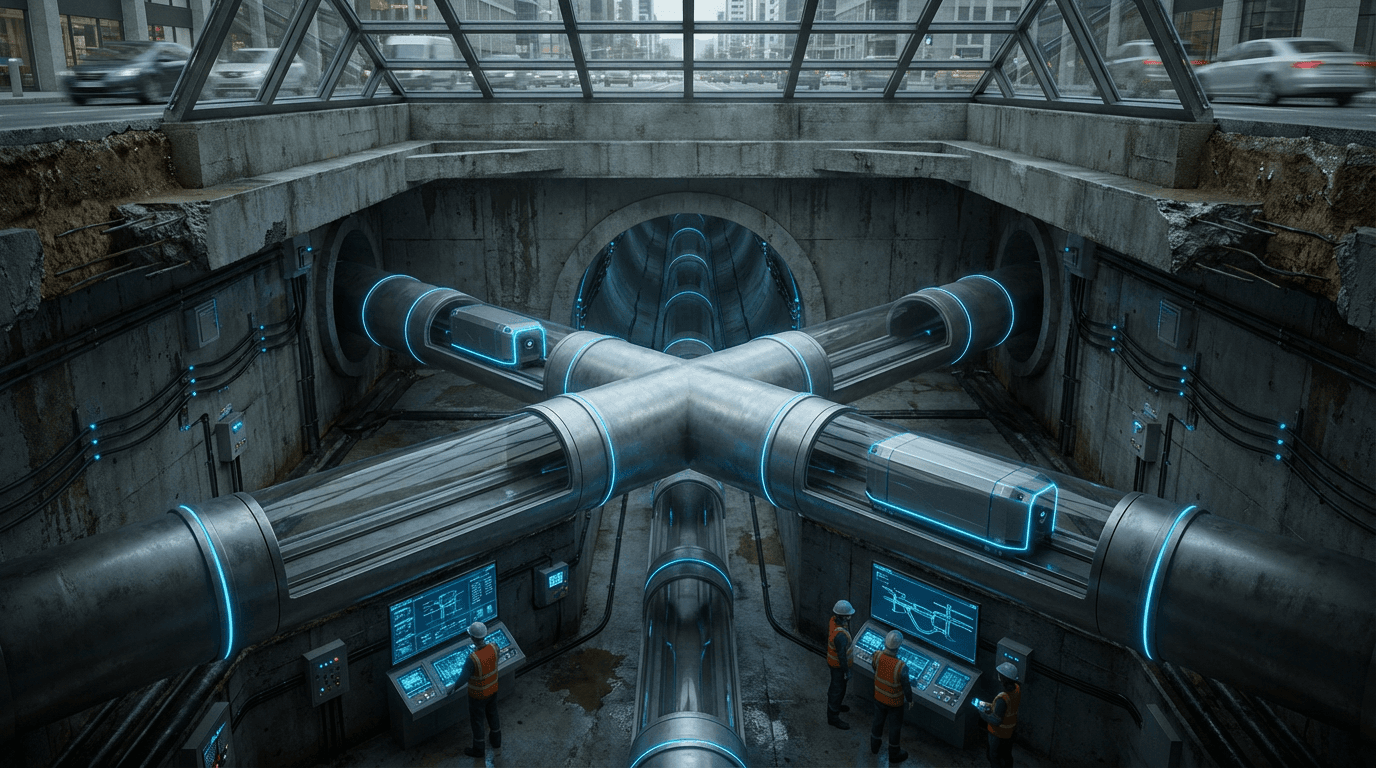
Underground Cargo Pipelines
Underground cargo pipelines represent a radical reimagining of freight logistics through dedicated subterranean infrastructure designed exclusively for autonomous goods movement. Unlike traditional tunneling projects that simply relocate existing transportation modes below ground, these systems employ purpose-built networks of tunnels housing automated vehicles or conveyor mechanisms that shuttle cargo between distribution centers, warehouses, and urban delivery points. The technical architecture typically involves smaller-diameter tunnels than those required for human transport, reducing excavation costs and environmental disruption. Automated electric vehicles or guided pods travel along predetermined routes, controlled by centralized traffic management systems that optimize flow, prevent collisions, and coordinate loading and unloading operations at strategically positioned access nodes. Some proposed designs incorporate linear induction motors or magnetic levitation principles to achieve higher speeds and energy efficiency, while others rely on conventional wheeled vehicles operating in a controlled, obstacle-free environment.
The fundamental challenge this technology addresses is the mounting crisis of urban freight congestion, which has intensified dramatically with the growth of e-commerce and just-in-time delivery expectations. Surface streets in major cities increasingly struggle to accommodate the competing demands of passenger vehicles, public transit, pedestrians, cyclists, and the relentless stream of delivery trucks that now account for a significant portion of urban traffic. This congestion not only slows commerce but also contributes disproportionately to air pollution, noise, and road wear in densely populated areas. By creating a separate, dedicated layer of infrastructure beneath city streets, underground cargo systems eliminate the competition for surface space while enabling predictable, weather-independent delivery schedules. The segregation of freight traffic also enhances safety by reducing interactions between heavy commercial vehicles and vulnerable road users, while the electric propulsion systems common to these designs significantly reduce emissions and noise pollution compared to diesel truck fleets.
Early conceptual frameworks and pilot proposals have emerged in several European nations, with Switzerland's Cargo Sous Terrain initiative representing one of the most developed visions for such infrastructure. This project envisions a nationwide network connecting major urban centers and logistics hubs through tunnels operating automated electric vehicles at speeds up to 30 kilometers per hour, with operations planned to begin on initial route segments within the coming decade. Similar concepts have been explored in urban contexts where surface congestion has reached critical levels and where existing underground infrastructure development provides relevant engineering experience. The technology aligns with broader trends toward automation in logistics, the electrification of transport, and the development of smart city infrastructure that leverages digital coordination systems. As urban populations continue to concentrate and delivery demands intensify, underground cargo systems may transition from ambitious concept to practical necessity, offering cities a path toward sustainable freight movement that preserves surface space for human activity while maintaining the commercial vitality that modern economies demand.
Related Organizations

Developing a comprehensive underground logistics system in Switzerland for autonomous transport of pallets and crates.

Magway
United Kingdom · Startup
Developing a zero-emissions delivery system using magnetic waves to propel carriages through small diameter pipes.

Pipedream Labs
United States · Startup
Building underground autonomous delivery networks for instant last-mile logistics in cities.
Mole Solutions
United Kingdom · Company
Develops the Freight Pipeline concept using capsules running in underground pipelines powered by linear induction motors.
Germany · University
Home to the CargoCap project, a research initiative for automated underground transportation of goods.

Conducts research and pilot projects for urban underground logistics systems in China.

European hyperloop technology company focusing on the European Hyperloop Center.

Crowdsourced engineering company developing hyperloop transportation systems.

Developing hyperloop capsule technology for high-speed intra-city and inter-city cargo transport.

Constructs low-cost tunnels (Loop) primarily for passengers but with stated applications for freight containers.
Supporting Evidence
Research this in Signals
Signals turns a topic into a sourced research record you can inspect and rerun. Your first scan is free, and this one starts with Underground Cargo Pipelines already loaded, so edit it or scan as is.