









Heavy Trucks
This page is a narrower case of it.
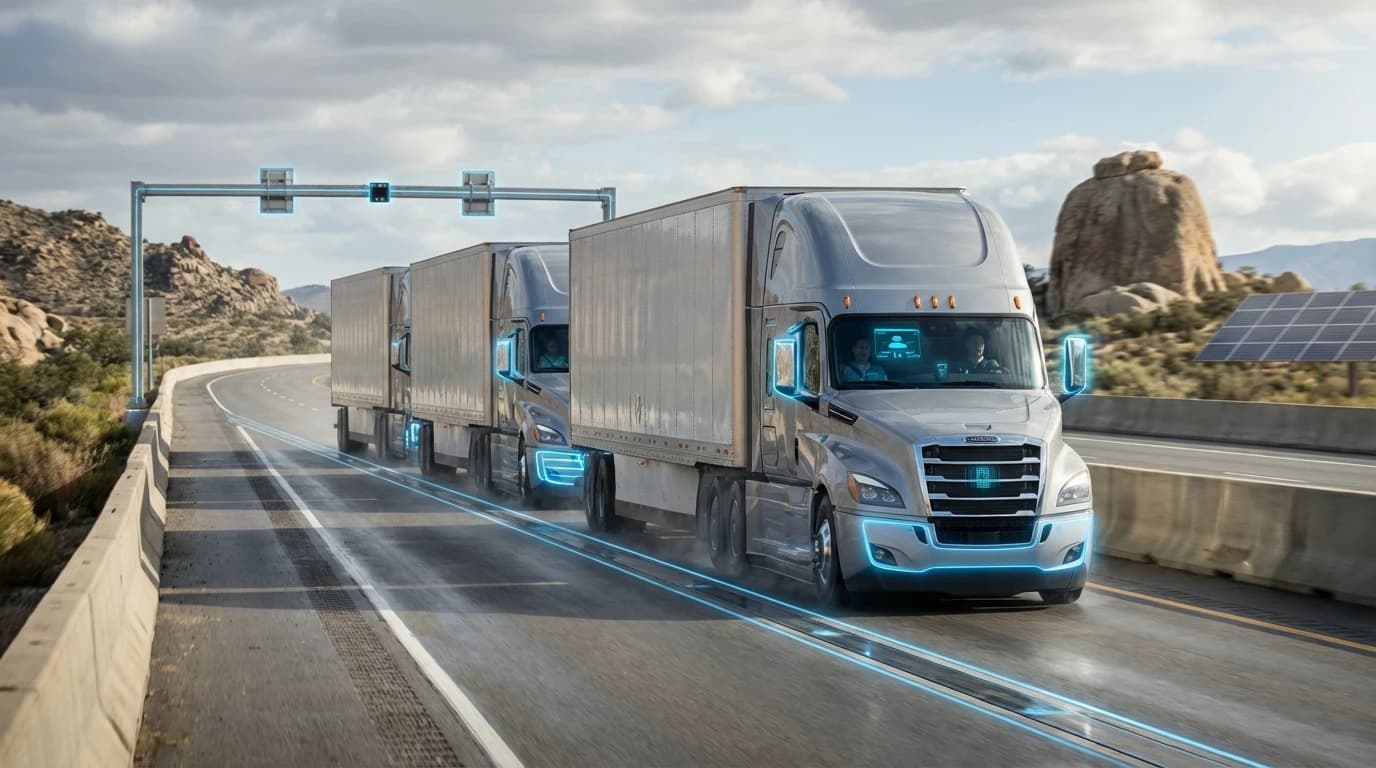
Autonomous truck platooning represents a coordinated approach to long-haul freight transport where multiple heavy-duty vehicles travel in close formation, typically separated by gaps of 10 to 20 meters rather than the standard 40 to 50 meters maintained in conventional highway driving. This system relies on vehicle-to-vehicle (V2V) communication protocols that enable real-time data exchange between trucks in the convoy, sharing information about speed, braking, acceleration, and road conditions within milliseconds. The lead truck, often operated by a human driver, establishes the convoy's speed and navigation decisions, while following vehicles employ adaptive cruise control, automated braking systems, and lane-keeping assistance to maintain precise spacing and synchronised movement. The aerodynamic benefits of this tight formation are substantial: trailing trucks experience significantly reduced air resistance as they travel in the slipstream of the vehicle ahead, while even the lead truck gains modest efficiency improvements from reduced turbulence at its rear.
The freight industry faces mounting pressure to reduce operational costs and environmental impact while meeting growing demand for goods movement. Fuel represents one of the largest expenses in trucking operations, and the aerodynamic drag experienced by large commercial vehicles at highway speeds accounts for a substantial portion of energy consumption. Platooning addresses this challenge directly, with research suggesting potential fuel savings of 10 to 15 percent for trailing vehicles and 4 to 8 percent for lead trucks, translating to meaningful reductions in both operating costs and carbon emissions across fleet operations. Beyond fuel efficiency, platooning offers solutions to driver shortage concerns by potentially allowing a single lead driver to supervise multiple following vehicles on designated highway corridors, effectively multiplying driver productivity on long-distance routes. The technology also promises to increase highway capacity without infrastructure expansion, as the reduced following distances allow more vehicles to occupy the same stretch of road safely.
Several pilot programs have demonstrated platooning on public highways in North America and Europe, with designated corridors emerging as testing grounds for commercial deployment. These corridors typically feature limited-access highways with predictable traffic patterns and minimal complex merging scenarios, allowing platoons to maintain formation for extended distances. Early commercial applications focus on routes between major logistics hubs where trucks frequently travel the same paths, such as connections between ports and inland distribution centers. The technology integrates with broader trends toward freight automation and connected vehicle ecosystems, serving as an intermediate step between conventional trucking and fully autonomous freight transport. As regulatory frameworks evolve and V2V communication standards mature, platooning corridors are expected to expand, potentially forming networks of designated routes where fuel-efficient convoy operations become standard practice, fundamentally reshaping the economics and environmental footprint of long-haul trucking.
Leading international provider of commercial vehicles and transport solutions.
Research center at UC Berkeley focusing on intelligent transportation systems.
A major Swedish manufacturer of commercial vehicles, specifically heavy trucks and buses.
A global automotive leader active in the commercial vehicles and powertrain segments.
Dutch organization for applied scientific research, actively investigating molten metal pyrolysis for industrial hydrogen.
Developing the Aurora Driver for Class 8 trucks, focusing on highway corridors in Texas.
Focuses exclusively on long-haul autonomous trucking for freight corridors, using a 'light' mapping approach.
Autonomous trucking technology company developing the PlusDrive system.
The trading arm of the Toyota Group, deeply involved in global logistics and supply chain management.
The Intelligent Transportation Society of America.
Published forecasts about this technology, graded against what happened in Hindsight.
Heavy Trucks
This page is a narrower case of it.
Signals turns a topic into a sourced research record you can inspect and rerun. Your first scan is free, and this one starts with Autonomous Truck Platooning Corridors already loaded, so edit it or scan as is.