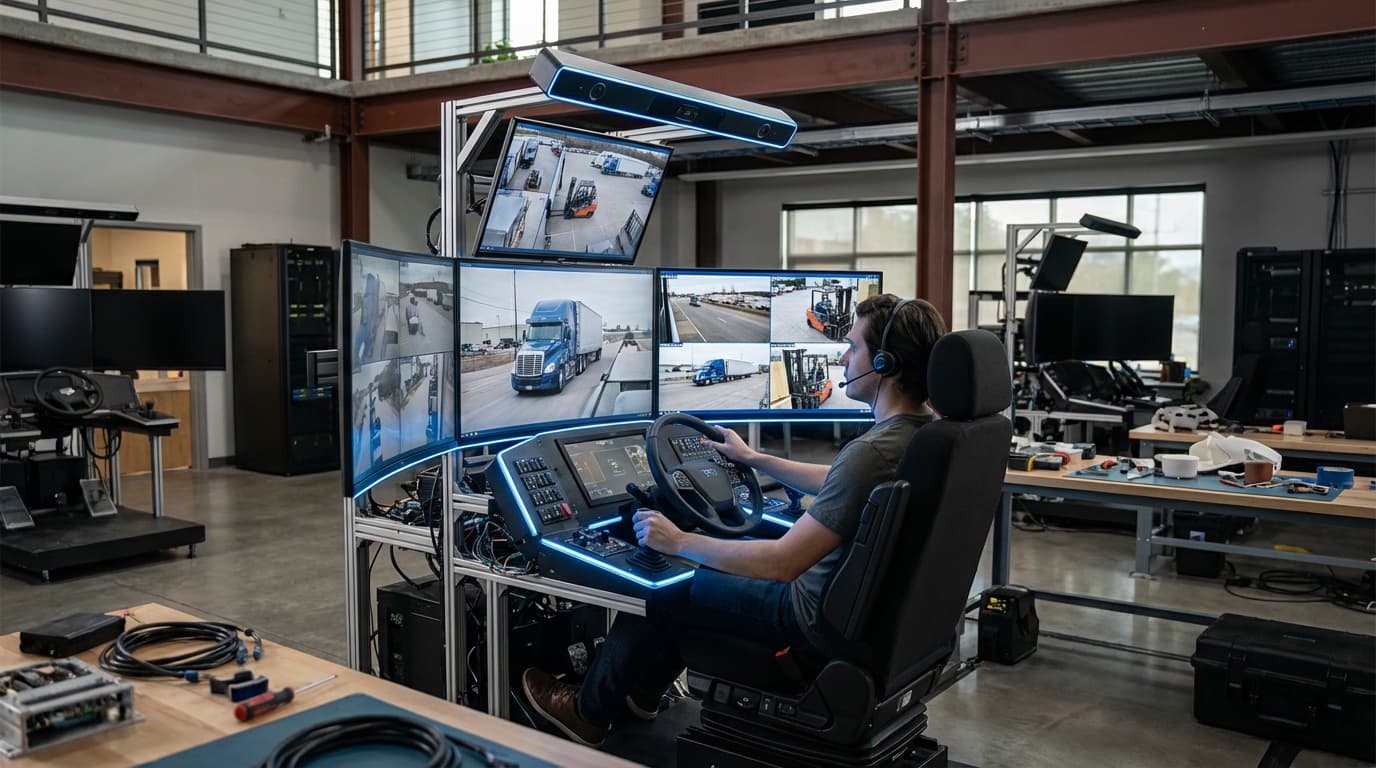
Tele-Driving and Remote Operation Platforms
Tele-driving and remote operation platforms represent a hybrid approach to vehicle automation, combining human judgment with remote control technology to operate trucks, forklifts, and other logistics vehicles from centralized command centers. The technical foundation relies on high-bandwidth, low-latency communication networks that transmit real-time video feeds, sensor data, and control signals between the vehicle and operator. Multiple camera angles, LiDAR data, and haptic feedback systems provide operators with comprehensive situational awareness, while redundant communication channels and fail-safe protocols ensure safety if connectivity is interrupted. The platforms typically feature specialized cockpits that replicate vehicle controls, allowing a single operator to potentially manage multiple vehicles sequentially, switching between units as needed for challenging maneuvers or unexpected situations.
This technology addresses several critical challenges facing the logistics and warehousing industries, particularly the persistent shortage of qualified drivers and the inefficiencies of traditional vehicle operation. By enabling remote operation, companies can deploy autonomous or semi-autonomous vehicles for routine tasks while maintaining human oversight for complex scenarios such as navigating construction zones, responding to unexpected obstacles, or executing precise loading dock maneuvers. This approach significantly reduces the limitations that have slowed full autonomous vehicle adoption, as operators can intervene remotely whenever the automated system encounters situations beyond its capabilities. The model also transforms driver working conditions, eliminating long-haul trips and allowing operators to work regular shifts from fixed locations, potentially expanding the labor pool and improving retention rates. For warehouse operations, remote forklift control enables facilities to optimize staffing, with operators managing equipment across multiple sites or shifts without physical presence requirements.
Early deployments of tele-driving platforms are already underway in controlled environments such as ports, mining operations, and large distribution centers, where structured routes and predictable conditions reduce complexity. Several logistics companies have initiated pilot programs combining autonomous trucks for highway driving with remote operators who handle first-mile and last-mile segments in urban areas. The technology aligns with broader industry trends toward flexible automation and human-machine collaboration, offering a pragmatic pathway to increased efficiency without requiring immediate full autonomy. As 5G networks expand and edge computing capabilities improve, the reliability and responsiveness of remote operation systems are expected to enhance significantly, potentially enabling wider deployment across diverse logistics scenarios. This evolution positions tele-driving as a transitional yet potentially enduring component of supply chain operations, balancing the benefits of automation with the irreplaceable value of human decision-making in unpredictable situations.
Related Organizations

Provides a human-assisted autonomy platform for yard trucking, integrating teleoperation centers to handle edge cases in logistics hubs.

Develops a software platform for remote teleoperation of autonomous vehicles, focusing on low-latency video compression and network bonding.

Provides a connectivity platform optimized for teleoperation, ensuring consistent high-quality video transmission over cellular networks.
A robotics company deploying high-reach autonomous forklifts with remote assist capabilities.

Operates a teledriving service where remote drivers in a control center deliver cars to customers or drive them remotely.

A high-tech company specializing in driverless technology and smart mobility solutions, famous for the EZ10 autonomous shuttle.

A safety technology company for autonomous and remotely operated machines.

A manufacturer of terminal tractors and special vehicles for ports and logistics.


Multinational telecommunications, information technology, and consumer electronics company.
Supporting Evidence
Research this in Signals
Signals turns a topic into a sourced research record you can inspect and rerun. Your first scan is free, and this one starts with Tele-Driving and Remote Operation Platforms already loaded, so edit it or scan as is.