Envisioning is an emerging technology research institute and advisory.

LinkedInInstagramGitHub

2011 — 2026

research
  • Reports
  • Newsletter
  • Methodology
  • Origins
  • Vocab
services
  • Research Sessions
  • Signals Workspace
  • Bespoke Projects
  • Use Cases
  • Signal Scanfree
  • Readinessfree
impact
  • ANBIMAFuture of Brazilian Capital Markets
  • IEEECharting the Energy Transition
  • Horizon 2045Future of Human and Planetary Security
  • WKOTechnology Scanning for Austria
audiences
  • Innovation
  • Strategy
  • Consultants
  • Foresight
  • Associations
  • Governments
resources
  • Pricing
  • Partners
  • How We Work
  • Data Visualization
  • Multi-Model Method
  • FAQ
  • Security & Privacy
about
  • Manifesto
  • Community
  • Events
  • Support
  • Contact
  • Login
ResearchServicesPricingPartnersAbout
  1. Home
  2. Research
  3. Fabric
  4. Digital Knitting Machines with Per-Stitch Material Modulation

Digital Knitting Machines with Per-Stitch Material Modulation

Knitting systems that vary yarn properties stitch-by-stitch for gradient fabrics and embedded sensors
Back to FabricView interactive version

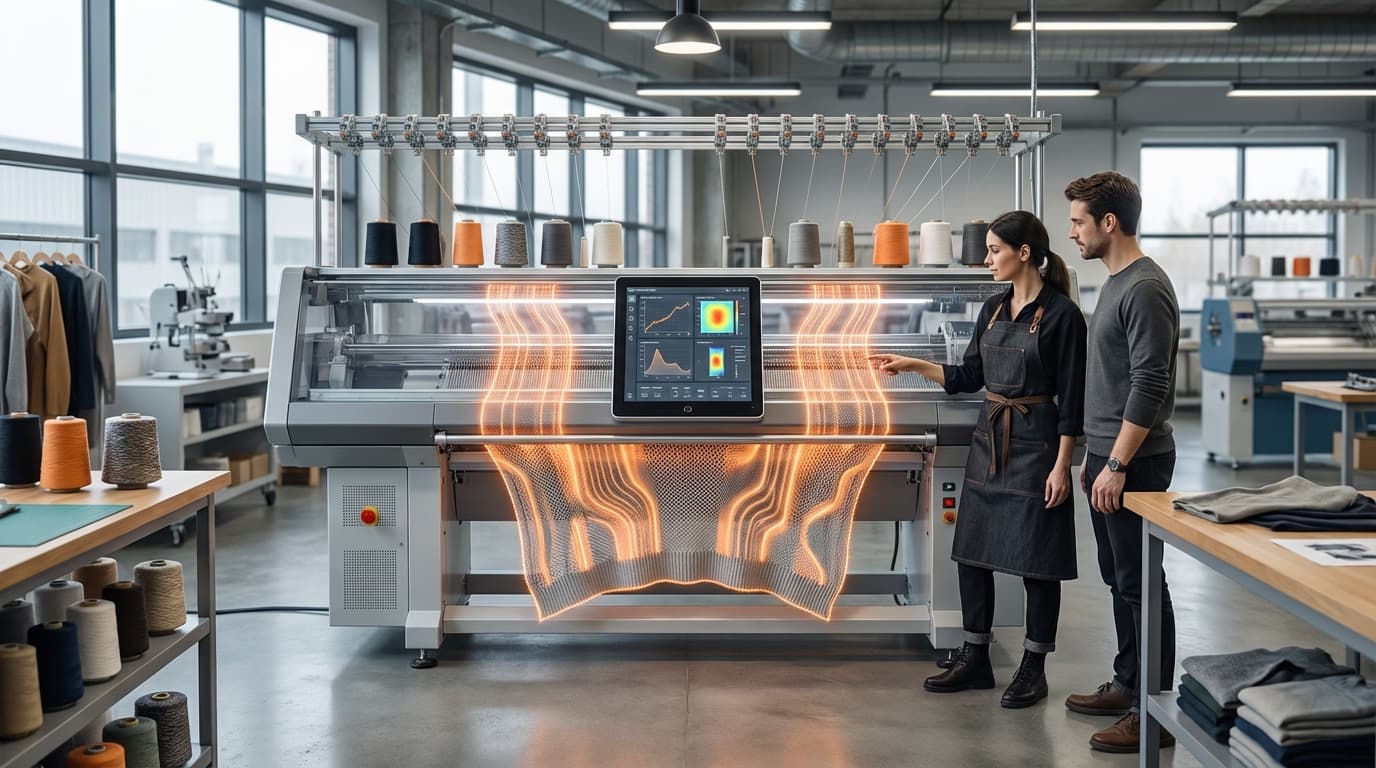
Advanced digital knitting machines capable of per-stitch material modulation enable unprecedented control over fabric properties during the manufacturing process. These systems can vary yarn types, stitch structures, and material properties at the individual stitch level in real time, creating garments with gradient properties, embedded sensors, or adaptive structures that respond to environmental conditions or user needs.

This innovation transforms knitting from a uniform manufacturing process into a programmable, variable-property fabrication system. By controlling material properties at the stitch level, designers can create garments with zones of different elasticity, breathability, or conductivity within a single seamless piece. Companies like Shima Seiki, Stoll, and Unmade are advancing these capabilities, enabling brands to produce highly customized, functionally-graded garments without seams or assembly steps.

The technology is particularly significant for performance wear, medical textiles, and smart clothing applications where different body regions require different material properties. As digital knitting becomes more sophisticated, per-stitch modulation enables new design possibilities and functional capabilities that were previously impossible, representing a fundamental shift toward programmable material manufacturing in fashion.

TRL
9/9Established
Impact
4/5
Investment
3/5
Category
Hardware

Related Organizations

Shima Seiki logo
Shima Seiki

Japan · Company

95%

Manufacturer of WHOLEGARMENT knitting machines which are compact enough to be installed in microfactories for on-demand production.

Developer
Stoll logo
Stoll

Germany · Company

95%

German flat knitting machine manufacturer (part of Karl Mayer Group) enabling technical textiles and on-demand knitwear.

Developer
Byborre logo
Byborre

Netherlands · Company

90%

A textile innovation studio and digital platform that allows brands to design custom engineered knits with specific functional properties.

Deployer
Kniterate logo
Kniterate

United Kingdom · Startup

90%

Developer of a compact, digital knitting machine designed for small-scale production and prototyping, bringing industrial capabilities to studios.

Developer
Carnegie Mellon University Soft Machines Lab logo
Carnegie Mellon University Soft Machines Lab

United States · Research Lab

85%

Research group focusing on soft robotics and textile integration.

Researcher
Santoni logo
Santoni

Italy · Company

85%

Italian manufacturer specializing in seamless circular knitting machines used for sportswear, underwear, and technical textiles.

Developer
Unspun logo
Unspun

United States · Startup

85%

Robotics and apparel company developing 3D weaving technology (Vega) to produce custom jeans on-demand.

Developer
Knitronix logo
Knitronix

Italy · Company

80%

Specializes in the development of smart knitted sensors and heating elements using industrial knitting machines.

Developer
Ministry of Supply logo
Ministry of Supply

United States · Company

80%

Performance fashion brand that installed 3D knitting machines in their Boston flagship store to print garments on demand.

Deployer
MIT Self-Assembly Lab logo
MIT Self-Assembly Lab

United States · Research Lab

80%

Research lab at MIT developing programmable materials and 4D printing/knitting technologies.

Researcher

Supporting Evidence

Evidence data is not available for this technology yet.

Connections

Software
Software
Additive Manufacturing for Functional Components

Layer-by-layer printing of complex structural elements directly into garments

TRL
7/9
Impact
3/5
Investment
3/5
Applications
Applications
Closed-Loop Microfactory Retail Units

Compact in-store systems that fabricate custom garments on demand from digital designs

TRL
5/9
Impact
4/5
Investment
3/5
Software
Software
Generative Garment Pattern Engines

ML systems that generate clothing patterns from body scans, design sketches, or brand aesthetics

TRL
6/9
Impact
4/5
Investment
3/5
Hardware
Hardware
High-Performance Stretch and Compression Knits

Engineered knits delivering graduated compression for athletic support and medical therapy

TRL
9/9
Impact
4/5
Investment
4/5
Software
Software
AI-Driven Material Property Modeling

Machine learning that predicts fabric performance from composition data before physical prototyping

TRL
5/9
Impact
3/5
Investment
3/5
Software
Software
Mass Customization Manufacturing Platforms

Production systems that combine body data with flexible manufacturing to create made-to-measure garments at scale

TRL
6/9
Impact
4/5
Investment
4/5

Book a research session

Bring this signal into a focused decision sprint with analyst-led framing and synthesis.
Research Sessions