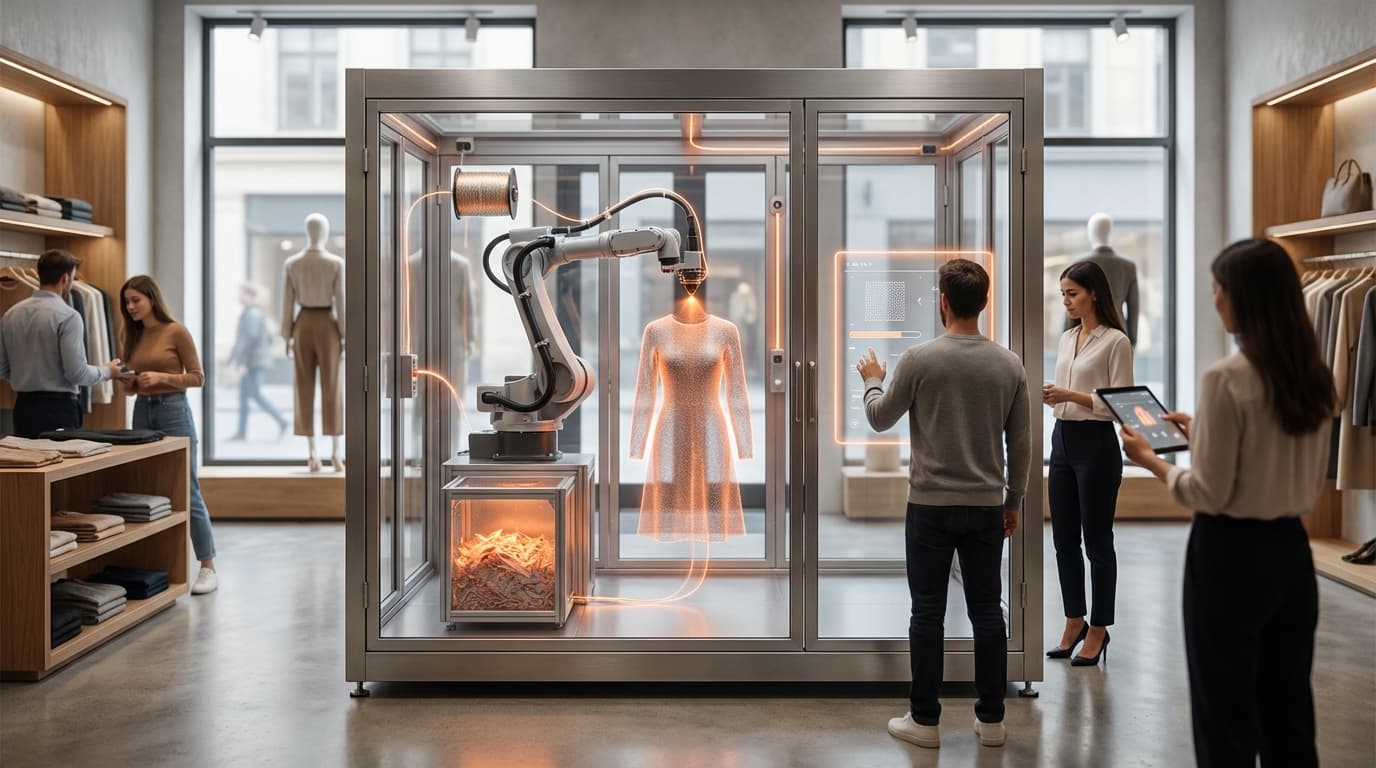
Closed-Loop Microfactory Retail Units
Closed-loop microfactory retail units are compact, automated manufacturing systems installed in retail stores that can produce customized garments on-demand from digital designs. These systems integrate 3D knitting machines, cutting systems, and finishing equipment into self-contained units that can create finished garments in hours rather than weeks, using minimal materials and generating little waste compared to traditional manufacturing.
This innovation enables a new retail model where customers can design, customize, and receive personalized garments during a single store visit, eliminating the need for large inventories and long supply chains. By producing garments only after orders are placed, these systems reduce waste, enable true customization, and create new retail experiences. Companies like Unmade, Ministry of Supply, and various startups are developing and deploying these technologies, though they remain largely experimental due to technical and economic challenges.
The technology represents a potential future for fashion retail where stores become manufacturing hubs rather than just distribution points. As automation improves and costs decrease, microfactory retail units could transform how consumers interact with fashion, enabling personalized production at scale while reducing the environmental impact of overproduction and long-distance shipping. However, significant technical and economic barriers remain before widespread adoption becomes viable.
Related Organizations

Manufacturer of WHOLEGARMENT knitting machines which are compact enough to be installed in microfactories for on-demand production.

Robotics and apparel company developing 3D weaving technology (Vega) to produce custom jeans on-demand.

Performance fashion brand that installed 3D knitting machines in their Boston flagship store to print garments on demand.

Deployed 'Looop', the world's first in-store garment-to-garment recycling system, in their Stockholm flagship.

Develops industrial digital printing technologies that enable waterless, on-demand textile production suitable for urban microfactories.

German flat knitting machine manufacturer (part of Karl Mayer Group) enabling technical textiles and on-demand knitwear.

Provides integrated software and hardware solutions for the apparel industry, including microfactory setups.

Industrial giant offering Modaris and Retviews, automating pattern making and nesting for mass production.

Inventors of a process that temporarily stiffens fabric with a water-soluble polymer, allowing standard industrial robotic arms to fold and sew garments.

Developed '3D Bonding' technology that replaces sewing with chemical bonding, simplifying footwear and apparel assembly.
Supporting Evidence
Research this in Signals
Signals turns a topic into a sourced research record you can inspect and rerun. Your first scan is free, and this one starts with Closed-Loop Microfactory Retail Units already loaded, so edit it or scan as is.