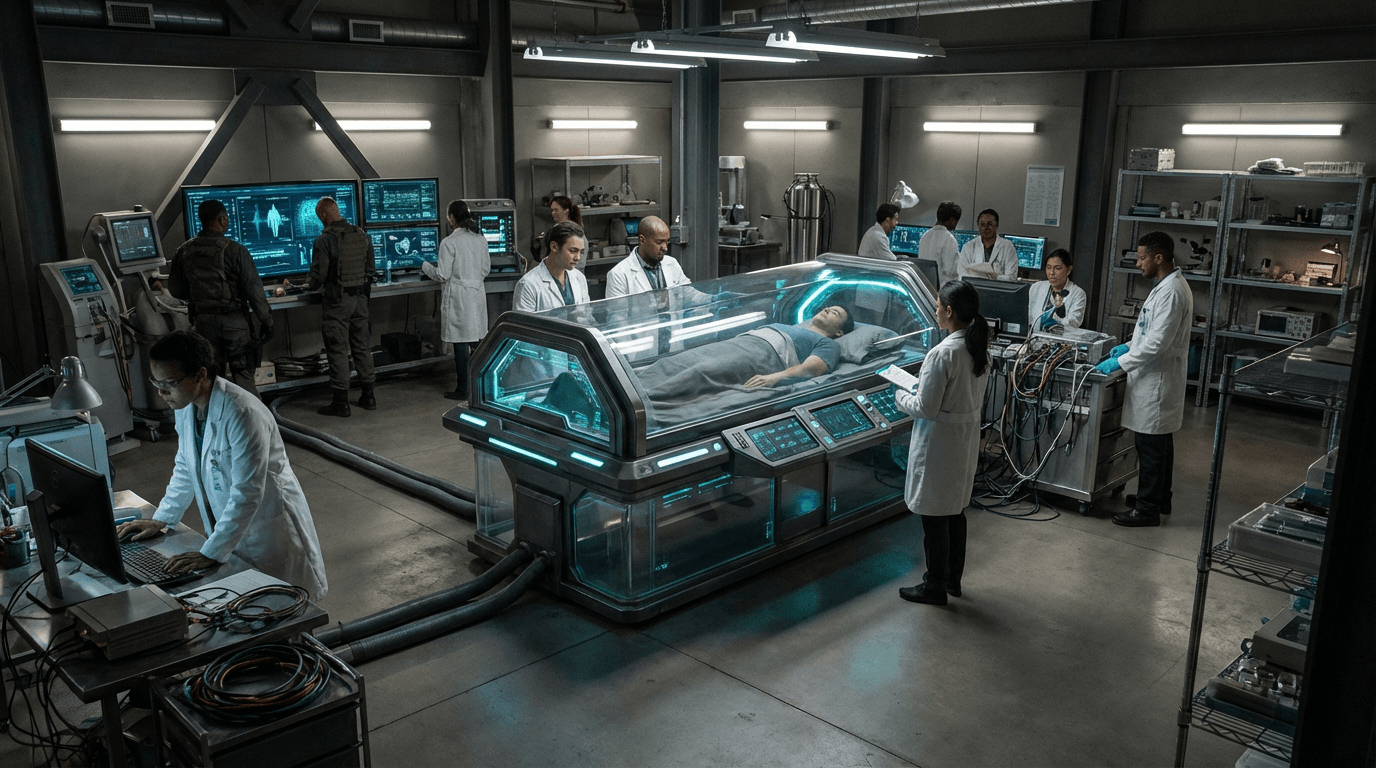
Induced Torpor Stasis
Induced torpor stasis represents a frontier in metabolic engineering that seeks to temporarily suspend normal biological processes through controlled reduction of core body temperature and metabolic activity. Unlike natural hibernation observed in certain mammals, human-induced torpor requires precise pharmacological intervention combined with environmental controls to safely lower metabolic rates by 50-90% while maintaining critical organ function. The approach typically involves targeted suppression of thyroid function, controlled hypothermia protocols, and administration of neuroprotective agents that prevent cellular damage during the reduced-activity state. Research in this domain draws heavily from studies of natural hibernators, whose cells possess unique mechanisms to prevent the oxidative stress and protein degradation that would normally occur during prolonged periods of reduced oxygen and nutrient delivery. The technical challenge lies in replicating these protective mechanisms in humans, whose physiology did not evolve for such dramatic metabolic shifts.
The primary driver for induced torpor research stems from two distinct but complementary needs: extending the viable treatment window for critical medical interventions and enabling long-duration space exploration. In emergency medicine, even brief periods of metabolic suppression could preserve organ viability following traumatic injury or cardiac arrest, buying crucial time for transport to specialized facilities or awaiting donor organs. For space agencies and commercial spaceflight ventures, torpor offers a potential solution to the resource constraints and psychological challenges of multi-year interplanetary missions, reducing the life support requirements and radiation exposure that crew members would otherwise accumulate. Beyond these immediate applications, the technology addresses a fundamental limitation in longevity science: the inability to selectively pause biological aging during periods when life extension therapies are unavailable or when individuals face temporarily elevated health risks. By effectively stopping the cellular damage accumulation that drives aging, torpor could serve as a bridge technology while more permanent rejuvenation solutions mature.
Current research remains largely confined to animal models and short-duration human trials, with several research institutions exploring different induction protocols and monitoring the long-term effects of repeated torpor cycles. Early human studies have demonstrated that mild therapeutic hypothermia can be safely maintained for days under clinical supervision, though achieving the deeper metabolic suppression seen in natural hibernators remains elusive. The technology's trajectory suggests initial deployment in specialized medical contexts—particularly trauma centers and organ transplant programs—before potential expansion to elective applications. As our understanding of the molecular mechanisms underlying torpor deepens, particularly regarding cellular protection during metabolic suppression, the prospect of using induced stasis as a longevity tool becomes increasingly plausible. This positions torpor stasis as perhaps the most literal interpretation of "life extension": not adding years to life, but preserving life across extended timescales by fundamentally altering the relationship between chronological time and biological aging.
Related Organizations

Developing the RED (Re-entry Device) product line using flexible thermal protection systems.

A biotechnology company using comparative genomics of hibernating animals to find human therapies.

NASA program that funds visionary aerospace concepts, including multiple grants for torpor-inducing transfer habitats.

Japanese research institute where scientists (Sunagawa Lab) identified Q neurons capable of inducing a hibernation-like state in mice.

Leads the EAGLE-1 mission and the SAGA program to build a European quantum communication infrastructure in space.

Leading academic center for hibernation research, specifically studying metabolic suppression in black bears and arctic ground squirrels.

Home to the International Institute for Integrative Sleep Medicine, conducting key research on the link between sleep regulation and hibernation.

A cryobiological research company developing vitrification solutions and perfusion technologies.
Supporting Evidence
Research this in Signals
Signals turns a topic into a sourced research record you can inspect and rerun. Your first scan is free, and this one starts with Induced Torpor Stasis already loaded, so edit it or scan as is.