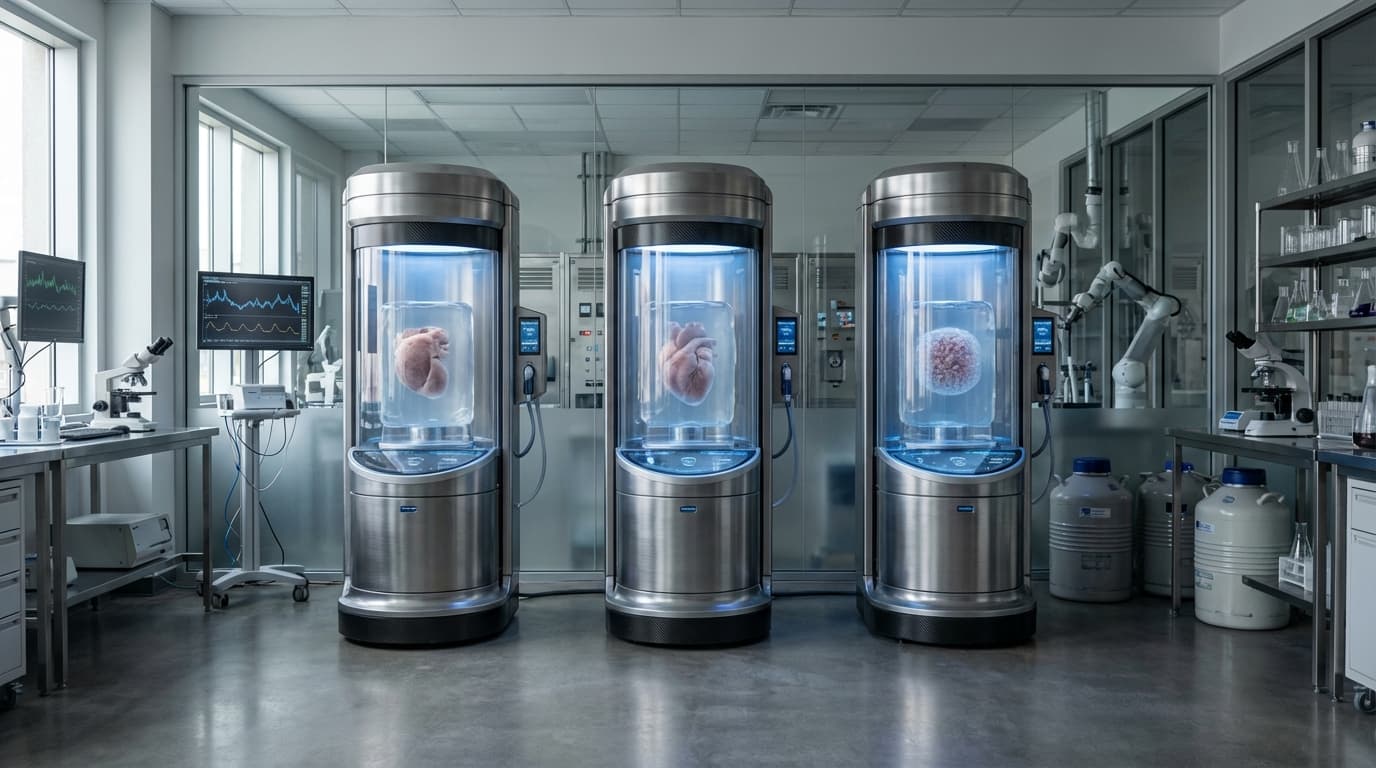
Vitrification Biostasis Pods
Vitrification represents a fundamental departure from traditional cryopreservation methods by transforming biological tissues into a glass-like solid state without ice crystal formation, the primary cause of cellular damage in conventional freezing. These advanced biostasis pods employ sophisticated cryoprotectant cocktails—typically combinations of dimethyl sulfoxide, ethylene glycol, and proprietary compounds—that are perfused through vascular networks at precisely controlled rates and concentrations. The technology relies on ultra-rapid cooling protocols, often exceeding 100 degrees Celsius per minute, combined with magnetic field stabilization to prevent ice nucleation during the critical glass transition temperature range. Modern systems integrate real-time monitoring of tissue electrical impedance and thermal gradients, allowing dynamic adjustment of cooling rates across different tissue densities. This precision is essential because organs contain diverse cell types with varying water content and metabolic characteristics, each requiring tailored vitrification parameters to maintain structural and functional integrity during the transition to biostasis.
The most immediate application addresses a critical bottleneck in transplant medicine: the severe shortage of viable donor organs. Current cold storage methods limit organ preservation to hours—typically four to six hours for hearts, twelve for livers—resulting in thousands of organs discarded annually due to logistical constraints and geographic mismatches between donors and recipients. Vitrification biostasis pods promise to extend this window to weeks, months, or potentially years, fundamentally transforming organ allocation systems by decoupling the urgency of transplantation from the unpredictability of organ availability. Research institutions have demonstrated successful vitrification and rewarming of rabbit kidneys with partial function restoration, while early trials with human liver segments show promising cellular viability markers post-thaw. Beyond transplantation, this technology enables new paradigms in regenerative medicine, allowing bioengineered tissues and organs grown from patient cells to be manufactured in advance and stored until needed, eliminating immune rejection concerns while creating strategic medical reserves for disaster response or military applications.
Several research consortia and specialized facilities currently operate experimental vitrification systems, with some offering whole-body biostasis services under legal frameworks that classify the procedure as experimental tissue preservation rather than medical treatment. The technology remains in transition from research prototype to clinical tool, with significant challenges in achieving uniform vitrification across large tissue volumes and developing reliable rewarming protocols that prevent fracturing during the glass-to-liquid transition. Industry observers note growing interest from both the transplant medicine community and the emerging longevity sector, where vitrification represents a potential bridge technology—allowing individuals with currently terminal conditions to preserve themselves until future medical advances offer viable treatments. As cryoprotectant formulations improve and automated perfusion systems become more sophisticated, vitrification biostasis pods are positioned at the intersection of emergency medicine, regenerative therapies, and the broader movement toward viewing biological time as a controllable variable rather than an immutable constraint.
Related Organizations

The world's longest-operating cryonics organization, providing whole-body and neuropreservation services.

The first and largest cryopreservation provider in Europe, offering end-to-end biostasis services.

A member-owned non-profit corporation providing cryonics services and storage.

Developing biomimetic peptoids to enable ice-free cryopreservation (vitrification) of organs.

Focuses on organ preservation technology using supercooling and vitrification techniques.

Develops ice recrystallization inhibitors (IRIs) to improve cryopreservation outcomes.

Home to the Bischof Lab, which pioneered nanowarming technologies to rewarm vitrified organs.

Conducts extensive research on crop yield and water usage under solar arrays.

Developing the RED (Re-entry Device) product line using flexible thermal protection systems.

A biotechnology company using comparative genomics of hibernating animals to find human therapies.
Supporting Evidence
Research this in Signals
Signals turns a topic into a sourced research record you can inspect and rerun. Your first scan is free, and this one starts with Vitrification Biostasis Pods already loaded, so edit it or scan as is.