Non-Contact Monitoring
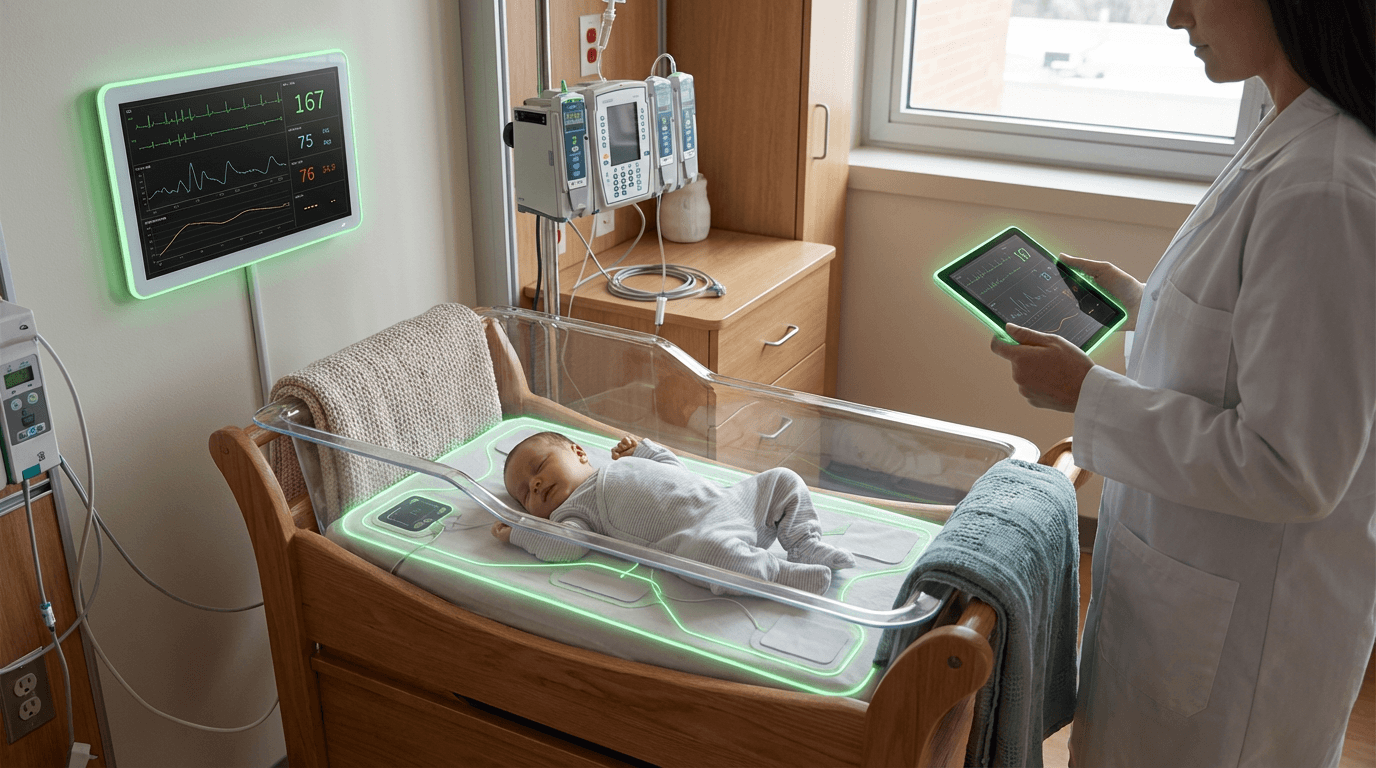
Non-contact monitoring represents a significant advancement in neonatal care technology, addressing the critical need for continuous vital sign tracking while minimizing physical disturbance to vulnerable infants. Traditional monitoring systems require electrodes, wires, or other sensors to be attached directly to an infant's delicate skin, which can cause discomfort, skin irritation, and stress responses that may interfere with normal sleep patterns and development. This technology employs electric potential sensors embedded within mattresses or bedding materials that can detect the minute electrical signals generated by cardiac activity and the mechanical movements associated with respiration. These sensors work by measuring changes in the electric field surrounding the body, capturing bioelectric signals through capacitive coupling without requiring any direct skin contact. The system translates these detected signals into accurate measurements of heart rate, respiratory rate, and breathing patterns, providing continuous monitoring data comparable to traditional contact-based methods.
The healthcare industry has long grappled with the challenge of balancing comprehensive patient monitoring with infant comfort and developmental needs, particularly in neonatal intensive care units and home care settings. Premature infants and newborns with medical complications require constant surveillance to detect potentially life-threatening events such as apnea, bradycardia, or irregular heart rhythms, yet the stress induced by traditional monitoring equipment can itself compromise their fragile health. Non-contact monitoring addresses this paradox by enabling clinicians to maintain vigilant oversight while creating a less invasive care environment. This technology also reduces the time healthcare providers spend applying, adjusting, and replacing traditional sensors, allowing them to focus more attention on direct patient care. For parents, particularly those caring for at-risk infants at home, these systems offer peace of mind without the anxiety of managing complex medical equipment or worrying about sensor displacement during routine care activities like feeding or diaper changes.
Early deployments of non-contact monitoring systems have shown promising results in both hospital and home settings, with research suggesting comparable accuracy to conventional monitoring methods for stable patients. Several medical device companies have begun developing commercial products incorporating this technology, targeting both clinical environments and the growing market for infant health monitoring solutions. In neonatal units, these systems are being evaluated as complementary tools that can reduce the overall sensor burden on critically ill infants while maintaining safety standards. The home care market represents another significant application area, where simplified monitoring solutions can support earlier hospital discharge for recovering infants while ensuring appropriate surveillance during the vulnerable transition period. As sensor technology continues to advance and machine learning algorithms improve signal processing capabilities, non-contact monitoring is expected to expand beyond basic vital signs to detect more subtle physiological changes, potentially enabling earlier intervention for emerging health issues. This trajectory aligns with broader healthcare trends toward less invasive monitoring, patient-centered care design, and the integration of medical-grade sensing capabilities into everyday environments.
Related Organizations

Babysense
Israel · Company
Manufactures under-the-mattress movement monitors that detect the cessation of micro-movements associated with breathing.

Provides FDA-cleared radar solutions for contactless health monitoring and occupancy detection in healthcare and smart buildings.

Produces movement monitor pads that sit under the crib mattress to detect breathing movements.

Produces a contact-free baby monitor using proprietary SensorFusion technology to track breathing and sleep patterns.

Uses computer vision AI to monitor baby sleep and breathing; integrates feeding tracking into their insights platform.

Developer of 4D imaging radar sensors for fall detection without cameras.

Develops a smart baby monitor with AI detection for covered face, rollover, and danger zones.

Provides vision-based patient monitoring software that turns standard digital cameras into medical-grade vital sign monitors.

Developers of Anura, an AI platform that measures blood pressure, heart rate, and stress levels via 30-second video selfies using Transdermal Optical Imaging.
Supporting Evidence
Research this in Signals
Signals turns a topic into a sourced research record you can inspect and rerun. Your first scan is free, and this one starts with Non-Contact Monitoring already loaded, so edit it or scan as is.