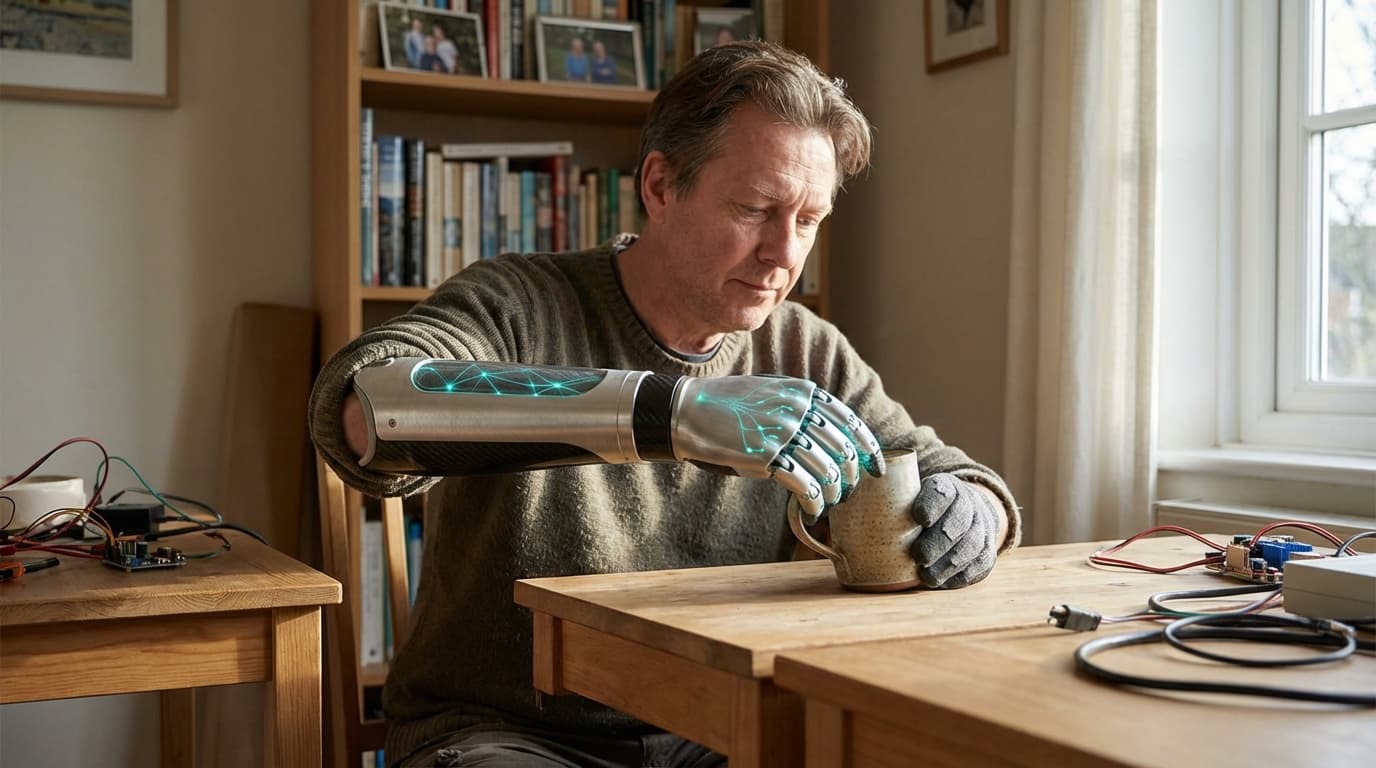
Advanced Restorative Neuroprosthetics
Advanced restorative neuroprosthetics are next-generation prosthetic limbs that not only move in response to neural commands (thought-controlled movement) but also provide rich sensory feedback including texture, temperature, and pressure sensations directly to the user's nervous system through neural interfaces, enabling embodied control where the prosthetic feels like a natural part of the body and closed-loop manipulation where the user can feel what they're touching and adjust their grip or movement accordingly. These bidirectional systems create a complete feedback loop between the user and the prosthetic, enabling much more natural and intuitive control than prosthetics that only provide motor output without sensory input.
This innovation addresses the fundamental limitation of current prosthetics, which typically only restore motor function without sensory feedback, making them feel unnatural and limiting dexterity. By restoring both motor and sensory function, these prosthetics can feel more like natural limbs. Research institutions and companies are developing these technologies.
The technology is particularly significant for advanced prosthetics, where restoring both motor and sensory function could dramatically improve quality of life and functionality. As the technology improves, it could enable prosthetics that feel and function like natural limbs. However, ensuring natural-feeling sensations, managing complexity, and achieving reliable long-term performance remain challenges. The technology represents an important evolution in prosthetics, but requires continued development to achieve the performance and reliability needed for widespread use. Success could transform prosthetics by making them feel natural, but the technology must overcome significant challenges in creating natural sensory experiences and maintaining long-term reliability.
Related Organizations

Home to the Wallenberg Centre for Quantum Technology, where researchers actively develop wideband TWPAs and Josephson junction circuits.
Sweden · Company
A Swedish company known for the OPRA Implant System, pioneering bone-anchored prosthetics (osseointegration).

Developed the Modular Prosthetic Limb (MPL), one of the most advanced robotic limbs designed for BCI control.
United States · Startup
Maker of the Ability Hand, a bionic hand with touch sensors.
United States · Startup
Developing the Atom Touch, a mind-controlled bionic arm with sensory feedback.
Italy · University
Home to the BioRobotics Institute.


The world market leader in technical orthopedics and prosthetics.
United States · Startup
Develops a bionic hand that uses AI to predict user intent.
Supporting Evidence
Research this in Signals
Signals turns a topic into a sourced research record you can inspect and rerun. Your first scan is free, and this one starts with Advanced Restorative Neuroprosthetics already loaded, so edit it or scan as is.