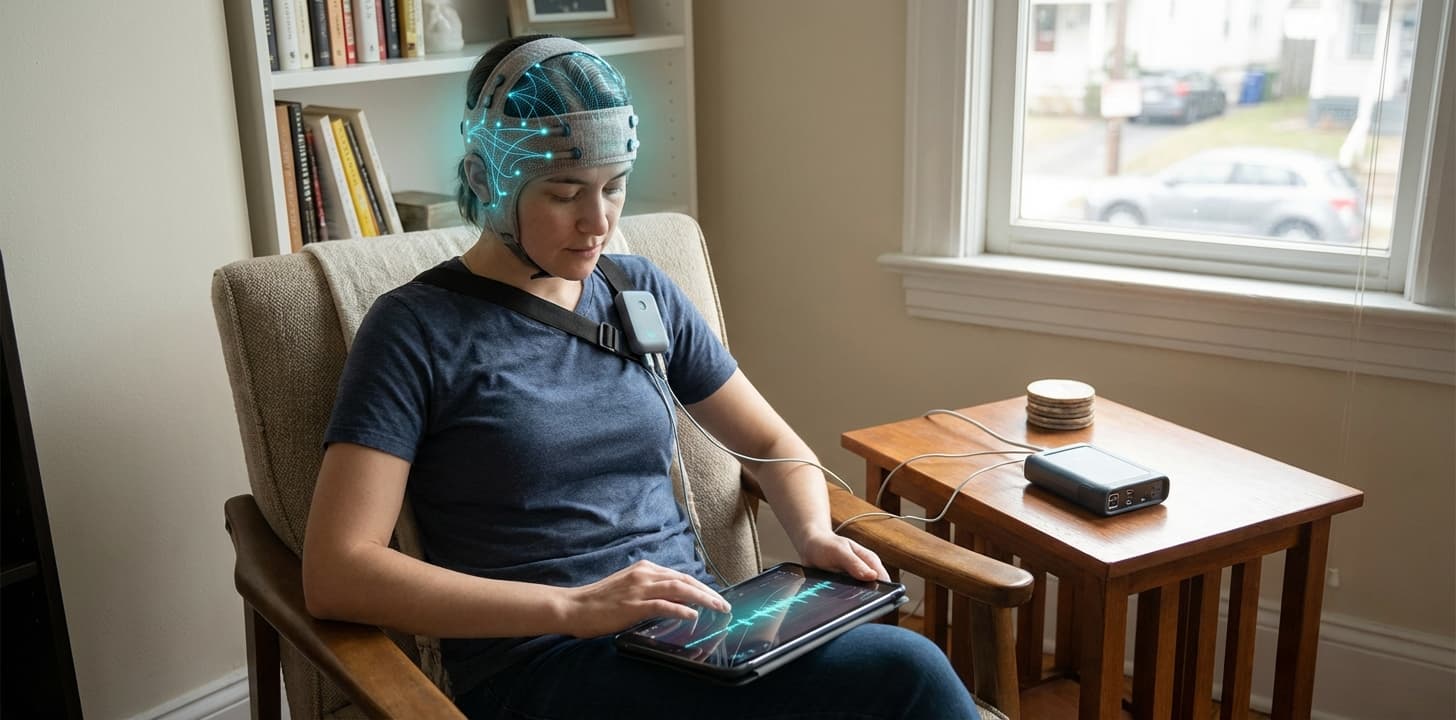
Next-Gen Noninvasive BCIs
Next-generation non-invasive brain-computer interfaces use advanced technologies including Optically Pumped Magnetometers (OPM-MEG), which measure magnetic fields produced by neural activity with much smaller, more portable sensors than traditional MEG systems, and functional Near-Infrared Spectroscopy (fNIRS), which measures changes in blood oxygenation that indicate neural activity. These technologies enable wearable, motion-tolerant brain imaging systems that can be used outside of traditional laboratory settings, with spatial resolution approaching that of functional MRI while being much more portable and allowing natural movement, opening new possibilities for real-world BCI applications.
This innovation addresses the limitations of traditional non-invasive brain imaging, where systems like fMRI require large, immobile equipment, and EEG has limited spatial resolution. By improving non-invasive sensing capabilities, these technologies enable better BCIs without the risks of invasive approaches. Companies and research institutions are developing these technologies.
The technology is particularly significant for enabling practical, real-world BCIs that don't require surgery, making the technology accessible to many more people. As the technology improves, it could enable new applications in assistive technology, gaming, and human-computer interaction. However, ensuring signal quality, managing motion artifacts, and achieving sufficient resolution for complex applications remain challenges. The technology represents an important evolution in non-invasive neural interfaces, but requires continued development to achieve the performance needed for sophisticated applications. Success could make BCIs much more accessible, but the technology must overcome limitations in signal quality and resolution compared to invasive approaches.
Related Organizations

Neuroscience company developing non-invasive brain recording technology (Flow and Flux).

A leader in wearable Near-Infrared Spectroscopy (NIRS) devices.

Develops high-performance BCI hardware, including the 'Unicorn' hybrid black interface for developers.

Creates open-source brain-computer interface tools and the Galea headset (integrating with VR) for researching physiological responses.

Develops semi-dry and dry EEG wearable devices for human behavior research and neurotechnology applications.

Builds AI-powered BCI headsets with AR displays for accessibility and communication.

Develops the Quest Pro and research prototypes (Butterscotch, Starburst) focusing on foveated systems.
United States · Company
Provides integrated fNIRS solutions for neuroimaging.

Develops BCI-enabled headphones that detect focus and intent to control digital experiences.

Social media and camera company developing AR spectacles.
Supporting Evidence
Research this in Signals
Signals turns a topic into a sourced research record you can inspect and rerun. Your first scan is free, and this one starts with Next-Gen Noninvasive BCIs already loaded, so edit it or scan as is.