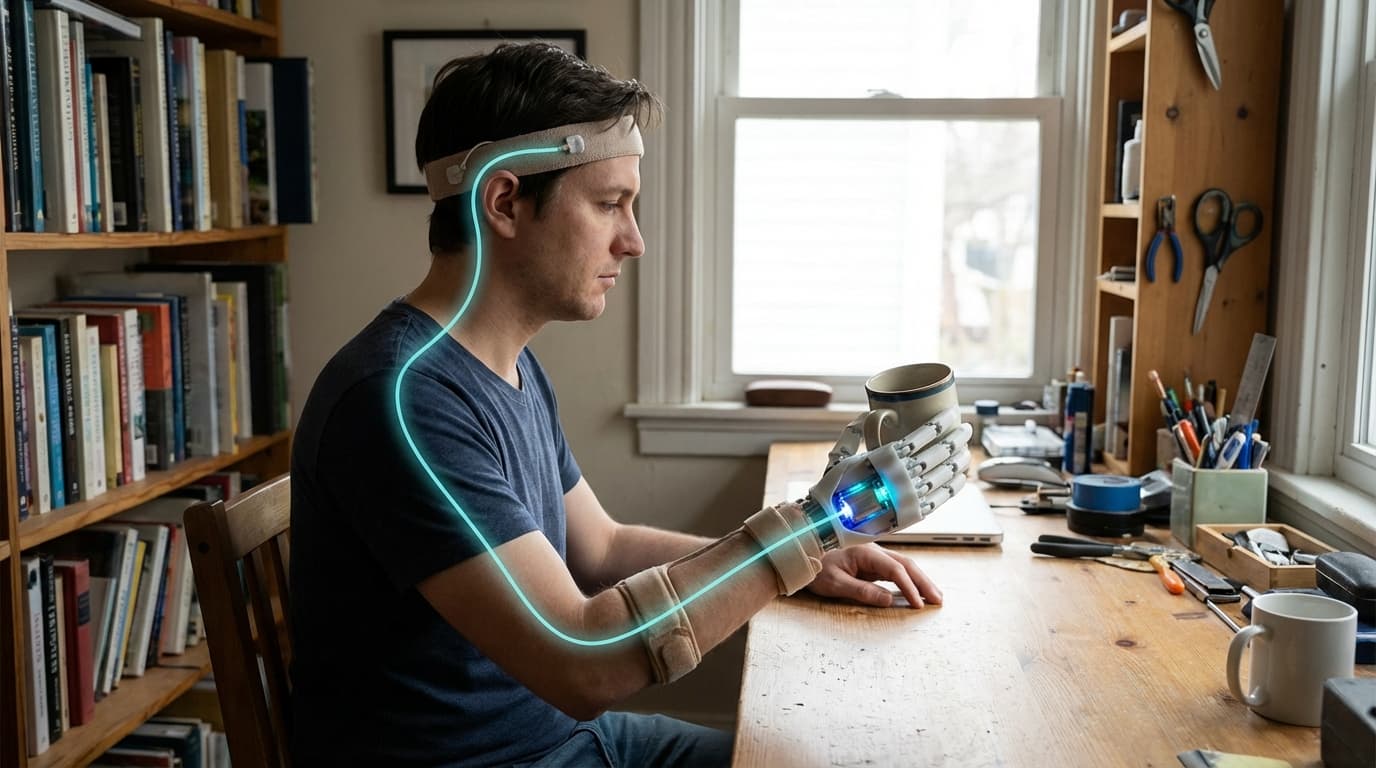
Neural Prosthesis Control Systems
Neural prosthesis control systems are adaptive control software stacks that combine multiple input modalities including myoelectric sensing (detecting muscle signals from residual limbs), cortical signals (from brain implants), and reinforcement learning algorithms to continuously adapt prosthetic limb responses to the user's intent, ensuring precise grip forces, coordinated multi-joint movement, and natural-feeling control throughout daily use. These systems learn from user feedback and adapt over time, improving performance as the user and system learn to work together, enabling dexterous prosthetic control that feels more natural and intuitive than traditional fixed-control schemes.
This innovation addresses the limitation of current prosthetics, where control is often unnatural and requires extensive training. By adapting to the user and learning from experience, these systems can provide better control. Research institutions and companies are developing these technologies.
The technology is particularly significant for advanced prosthetics, where natural-feeling control could dramatically improve quality of life. As the technology improves, it could enable prosthetics that feel like natural extensions of the body. However, ensuring reliability, managing adaptation, and achieving natural control remain challenges. The technology represents an important evolution in prosthetic control, but requires continued development to achieve the performance and reliability needed for widespread use. Success could enable more natural prosthetic control, but the technology must prove itself in long-term daily use and demonstrate clear advantages over simpler approaches.
Research this in Signals
Signals turns a topic into a sourced research record you can inspect and rerun. Your first scan is free, and this one starts with Neural Prosthesis Control Systems already loaded, so edit it or scan as is.