Brain-Guided Robotics
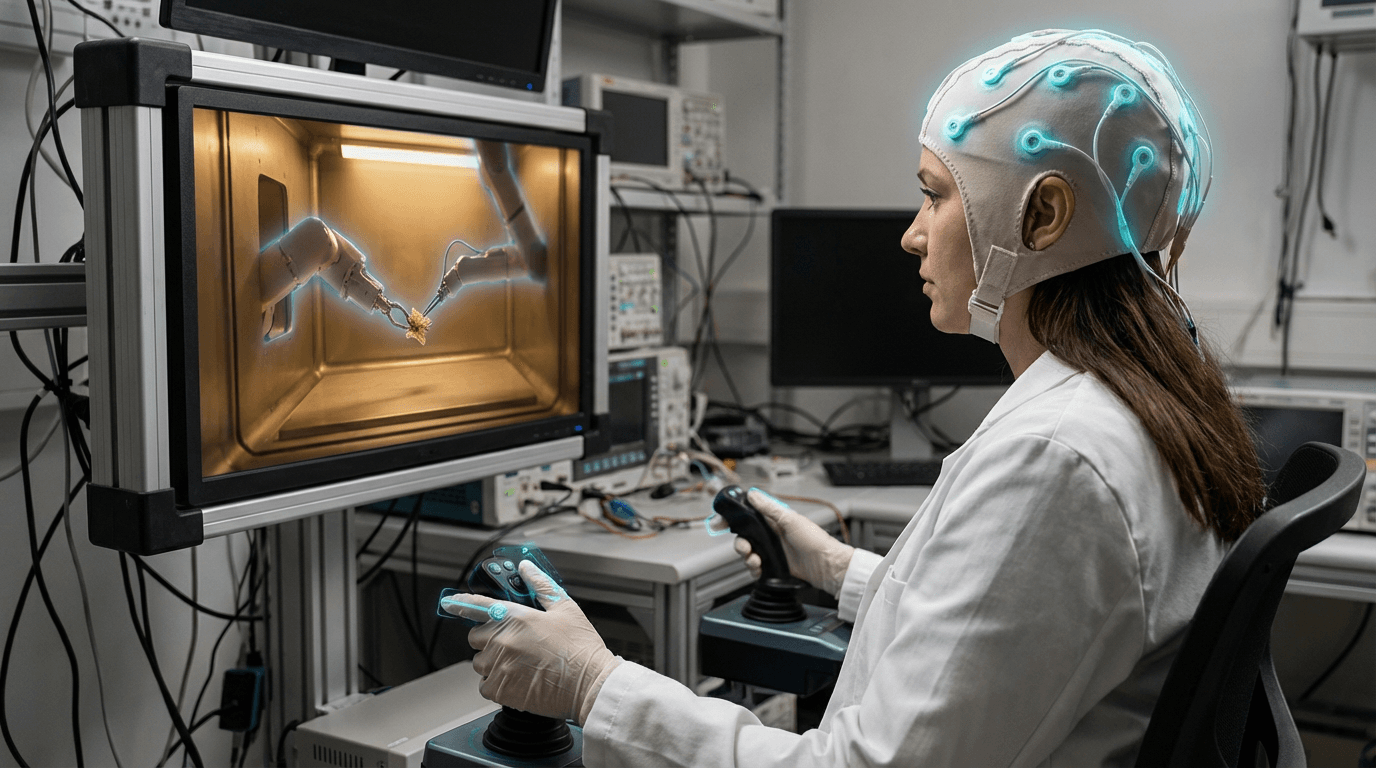
Brain-guided robotics are robotic systems controlled directly via brain-computer interfaces, enabling teleoperation (remote control) for high-precision tasks such as remote surgery, where a surgeon could control robotic surgical instruments from a distance using only their thoughts, or for operating in hazardous environments like nuclear facilities, space, or disaster zones where direct human presence is impossible or dangerous. These systems translate neural signals into precise robotic movements, potentially enabling more natural and intuitive control than traditional joystick or keyboard interfaces, and could allow experts to perform complex tasks remotely using their expertise and fine motor control through thought-based control of robotic systems.
This innovation addresses the need for remote operation of complex systems, where physical presence may be impossible or dangerous. By enabling thought-based control, these systems could provide more natural teleoperation. Research institutions and companies are developing these technologies.
The technology is particularly significant for applications where remote operation is necessary, potentially enabling new capabilities in surgery, space exploration, and hazardous environments. As the technology improves, it could enable new forms of remote work and operation. However, ensuring precision, managing latency, and achieving reliable control remain challenges. The technology represents an interesting application of BCIs, but requires extensive development to achieve the precision and reliability needed for critical applications. Success could enable new capabilities in remote operation, but the technology must prove it can achieve the precision and reliability needed for applications like surgery.
Related Organizations

Manufacturer of the Utah Array, the gold-standard electrode system used in the majority of human BCI research.
United States · Consortium
A multi-institutional consortium developing BCIs to restore communication, mobility, and independence for people with neurologic disease.
France · Research Lab
A biomedical research center that demonstrated a tetraplegic patient controlling a four-limb exoskeleton via ECoG.

Developed the Modular Prosthetic Limb (MPL), one of the most advanced robotic limbs designed for BCI control.
United States · University
A leading university lab focused on bidirectional BCI for controlling robotic prosthetics with sensory feedback.

Battelle
United States · Nonprofit
A massive applied science and technology organization developing PFAS Annihilator™ and other advanced remediation tech.

United States · Startup
Developing the Atom Touch, a mind-controlled bionic arm with sensory feedback.

Develops high-performance BCI hardware, including the 'Unicorn' hybrid black interface for developers.

Originally a rehab robotics company, now developing the GR-1 general-purpose humanoid robot.
Supporting Evidence
Research this in Signals
Signals turns a topic into a sourced research record you can inspect and rerun. Your first scan is free, and this one starts with Brain-Guided Robotics already loaded, so edit it or scan as is.