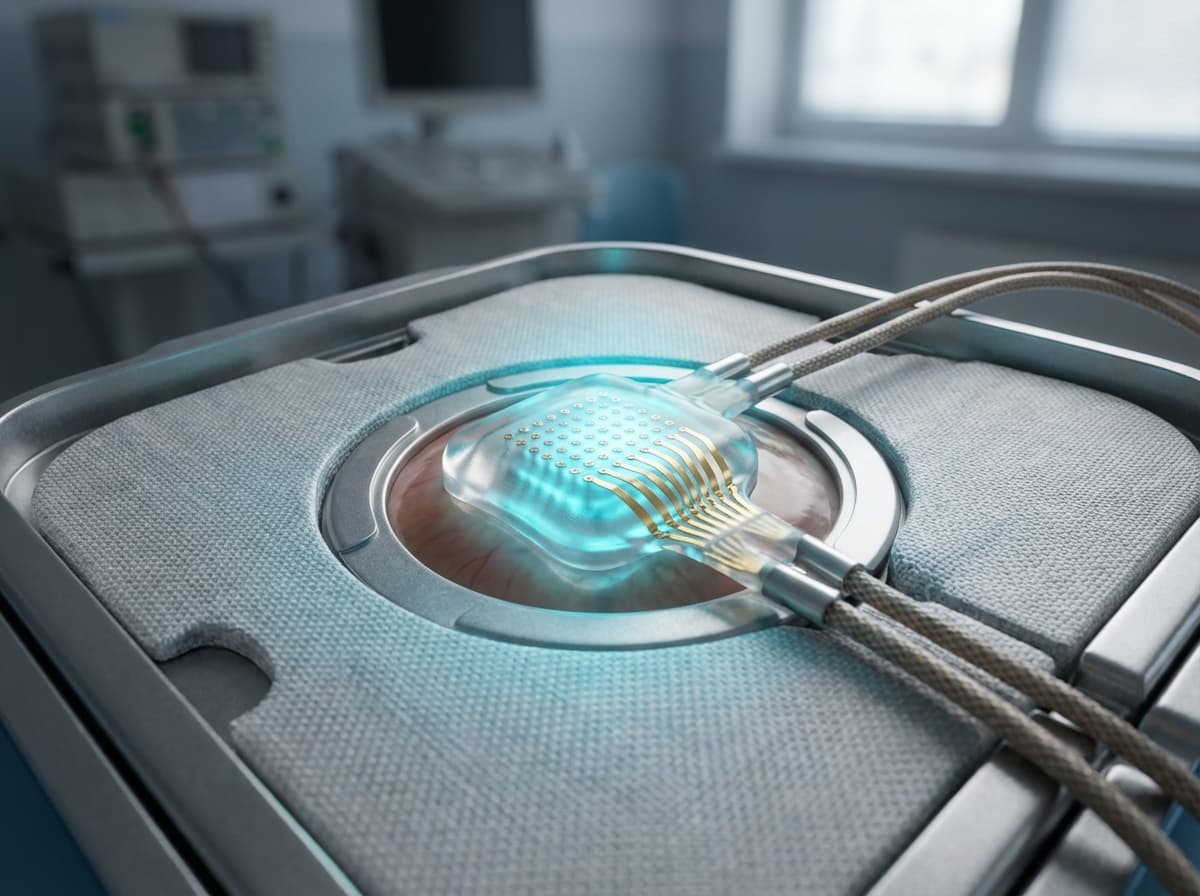
Retinal Implants
Next-generation retinal implants are vision prostheses that use high-density microelectrode arrays placed either epiretinally (on the surface of the retina) or subretinally (beneath the retina) to stimulate surviving retinal cells in people with retinal degenerative diseases, paired with smart glasses that capture visual information from the environment and process it into stimulation patterns. Companies like Pixium Vision and Second Sight are developing these systems to provide pattern vision for patients with conditions like retinitis pigmentosa, where the photoreceptor cells die but other retinal cells remain functional, enabling the restoration of some visual function by directly stimulating the retina to create phosphene patterns that the brain can interpret as vision.
This innovation addresses vision loss from retinal degenerative diseases, where the photoreceptors (light-sensing cells) are lost but other parts of the visual system remain functional. By stimulating surviving retinal cells, these implants can restore some vision. The technology is being developed for conditions like retinitis pigmentosa and age-related macular degeneration.
The technology is particularly significant for people with retinal degenerative diseases, where restoring vision could dramatically improve quality of life. As the technology improves, it could provide better vision restoration. However, achieving high resolution, creating natural visual perception, and managing long-term stability remain challenges. The technology represents an important approach to vision restoration, but requires continued development to achieve the resolution and quality needed for practical use. Success could restore vision for people with retinal diseases, but the technology must overcome challenges in creating high-quality visual perception and maintaining long-term functionality. The field has faced challenges, with some companies like Second Sight discontinuing products, highlighting the difficulty of creating effective vision prostheses.
Related Organizations
United States · University
The research lab responsible for inventing the photovoltaic retinal prosthesis technology licensed to Pixium Vision and Science Corp.

Developing the Science Eye, a visual prosthesis combining gene therapy and a micro-LED display implant.
Bionic Vision Technologies
Australia · Consortium
An Australian consortium commercializing a suprachoroidal retinal implant.
France · Research Lab
One of Europe's largest research centers dedicated to vision diseases, heavily involved in the clinical validation of the Prima implant.
Nano Retina
Israel · Startup
Developer of the NR600, a miniature artificial retina designed to be implanted with a minimally invasive procedure.

Developing protein-based artificial retinas manufactured in microgravity to improve layering quality.
Japan · Company
A major ophthalmic equipment manufacturer involved in the research and development of artificial retina systems (STS) in Japan.
Canada · Startup
Developing the 'Diamond Eye', a wireless retinal implant that aims to provide higher resolution vision.
Supporting Evidence
Research this in Signals
Signals turns a topic into a sourced research record you can inspect and rerun. Your first scan is free, and this one starts with Retinal Implants already loaded, so edit it or scan as is.