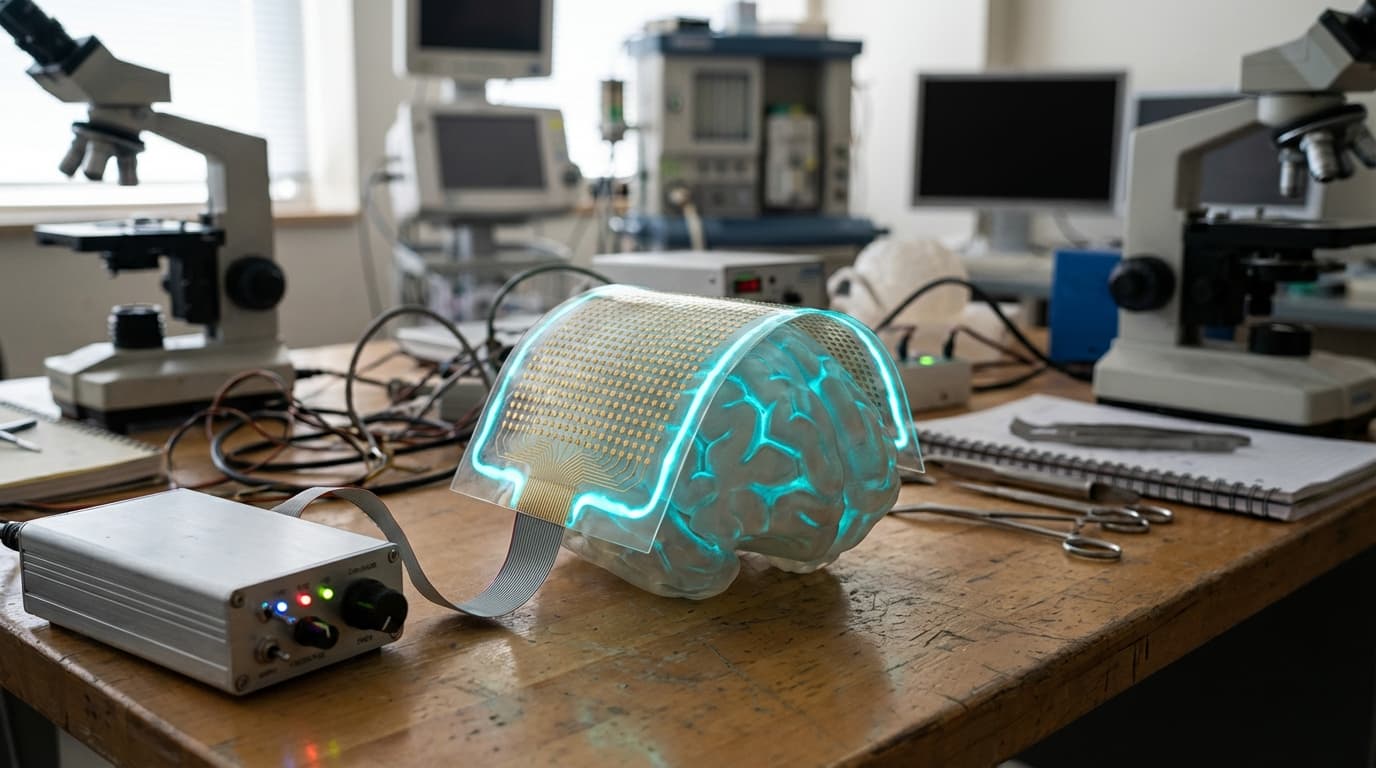
High-Density Cortical Arrays
High-density cortical arrays are next-generation penetrating electrode arrays (like Neuropixels and Neuralink's devices) that offer thousands of recording channels, providing single-neuron resolution at scale by placing electrodes close enough to individual neurons to record their activity with high fidelity. These devices can simultaneously record from thousands of neurons, enabling the decoding of complex motor sequences, cognitive processes, and high-bandwidth data transfer between the brain and external devices, representing a major advance in our ability to interface with the brain at the cellular level.
This innovation addresses the limitation of earlier neural interfaces, which could only record from relatively few neurons, limiting the complexity of signals that could be decoded. By scaling to thousands of channels, these arrays enable much more sophisticated brain-computer interfaces that can decode complex intentions and enable more natural control of prosthetics or computers. Companies like Neuralink, Blackrock Neurotech, and research institutions are developing these technologies.
The technology is essential for enabling sophisticated BCIs that can restore complex motor function or enable new forms of human-computer interaction. As the technology improves, it could enable new applications in assistive technology, communication, and potentially cognitive enhancement. However, ensuring long-term stability, managing data bandwidth, and maintaining biocompatibility remain challenges. The technology represents a major step toward high-performance neural interfaces, but requires continued development to achieve the reliability and longevity needed for clinical use. Success could enable transformative applications for people with paralysis or other conditions, but the technology must overcome significant technical and safety challenges.
Related Organizations

Conducts advanced research into cryogenic CMOS and quantum computing interconnects.

Neurotechnology company developing implantable brain-machine interfaces.

Creating the Connexus Direct Data Interface, a high-data-rate BCI for severe motor impairment.

Manufacturer of the Utah Array, the gold-standard electrode system used in the majority of human BCI research.
United Kingdom · Company
Specializes in advanced high-density silicon neural probes for electrophysiology research.

Developing graphene-based neural interfaces for high-resolution brain decoding and modulation.

Developing the Layer 7 Cortical Interface, a thin-film electrode array designed to sit on the brain's surface without penetrating tissue.
United States · Company
Provides a wide range of high-density microelectrode arrays and probes for neuroscience research.

Developing the Science Eye, a visual prosthesis combining gene therapy and a micro-LED display implant.
United States · Nonprofit
A major user and validator of Neuropixels technology, creating massive open datasets of high-density recordings.
Supporting Evidence
Research this in Signals
Signals turns a topic into a sourced research record you can inspect and rerun. Your first scan is free, and this one starts with High-Density Cortical Arrays already loaded, so edit it or scan as is.