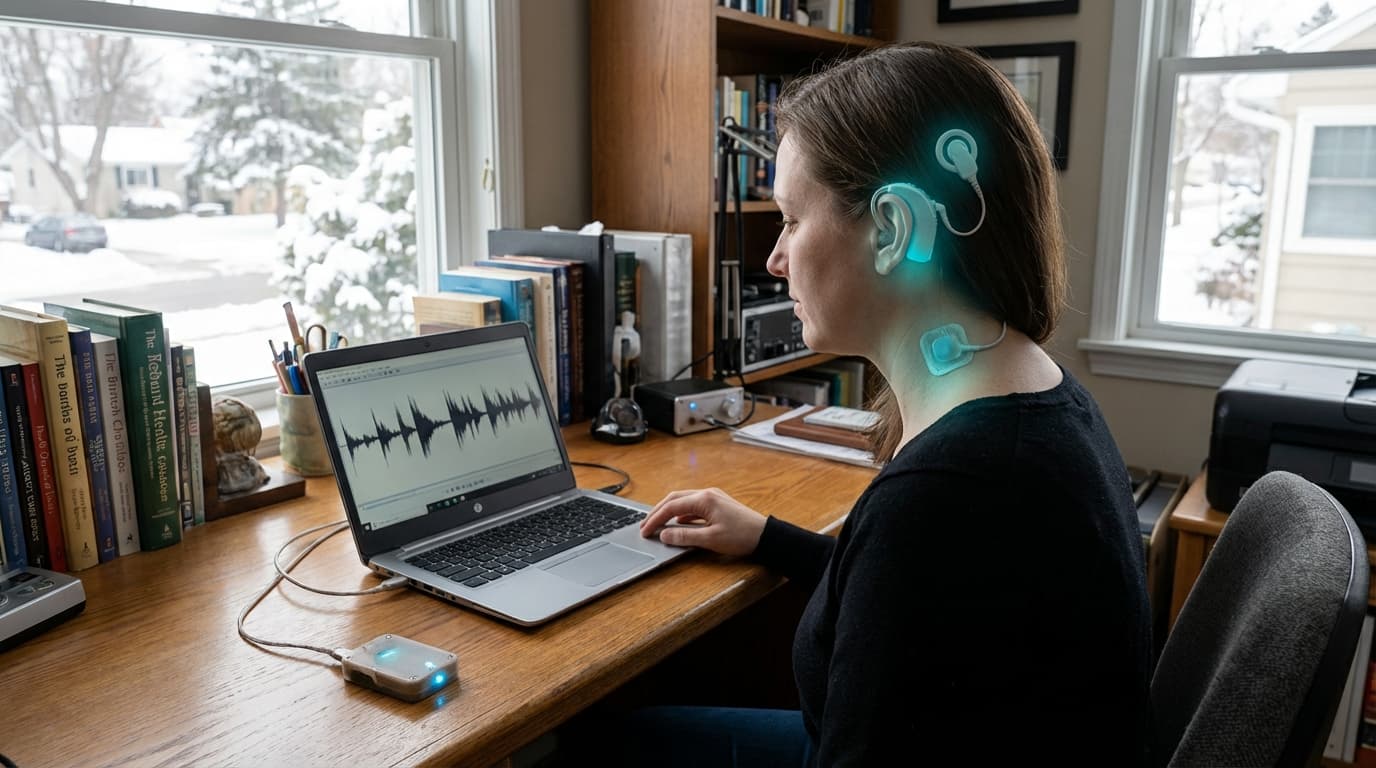
Cochlear Implant Advances
Advanced cochlear implants are state-of-the-art hearing prostheses that integrate deep learning processors for on-device noise suppression and sound processing, and deliver fully internalized hardware that eliminates external coils or processors, creating completely implantable systems that restore naturalistic hearing for people with severe sensorineural hearing loss. These systems use AI to process sound signals in real-time, filtering out background noise and enhancing speech, while the fully implanted design eliminates the need for external components, making the devices more convenient and cosmetically acceptable while potentially improving sound quality through advanced signal processing that adapts to the listening environment.
This innovation addresses the limitations of traditional cochlear implants, which require external processors and may not provide optimal sound quality in noisy environments. By integrating AI processing and fully implanting the system, these devices could provide better hearing outcomes. Companies like Cochlear, Advanced Bionics, and Med-El are developing these technologies.
The technology is particularly significant for people with severe hearing loss, where cochlear implants can restore hearing function. As the technology improves, it could provide better hearing outcomes and more convenient devices. However, ensuring battery life, managing processing power, and achieving natural sound quality remain challenges. The technology represents an important evolution in cochlear implants, but requires continued development to achieve the performance and convenience needed for widespread adoption. Success could improve hearing outcomes and device convenience, but the technology must balance processing capabilities with power consumption and device size constraints.
Related Organizations
United States · Company
Developing the Acclaim Cochlear Implant, a fully implanted system that uses the ear's natural anatomy without external components.
Austria · Company
A leading provider of hearing implants and research into vestibular implants.
United States · Company
A Sonova brand developing advanced sound processing AI (Marvel platform) for cochlear implants.
Germany · University
Home to the German Hearing Center, a leading site for clinical trials of totally implantable cochlear implants.
Denmark · Company
Develops the Neuro cochlear implant system and researches advanced signal processing for implants.
South Korea · Startup
Develops AI-based neural prosthetics and cochlear implants, focusing on miniaturization and localized manufacturing.

Conducts research on AI-based audio signal processing and noise suppression for hearing aids and implants.
Supporting Evidence
Research this in Signals
Signals turns a topic into a sourced research record you can inspect and rerun. Your first scan is free, and this one starts with Cochlear Implant Advances already loaded, so edit it or scan as is.