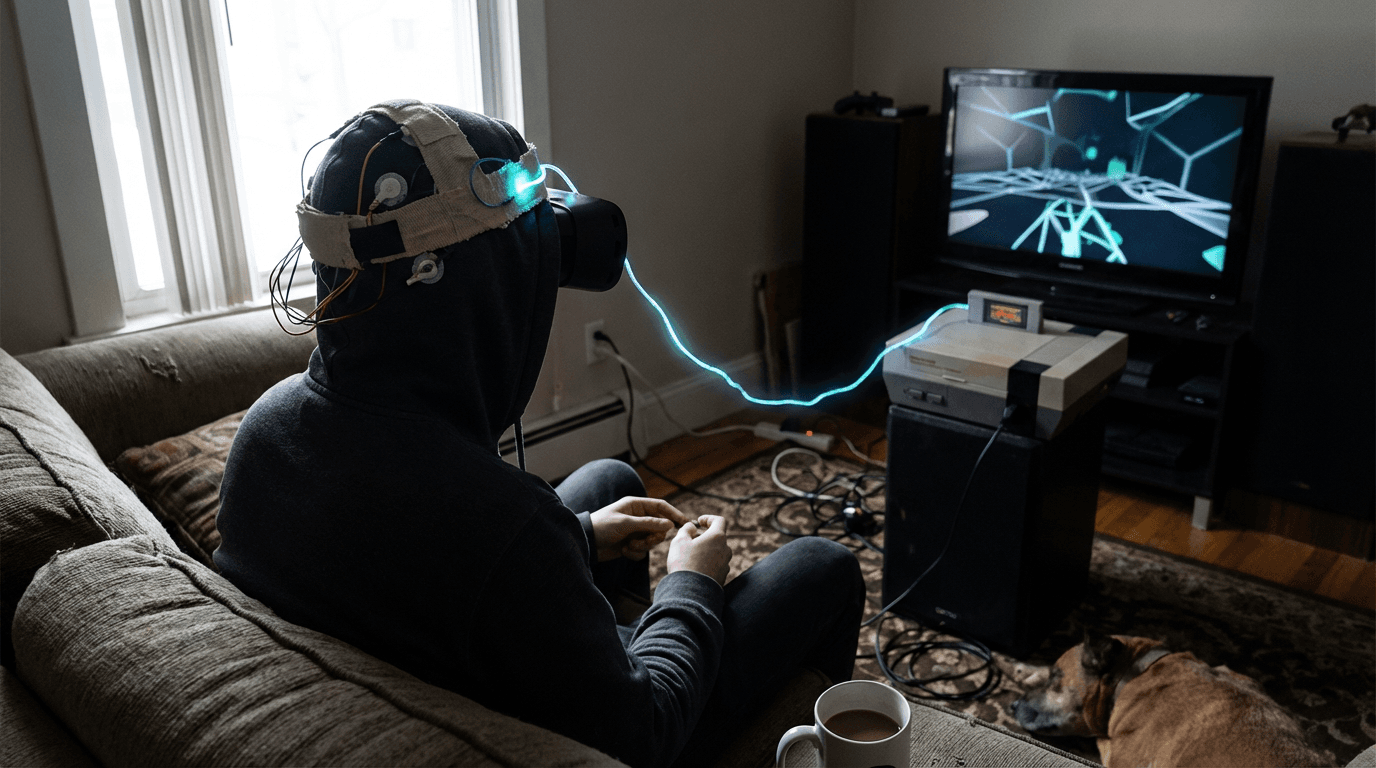
Neuro-Gaming Interfaces
Neuro-gaming interfaces are gaming systems that utilize brain-computer interface input for controlling game avatars, adjusting game difficulty dynamically based on the player's stress levels or cognitive state, and creating novel gameplay mechanics driven by mental state such as using attention, relaxation, or emotional states as game inputs. These systems enable direct neural control of games where thoughts can move avatars or trigger actions, and adaptive gameplay that responds to the player's mental state, potentially creating more immersive and personalized gaming experiences where the game adapts to how the player is feeling or thinking, and new forms of gameplay that use mental states as game mechanics.
This innovation addresses the potential for more immersive and personalized gaming experiences, where neural interfaces could enable new forms of interaction and gameplay. By using mental states as inputs, these systems could create unique gaming experiences. Companies and research institutions are developing these technologies.
The technology is particularly significant for gaming and entertainment, where neural interfaces could enable new forms of interaction and gameplay. As the technology improves, it could enable new gaming experiences. However, ensuring responsiveness, managing complexity, and creating compelling gameplay remain challenges. The technology represents an interesting application of BCIs, but requires development to achieve the performance and game design needed for compelling experiences. Success could enable new forms of gaming, but the technology must prove it can create experiences that are more engaging than traditional interfaces. The neuro-gaming market is still developing, and it remains to be seen which applications will prove most compelling.
Related Organizations

Develops BCI-enabled headphones that detect focus and intent to control digital experiences.
United Kingdom · Company
Creates video players and adventure games where the outcome is determined by the viewer's focus and relaxation levels via EEG.

Creator of SteamVR and its Motion Smoothing technology.

Develops high-performance BCI hardware, including the 'Unicorn' hybrid black interface for developers.

Develops VR-compatible brain sensor modules to analyze user emotion and stress levels during immersive experiences.

Develops the Muse EEG headband and software platform that adapts audio soundscapes in real-time based on the user's brain state (meditation/focus).
United States · University
Researchers at RIT's ESL Global Cybersecurity Institute and gaming departments study adaptive gaming using BCI inputs.

Produces a full-body haptic suit using electro-muscle stimulation (EMS) and TENS to simulate physical sensations.

Provides the High Definition Render Pipeline (HDRP) which supports real-time ray tracing for gaming and industrial visualization.
Supporting Evidence
Research this in Signals
Signals turns a topic into a sourced research record you can inspect and rerun. Your first scan is free, and this one starts with Neuro-Gaming Interfaces already loaded, so edit it or scan as is.