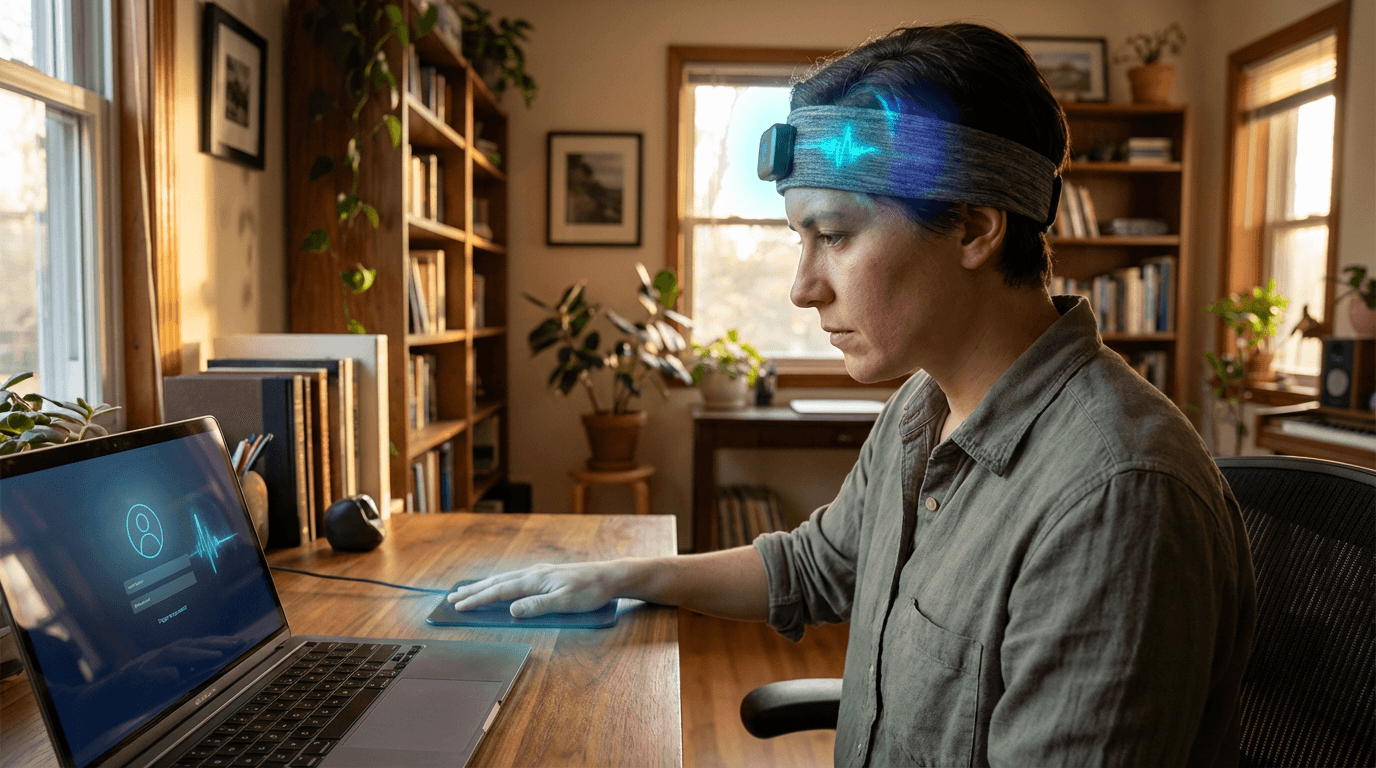
Neural Biometric Authentication
Neural biometric authentication systems use the unique, hard-to-replicate patterns of an individual's EEG (electroencephalography) signals or neural responses to specific stimuli (sometimes called 'Brainprint') for high-security authentication and continuous identity verification, where a person's brain activity patterns serve as a biometric identifier similar to fingerprints or facial recognition. These systems can authenticate users based on their unique neural signatures, which are difficult to forge or replicate, and can provide continuous verification by monitoring brain activity patterns, potentially offering more secure authentication than traditional methods while also enabling hands-free, continuous identity verification that doesn't require conscious action from the user.
This innovation addresses the need for secure, difficult-to-forge authentication methods, where traditional biometrics like fingerprints can be copied. By using neural patterns, these systems could provide more secure authentication. Research institutions and companies are developing these technologies.
The technology is particularly significant for high-security applications, where neural biometrics could provide more secure authentication. As the technology improves, it could enable new security applications. However, ensuring reliability, managing variability in neural signals, and addressing privacy concerns remain challenges. The technology represents an interesting approach to authentication, but requires extensive development to achieve the reliability and practicality needed for widespread use. Success could enable more secure authentication methods, but the technology must prove its reliability and address concerns about privacy and the implications of using brain activity for identification. The field is still developing, and it remains to be seen whether neural biometrics will prove practical and acceptable for widespread use.
Related Organizations

Home to key research on 'Brainprint' technology, demonstrating 100% accuracy in identifying individuals via EEG responses to images.

Specializes in soft, dry-EEG electrodes for in-ear applications (hearables).
United States · University
Conducted pioneering research on 'Passthoughts'—using mental tasks to generate unique EEG signatures for authentication.

Develops semi-dry and dry EEG wearable devices for human behavior research and neurotechnology applications.
Netherlands · University
Researchers here apply deep learning to EEG data to extract unique biometric features for user identification.

Developing 'Apple Intelligence', a personal intelligence system integrated into iOS/macOS that uses on-device context to mediate tasks and information.

Manufacturer of biosensor chips (ThinkGear) and the MindWave headset, enabling low-cost consumer EEG.
Japan · Company
NTT Research investigates bio-digital twins and brainwave analysis for secure identification and communication.
Supporting Evidence
Research this in Signals
Signals turns a topic into a sourced research record you can inspect and rerun. Your first scan is free, and this one starts with Neural Biometric Authentication already loaded, so edit it or scan as is.