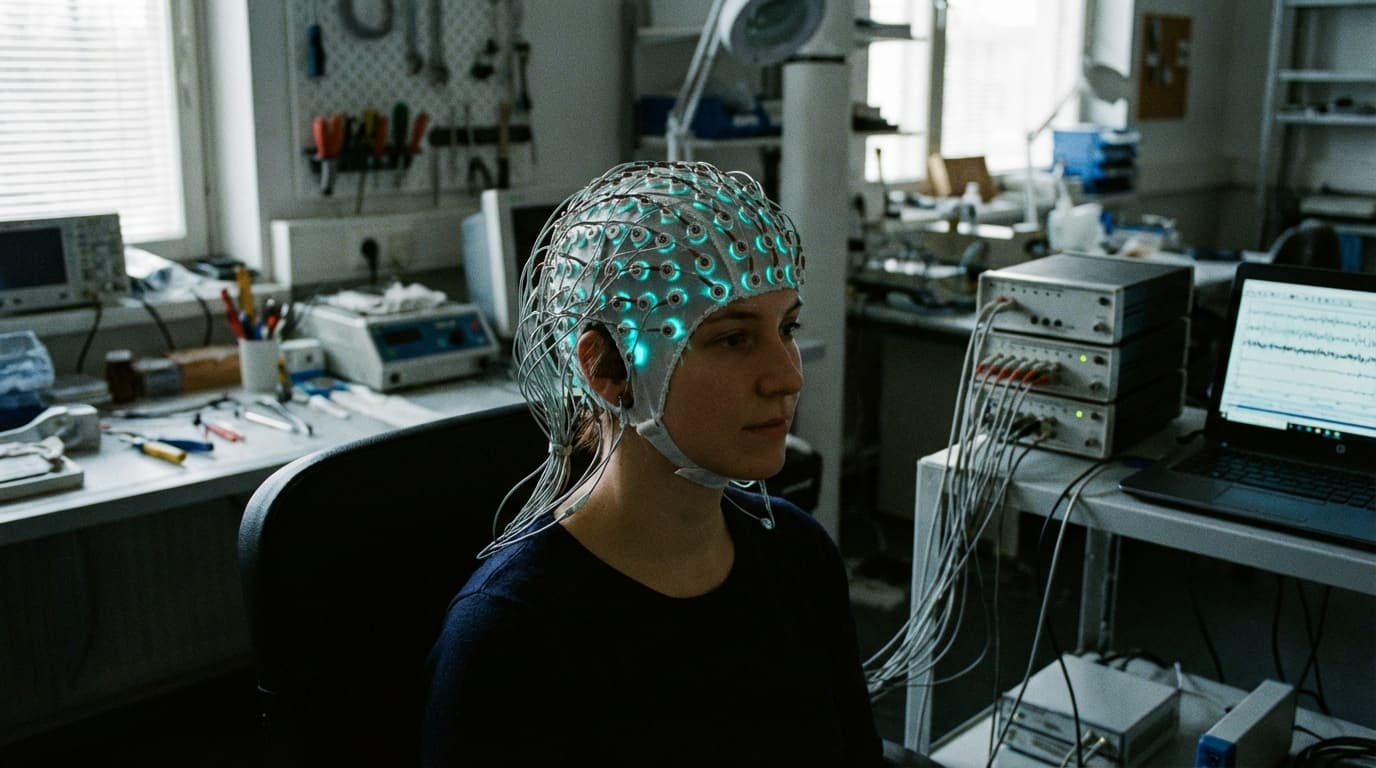
High-Density EEG Caps
High-density EEG caps are ergonomic headgear systems with 256 or more electrodes that leverage active amplification (built-in amplifiers at each electrode) and either rapid-setup conductive gels or dry electrode tips to deliver research-grade signal quality in clinical and field settings, enabling more detailed non-invasive brain-computer interfaces and cognitive monitoring than traditional lower-density EEG systems. These systems provide much better spatial resolution than standard EEG by using many more electrodes distributed across the scalp, allowing for more precise localization of brain activity and enabling more sophisticated BCIs and brain monitoring applications outside of traditional laboratory environments.
This innovation addresses the limitation of traditional EEG systems, which typically use 32-64 electrodes and have limited spatial resolution. By scaling to hundreds of electrodes, these systems enable much more detailed brain mapping. Companies like g.tec, ANT Neuro, and others manufacture these systems.
The technology is particularly valuable for research and clinical applications where detailed brain mapping is needed but non-invasive approaches are preferred. As the technology improves, it could enable better BCIs and diagnostics. However, ensuring signal quality, managing setup complexity, and reducing costs remain challenges. The technology represents an important evolution in EEG capabilities, but requires continued development to achieve the practicality and cost-effectiveness needed for widespread use. Success could make high-quality brain mapping more accessible, but the technology must balance performance with ease of use and cost.
Related Organizations
Netherlands · Company
Produces the ActiveTwo EEG system, known for high signal quality.
Germany · Company
A leading manufacturer of hardware and software for neurophysiological research.
United Kingdom · Company
The original developer of commercial TMS stimulators, providing devices for both research and clinical depression treatment (Horizon system).
Develops high-performance BCI hardware, including the 'Unicorn' hybrid black interface for developers.
Australia · Company
A veteran in the EEG space, providing the SynAmps and Curry software.
United States · Company
Known for high-quality dry and mobile EEG sensors.
Neuracle
China · Company
A Chinese neurotech company providing clinical and research EEG solutions.
Supporting Evidence
Research this in Signals
Signals turns a topic into a sourced research record you can inspect and rerun. Your first scan is free, and this one starts with High-Density EEG Caps already loaded, so edit it or scan as is.