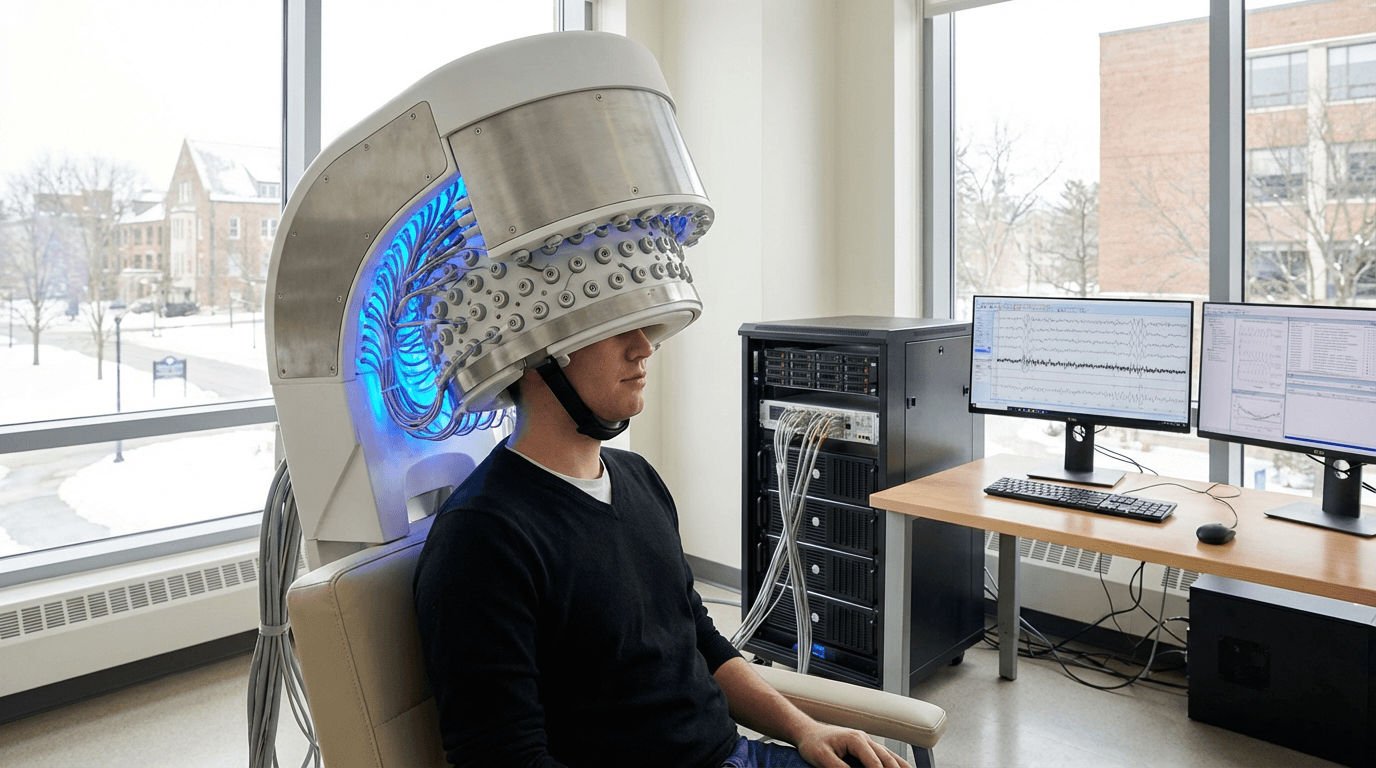
Magnetoencephalography Arrays
Next-generation magnetoencephalography (MEG) systems use optically pumped magnetometers (OPMs) arranged in dense arrays to capture sub-millisecond brain dynamics by measuring the extremely weak magnetic fields produced by neural electrical activity, while allowing subjects to move naturally unlike traditional MEG systems that require subjects to remain still in large, shielded rooms. These advanced systems enable precision diagnostics for neurological conditions and brain-computer interface research in more natural settings, making MEG technology more practical and accessible for clinical and research applications.
This innovation addresses the limitations of traditional MEG systems, which are large, expensive, require specialized shielded rooms, and force subjects to remain motionless. By using smaller, more sensitive OPM sensors, these systems can operate in less restrictive environments and allow natural movement. Companies and research institutions are developing these technologies.
The technology is particularly significant for making high-quality brain imaging more practical and accessible, enabling better diagnostics and research. As the technology improves, it could become more widely available in clinical settings. However, ensuring sensitivity, managing environmental interference, and reducing costs remain challenges. The technology represents an important evolution in brain imaging capabilities, but requires continued development to achieve the practicality and cost-effectiveness needed for widespread use. Success could make high-quality brain imaging more accessible, but the technology must overcome technical and economic challenges to achieve widespread adoption.
Related Organizations
United Kingdom · Startup
Develops and commercializes the world's first wearable OPM-MEG brain scanner system.
United States · Company
Manufactures the Zero-Field Magnetometers (OPMs) that power most current wearable MEG research and commercial systems.
United States · Company
Develops the HEDscan system, a non-invasive brain imaging device using quantum sensor arrays.
United Kingdom · University
Home to the Sir Peter Mansfield Imaging Centre, a global leader in OPM-MEG research and the birthplace of Cerca Magnetics.

A French technology research institute focusing on micro- and nanotechnologies.

A US Department of Energy lab actively researching adiabatic logic circuits and reversible computing to overcome thermodynamic limits in microelectronics.
Germany · Government Agency
Germany's national metrology institute, conducting advanced research on biomagnetism and OPM sensor calibration.
Supporting Evidence
Research this in Signals
Signals turns a topic into a sourced research record you can inspect and rerun. Your first scan is free, and this one starts with Magnetoencephalography Arrays already loaded, so edit it or scan as is.