









Indoor Plant Factories
This page is broader than it.
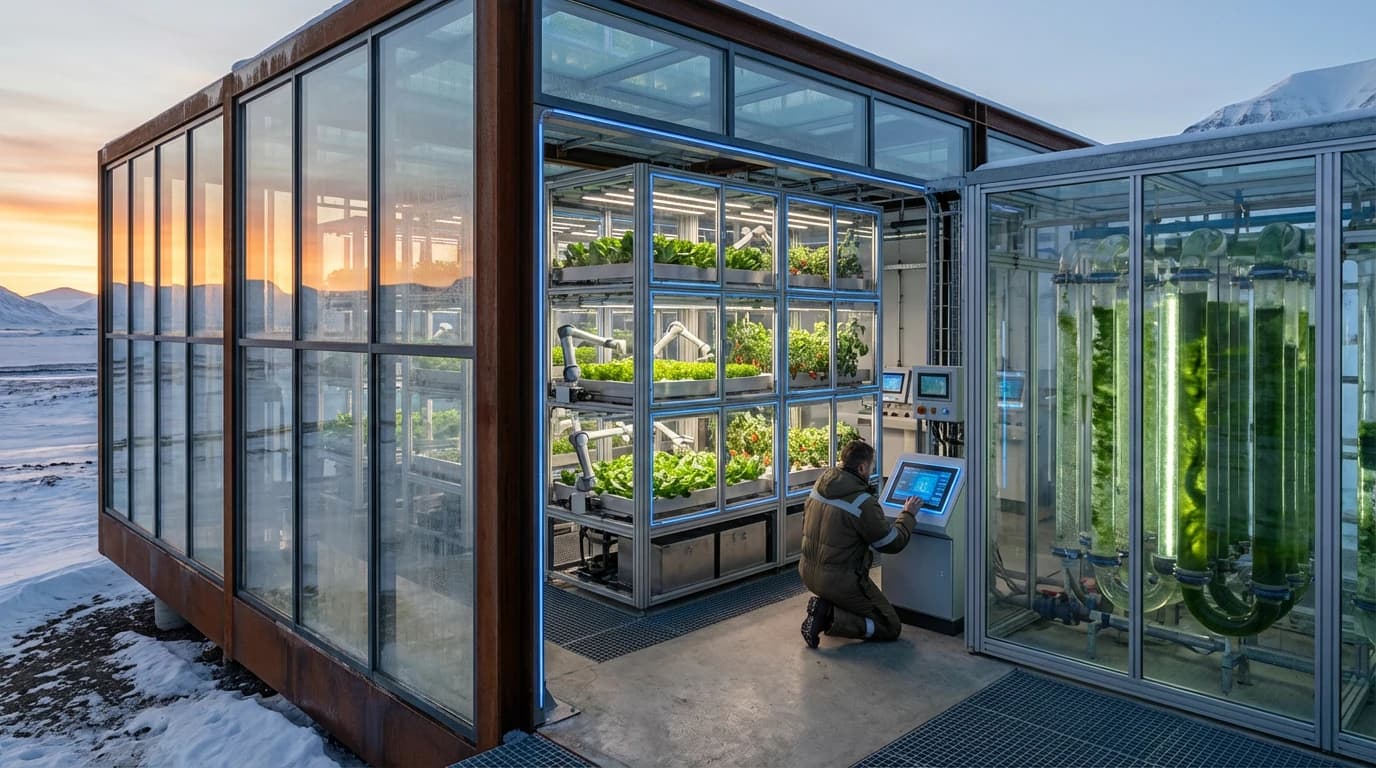
Climate-resilient food systems represent a fundamental reimagining of how humanity produces and secures nutrition in the face of mounting environmental pressures. These integrated production platforms combine controlled-environment agriculture—such as autonomous greenhouses and vertical farms—with emerging biotechnologies including cellular agriculture and microalgae cultivation. At their core, these systems rely on precise environmental control, using sensors, automation, and artificial intelligence to regulate temperature, humidity, light spectrum, and nutrient delivery with minimal human intervention. Vertical farms stack growing layers in climate-controlled facilities, often using LED lighting tuned to specific wavelengths that optimize photosynthesis while minimizing energy consumption. Microalgae bioreactors cultivate protein-rich organisms like spirulina in closed-loop systems that require far less land and water than traditional crops. Cellular meat production, though still emerging from laboratory settings, promises to generate animal protein without the resource intensity of conventional livestock. Together, these technologies create production stacks that can function in environments previously unsuitable for agriculture—from Arctic research stations to urban basements—and maintain output despite external climate volatility.
The agricultural challenges these systems address are becoming increasingly urgent as climate change disrupts traditional farming regions through droughts, floods, and unpredictable growing seasons. Conventional agriculture remains vulnerable to supply chain disruptions, whether from extreme weather events, geopolitical tensions, or pandemic-related logistics failures. Climate-resilient food systems overcome these limitations by localizing production and eliminating dependence on favorable outdoor conditions. Research suggests that controlled-environment facilities can achieve yields per square meter that are orders of magnitude higher than field agriculture, while using up to ninety percent less water through recirculation systems. This efficiency becomes critical in water-stressed regions or scenarios where communities must maintain food security with minimal external inputs. The technology also enables year-round production cycles independent of seasonal variations, stabilizing food availability and reducing the price volatility that often accompanies harvest fluctuations. For regions facing food import dependencies or those planning long-term resilience strategies, these systems offer a pathway to nutritional sovereignty.
Early deployments of climate-resilient food infrastructure are already visible in commercial vertical farms operating in Singapore, Japan, and urban centers across North America and Europe, where companies are producing leafy greens and herbs for local markets. Military and research organizations have piloted containerized growing systems in remote locations, from Antarctic research stations to forward operating bases, demonstrating the technology's viability in extreme conditions. Looking forward, industry analysts note growing interest in hybrid facilities that combine multiple production methods—pairing fast-growing microgreens with slower-maturing microalgae protein sources and experimental cellular agriculture units. As energy costs decline through renewable integration and automation systems become more sophisticated, these platforms are expected to expand beyond niche applications into mainstream food security infrastructure. This trajectory aligns with broader trends toward decentralized, resilient systems capable of maintaining critical functions during global disruptions, positioning climate-resilient food production as essential infrastructure for long-term civilizational stability rather than merely an agricultural innovation.
A top-tier university for agricultural research, specifically in greenhouse and vertical farming innovation.
A vertical farming technology company that uses vertical planes to grow leafy greens with high resource efficiency.
A nonprofit training and supporting regenerative ocean farmers in the era of climate change.
A technology company providing vertical farming infrastructure (Growth Towers) to other growers.
An indoor farming company that operates fully automated vertical farms.
Vertical farming company famous for pollinating strawberries indoors using bees and AI-driven climate control.
Operates a network of high-tech hydroponic greenhouses located on rooftops in urban centers across America.
Develops hardware and software for building automation and climate control.
A hybrid potato breeding company developing disease-free potato seeds.
A global leader in lactic acid and its derivatives, and a leading supplier of emulsifiers, functional enzyme blends, minerals, vitamins, and algae ingredients.
Published forecasts about this technology, graded against what happened in Hindsight.
Indoor Plant Factories
This page is broader than it.
Signals turns a topic into a sourced research record you can inspect and rerun. Your first scan is free, and this one starts with Climate-Resilient Food Systems already loaded, so edit it or scan as is.