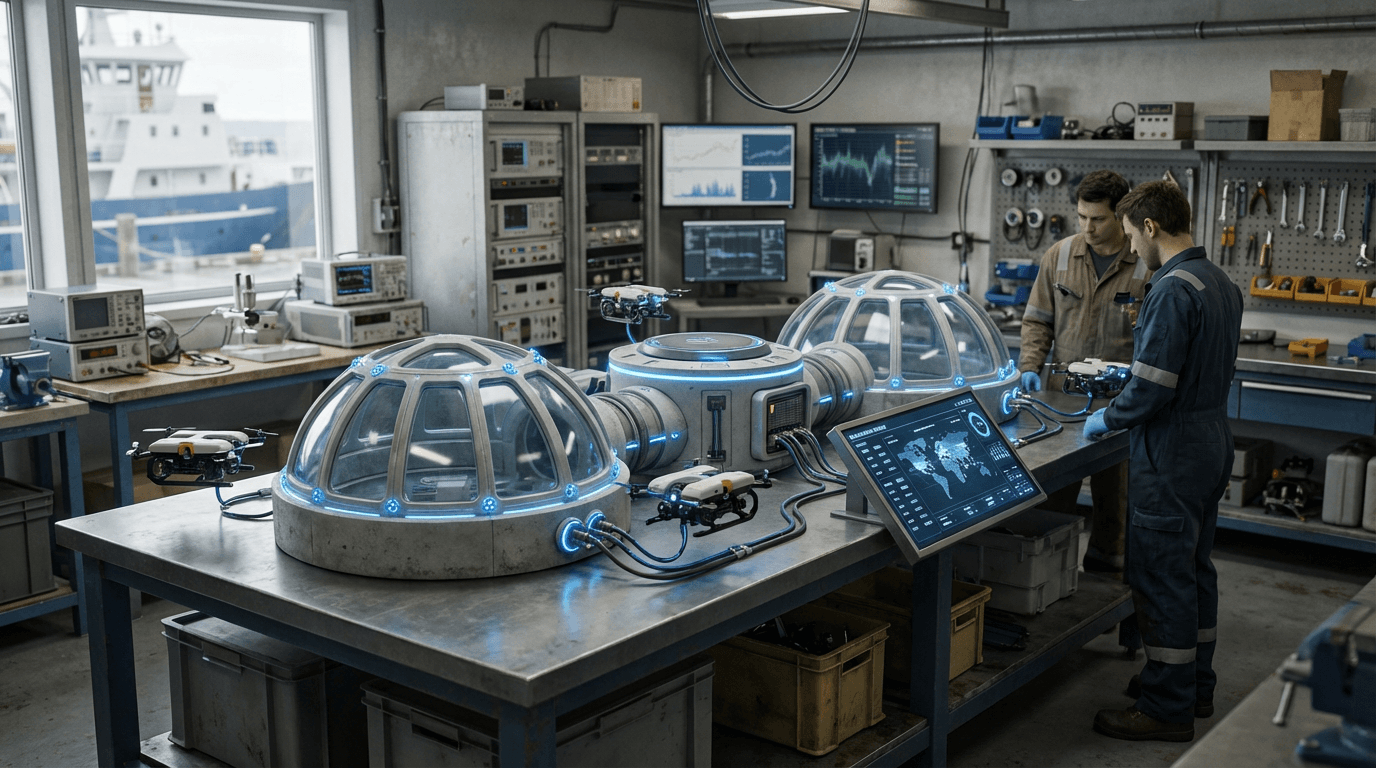
Oceanic Refuge Habitats
Oceanic refuge habitats represent a radical reimagining of human settlement patterns, moving critical infrastructure and populations onto the ocean's surface through advanced floating and semi-submersible platforms. These structures combine principles from offshore engineering, marine architecture, and sustainable systems design to create self-sufficient communities that can persist independently of terrestrial infrastructure for extended periods. The platforms typically employ modular construction techniques using corrosion-resistant materials such as reinforced concrete pontoons, advanced composites, and marine-grade steel frameworks that can withstand extreme weather events and wave action. Their semi-submersible configurations—where portions of the structure sit below the waterline—provide enhanced stability in rough seas while reducing the visual and environmental footprint. Integrated renewable energy systems, including solar arrays, wind turbines, and wave energy converters, supply power needs, while onboard desalination plants convert seawater into potable water. Aquaculture systems and hydroponic growing facilities enable food production, creating closed-loop ecosystems that minimize dependence on external supply chains.
The emergence of oceanic refuge habitats addresses several converging challenges facing contemporary civilization. Rising geopolitical tensions, climate-driven displacement, and the concentration of critical research facilities in vulnerable coastal zones have created urgent demand for distributed, resilient alternatives to land-based infrastructure. These platforms offer sanctuary for populations displaced by sea-level rise or conflict, while simultaneously serving as secure repositories for genetic material, cultural artifacts, and scientific knowledge that might otherwise be lost during catastrophic events. Research institutions are particularly interested in these habitats as platforms for marine science, climate monitoring, and experimental governance models that could inform future settlement patterns. The ability to relocate platforms in response to changing conditions—whether environmental threats or political instability—provides a flexibility that fixed terrestrial installations cannot match. Early deployments suggest these structures could also support economic activities such as offshore aquaculture, renewable energy generation, and marine resource management, potentially creating viable economic models beyond their refuge function.
Several pilot projects and conceptual designs have emerged in recent years, though large-scale permanent settlements remain in developmental stages. Smaller research platforms and temporary installations have demonstrated the technical feasibility of extended ocean habitation, with some operating continuously for months at a time while supporting scientific teams and testing life-support systems. Industry analysts note growing interest from governments concerned with climate adaptation, private foundations focused on existential risk mitigation, and marine research organizations seeking new operational capabilities. The technology builds upon decades of experience with offshore oil platforms, floating cities concepts, and Antarctic research stations, adapting proven engineering solutions to the unique requirements of permanent ocean habitation. As climate pressures intensify and traditional settlement patterns face increasing disruption, oceanic refuge habitats represent a pragmatic response to civilizational fragility—offering not just emergency shelters but functioning communities that could help preserve human knowledge, biodiversity, and cultural continuity across potential discontinuities in terrestrial civilization.
Related Organizations
A blue tech company building floating cities, including a prototype in Busan, South Korea, designed to withstand floods and sea-level rise.
A nonprofit think tank promoting the creation of floating ocean communities with significant political and legal autonomy.

Specialists in floating developments, including the Maldives Floating City project.

Developing 'SeaPods', affordable, single-family floating homes designed for open ocean living.

An architectural firm exclusively dedicated to floating urbanization, designing floating foundations and modular structures for housing and public services.
Focused on developing open-source technology for scalable, affordable seasteading solutions.

Blue Frontiers
Singapore · Startup
A spin-off from the Seasteading Institute focused on constructing the first floating islands with special economic zones.

Major construction firm researching the 'Luna Ring' concept and robotic lunar construction methods.
Developing 'Proteus', a modular underwater habitat serving as an International Space Station for the ocean.

Architecture firm partnering with ICON and NASA on Project Olympus to design the layout and structure of 3D printed lunar bases.
Supporting Evidence
Research this in Signals
Signals turns a topic into a sourced research record you can inspect and rerun. Your first scan is free, and this one starts with Oceanic Refuge Habitats already loaded, so edit it or scan as is.