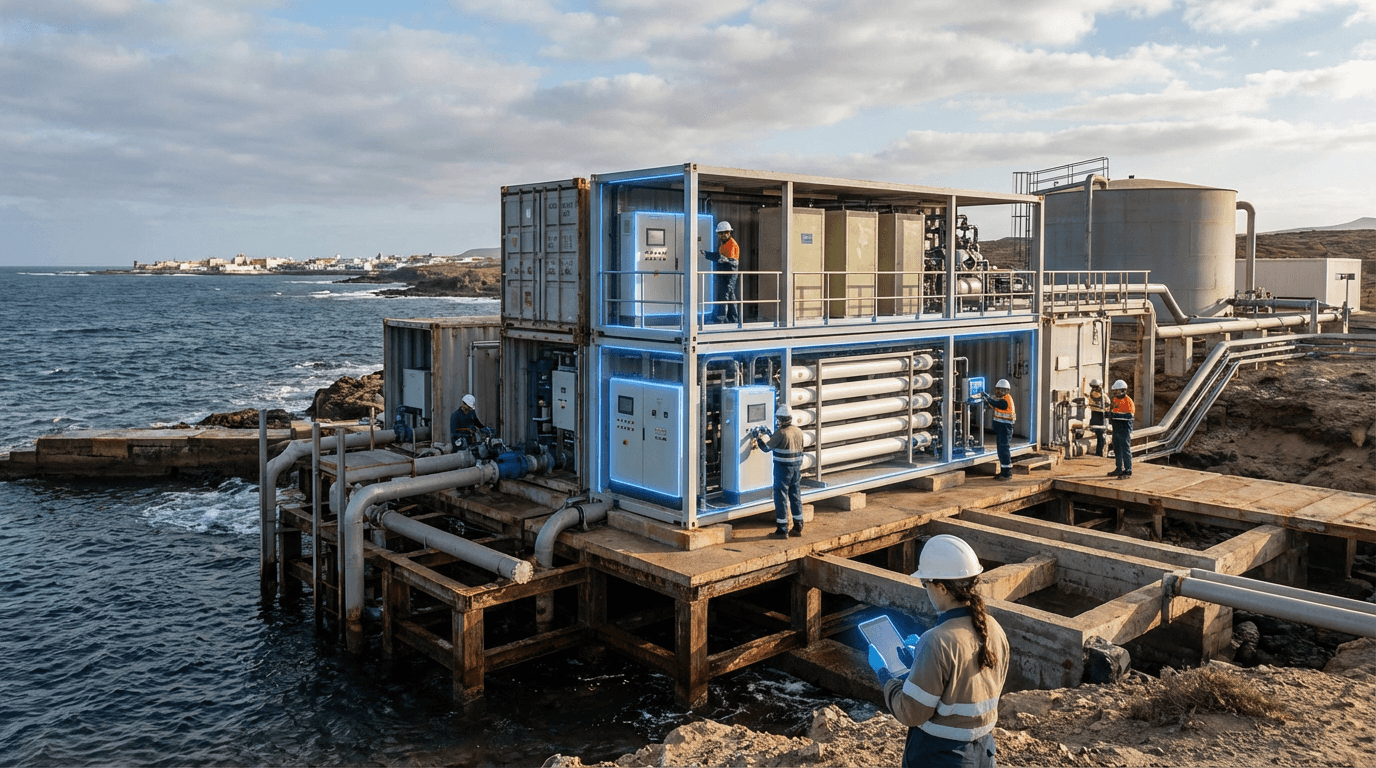
Modular Desalination Arrays
Modular desalination arrays represent a fundamental shift in how communities approach freshwater security, particularly in regions facing chronic water scarcity or climate-driven disruptions to traditional water sources. These systems integrate advanced desalination technologies—including next-generation reverse osmosis membranes, electrodialysis separation, and enhanced solar-still evaporation—into standardized, containerized units that can be rapidly deployed and scaled according to local demand. Unlike conventional large-scale desalination plants that require substantial capital investment and centralized infrastructure, modular arrays operate as distributed networks of smaller treatment units, each capable of processing seawater, brackish groundwater, or contaminated surface water into potable supplies. The technical architecture emphasizes energy efficiency through innovations such as energy recovery devices that capture pressure from brine discharge, graphene-enhanced membranes that reduce osmotic resistance, and hybrid systems that combine multiple separation methods to optimize performance across varying water chemistries. By standardizing components and interfaces, these arrays enable incremental capacity expansion, simplified maintenance through component replacement rather than system overhaul, and adaptation to diverse water sources without complete redesign.
The primary challenge these systems address is the growing disconnect between water demand and reliable supply in an era of intensifying droughts, aquifer depletion, and unpredictable precipitation patterns. Traditional water infrastructure depends heavily on stable hydrological cycles—assumptions increasingly undermined by climate change. Modular desalination arrays break this dependency by creating location-independent freshwater sources powered predominantly by renewable energy and waste heat recovery from industrial processes or power generation. This energy integration is critical, as conventional desalination's high energy consumption has historically limited its viability in resource-constrained settings. Research suggests that coupling modular units with solar photovoltaic systems, wind turbines, or geothermal sources can achieve near-autonomous operation in remote locations, while industrial deployments benefit from capturing otherwise-wasted thermal energy. The modular approach also enables rapid response capabilities that centralized infrastructure cannot match, making these systems particularly valuable for humanitarian applications in refugee settlements, disaster recovery scenarios, and rapidly growing informal urban areas where conventional water networks are absent or overwhelmed.
Early deployments indicate growing adoption across multiple contexts, from small island nations seeking energy-efficient alternatives to diesel-powered desalination to mining operations in arid regions requiring self-sufficient water supplies. Pilot programs in coastal communities vulnerable to saltwater intrusion have demonstrated the technology's ability to maintain water security as traditional freshwater sources become compromised. The containerized format allows for transportation via standard shipping methods and installation on prepared sites within days rather than the years required for conventional plants. Industry analysts note particular interest from military and emergency management organizations, which value the systems' deployability and operational independence. Looking forward, modular desalination arrays align with broader trends toward decentralized infrastructure and climate adaptation strategies that prioritize resilience over efficiency alone. As manufacturing scales and component costs decline, these systems are positioned to become foundational elements of water security architecture in the coming decades, particularly in regions where conventional approaches prove economically or technically infeasible. The technology represents not merely an incremental improvement in desalination but a reimagining of how societies can secure essential resources in an increasingly volatile climate.
Related Organizations

Develops solar-thermal desalination technology that purifies water using only solar energy without filters or chemicals.

Develops wave-powered desalination buoys that require no external electricity.

Provides renewable energy driven desalination solutions, often using gravity to buffer energy.

Global market leader in energy storage products and services, and digital applications for renewables and storage.

Provides decentralized solar-powered water purification and desalination units for remote locations.

Berlin-based company specializing in renewable energy solutions for water treatment.

A non-profit organization that installs solar water farms in developing regions.

Develops FO desalination systems using a proprietary thermolytic draw solution.

Manufactures pressure exchanger technology that makes desalination energy-efficient.

A global leader in renewable energy and sustainable urban development (Masdar City).
Supporting Evidence
Research this in Signals
Signals turns a topic into a sourced research record you can inspect and rerun. Your first scan is free, and this one starts with Modular Desalination Arrays already loaded, so edit it or scan as is.