



Tidal turbines
This page is broader than it.
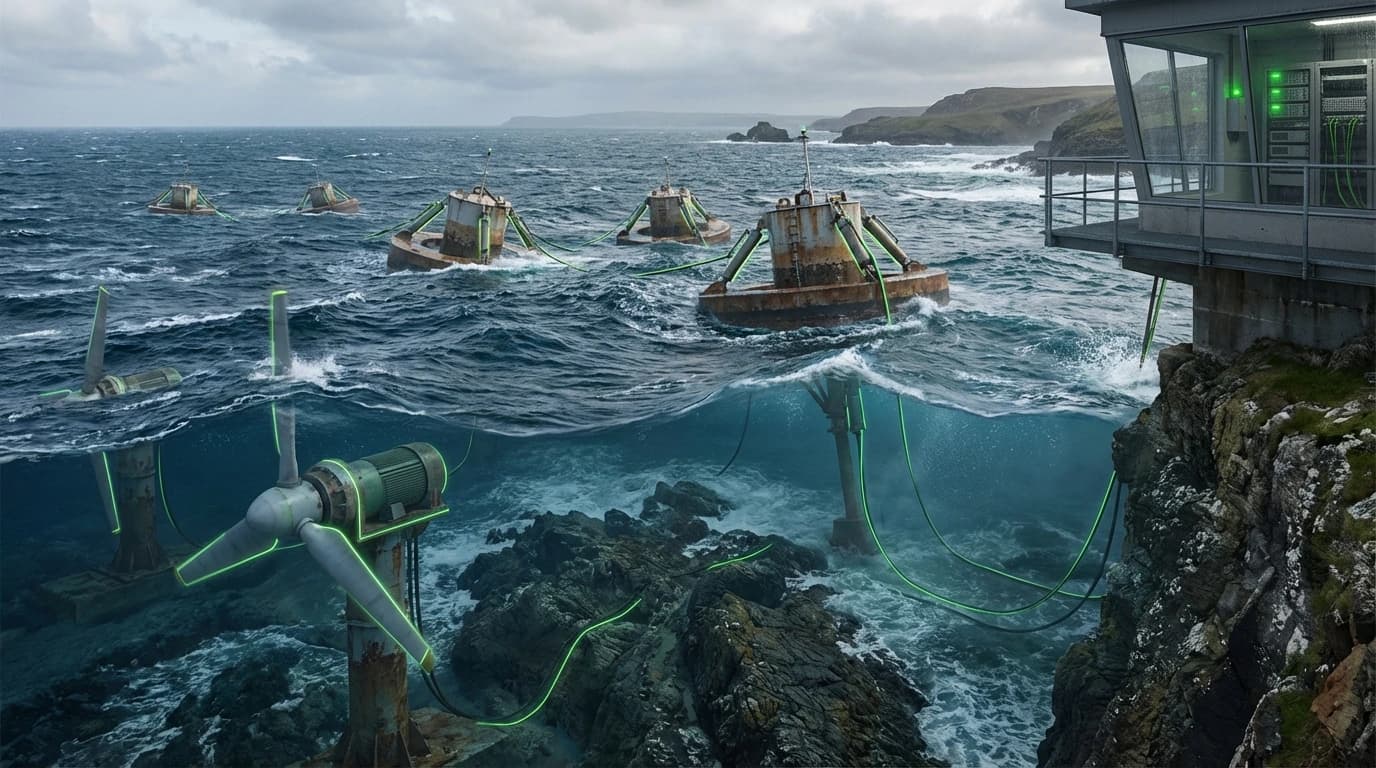
Tidal stream turbines resemble underwater wind turbines, mounted on monopiles or floating platforms to capture predictable currents in straits and channels. Companies like Orbital Marine, Nova Innovation, and Verdant Power are deploying multi‑megawatt arrays with maintenance-friendly floating platforms that can be towed to port. Wave-energy converters—point absorbers, oscillating water columns, and flexible attenuators—convert surface motion into electricity via hydraulic rams or linear generators, with deployments from CorPower, Eco Wave Power, and CalWave.
Because tides are forecastable decades in advance, utilities integrate tidal power into microgrids for remote islands, data centers, and coastal communities needing reliable baseload. Wave devices co-locate with offshore wind farms, sharing export cables and maintenance vessels. Some systems focus on powering aquaculture, desalination, or subsea sensors, creating niche markets while utility-scale economics mature.
The technology sits around TRL 5–6: survivability in harsh seas, cost-effective installation, and financing remain challenges. Supportive policies in the UK, Canada, Portugal, and Japan provide grants, revenue guarantees, and test sites like EMEC and Wave Hub. As supply chains learn from offshore wind and oil & gas, tidal and wave power could supply gigawatts of carbon-free, predictable energy by the 2030s.
Developer of high-efficiency wave energy converters inspired by the pumping principles of the human heart.
The world's leading test facility for wave and tidal energy converters, located in Orkney, Scotland.
Develops 'Deep Green' technology, underwater kites that fly in tidal streams to generate electricity from low-flow velocities.
Develops onshore wave energy technology that attaches to existing marine structures like breakwaters and piers.
Provides the PB3 PowerBuoy, a wave energy device used primarily for powering offshore defense and surveillance applications.

Sabella
France · Company
French tidal turbine developer focusing on supplying energy to non-interconnected islands (e.g., Ushant island).
United States · Startup
Spin-off from UC Berkeley developing a fully submerged wave energy converter that survives storms by operating underwater.
Australian developer of the CETO wave energy technology, a submerged point absorber.
France · Company
Develops vertical axis tidal turbines for both river and ocean applications.
Spain · Company
Spanish company developing a floating tidal platform with contra-rotating rotors, tested at EMEC.
Published forecasts about this technology, graded against what happened in Hindsight.
Signals turns a topic into a sourced research record you can inspect and rerun. Your first scan is free, and this one starts with Tidal/Wave Energy Converters already loaded, so edit it or scan as is.