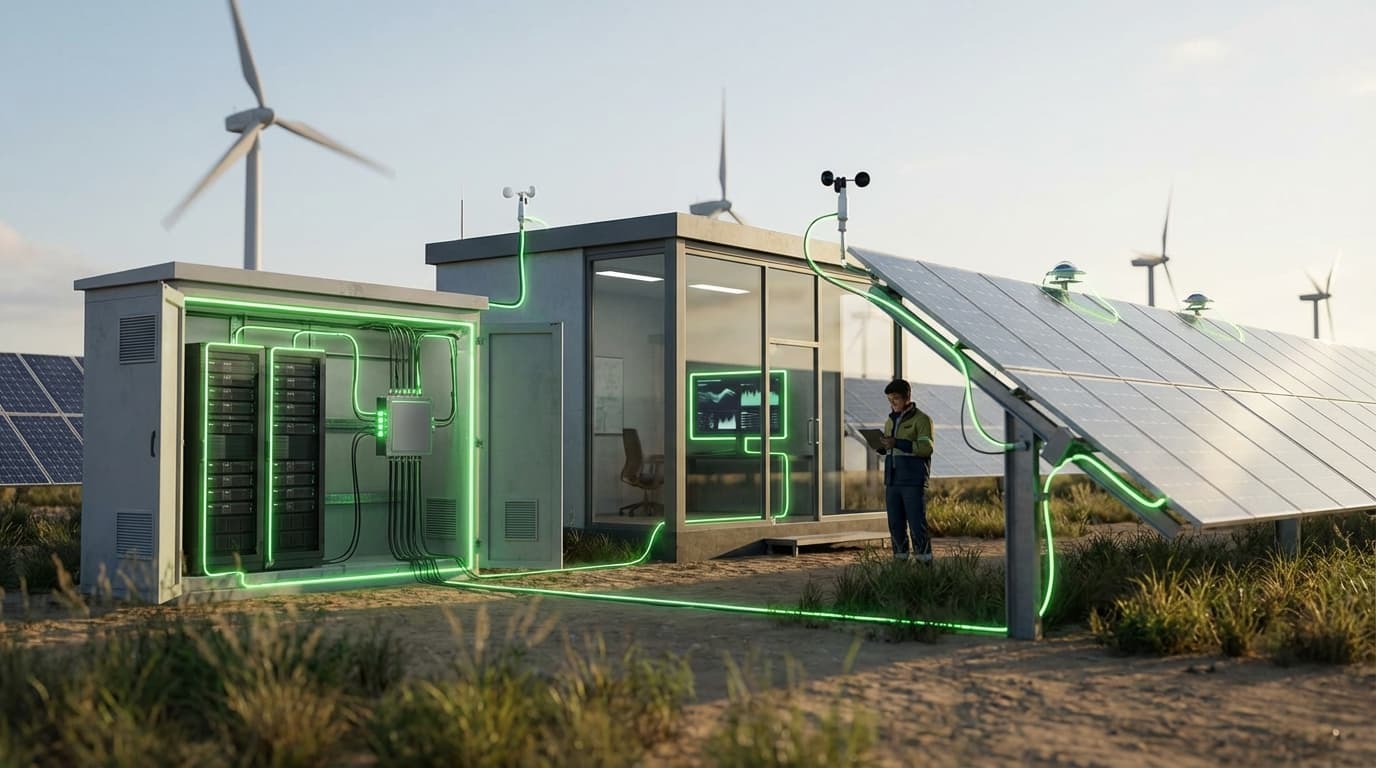
Renewable Energy Forecasting Engines
Solar and wind forecasting engines fuse satellite imagery, numerical weather prediction ensembles, sky cameras, lidar, and turbine SCADA data to deliver minute-to-day-ahead power estimates. Machine-learning models correct biases, capture ramp events, and quantify uncertainty, while edge devices at solar plants analyze cloud motion in real time to update dispatch schedules every few seconds. APIs stream probabilistic forecasts to traders, grid operators, and storage optimizers so they can plan bidding strategies and battery setpoints.
Utilities use the forecasts to minimize imbalance penalties, optimize reserve procurement, and coordinate maintenance windows with expected lulls. Independent power producers feed the data into automated trading systems, while corporate offtakers rely on it to time flexible loads or hedging instruments. Some services extend to rooftop fleets, aggregating behind-the-meter PV output for distribution grid planning.
TRL 7 solutions are widely deployed, but accuracy hinges on data access and integration into market systems. As 5G, IoT, and open weather data expand, forecasting engines will become more granular, supporting distribution-level control and carbon-aware operations for data centers and EV fleets.
Related Organizations
Slovakia · Company
Specializes in solar resource assessment and PV energy forecasting using satellite data and algorithms.

A global leader in weather, environmental, and industrial measurements.
Germany · Company
Provides AI-based power forecasting for wind and solar assets to enable precise energy trading.

Delivers high-resolution weather data via API and uses 'Meteodrones' to gather lower-atmosphere data for better forecasts.
United Kingdom · Nonprofit
Nonprofit research lab focused on using open source machine learning to reduce emissions, specifically in grid forecasting.
Spain · Company
Provides wind resource assessment and forecasting using the WRF (Weather Research and Forecasting) model.
Netherlands · Startup
Uses Large Eddy Simulation (LES) on GPUs to provide ultra-high-resolution local weather forecasts for wind farms.

Provides extensive solar and wind forecasting services (Forecaster) for grid operators and asset owners.

Uses a constellation of nanosatellites to collect radio occultation data, fed into ML models for forecasting.

Operates proprietary radar satellites and uses generative AI ('Gale') for weather intelligence.

Offers the AWS Truepower suite, a leading platform for renewable energy project design and operational forecasting.
Supporting Evidence
Research this in Signals
Signals turns a topic into a sourced research record you can inspect and rerun. Your first scan is free, and this one starts with Renewable Energy Forecasting Engines already loaded, so edit it or scan as is.