

Ocean Thermal Energy Conversion
Ocean Thermal Energy Conversion
Harvesting ocean temperature differences to generate continuous baseload power
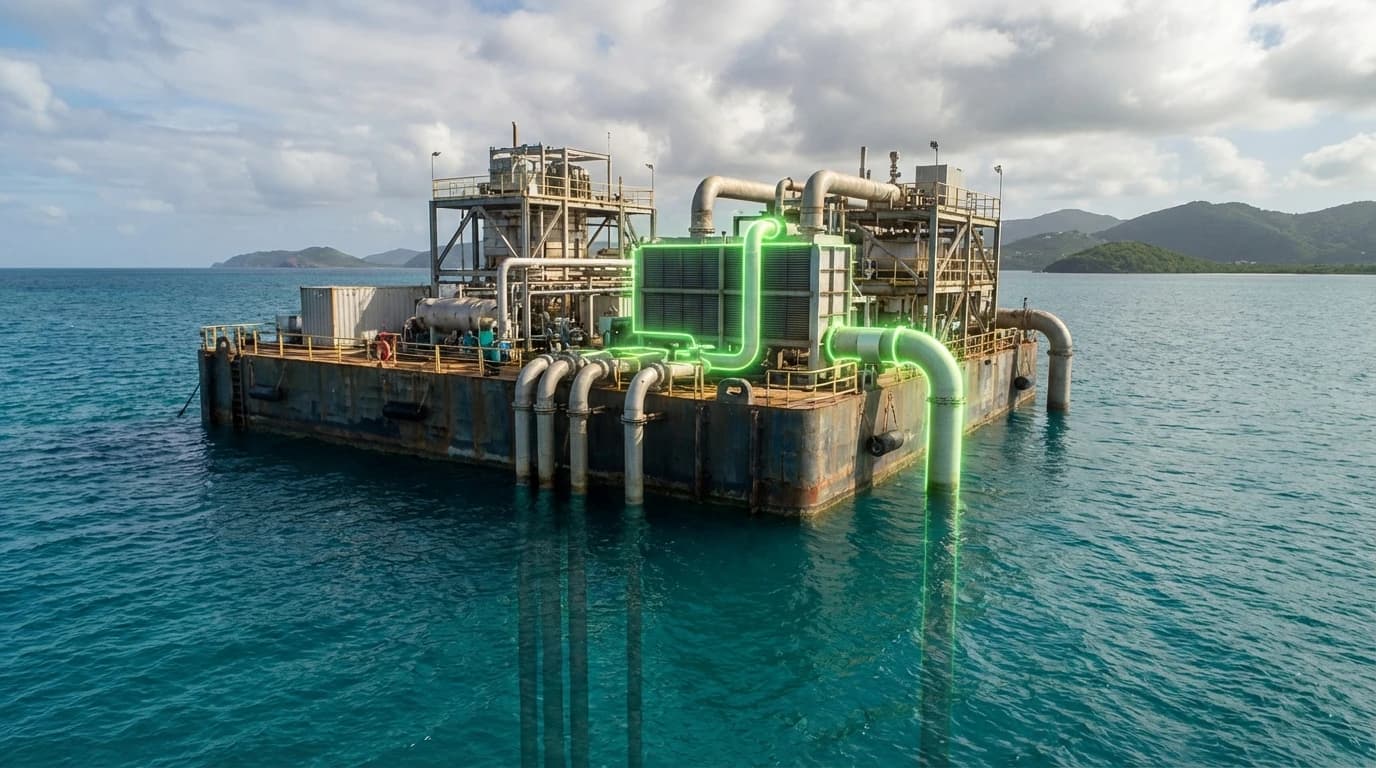
Ocean Thermal Energy Conversion (OTEC) exploits the 20 °C temperature gradient between warm surface seawater and cold deep water to drive a Rankine cycle using ammonia or low-boiling-point working fluids. Closed-cycle systems pump warm surface water through heat exchangers to vaporize the working fluid and cold water to condense it, producing continuous baseload power and fresh water. Modular floating platforms or shore-based plants can supply island nations, naval bases, or coastal industries with 24/7 renewable energy.
Pilot projects from Makai Ocean Engineering, Global OTEC, and Japan’s Saga University are scaling from hundreds of kilowatts to tens of megawatts, integrating with desalination units, hydrogen production, or data centers that benefit from constant cooling. OTEC can also support aquaculture and sea-water air conditioning by bringing nutrient-rich deep water to the surface, creating co-benefits for coastal economies. Because resource potential is vast in tropical regions, OTEC could reduce reliance on imported diesel and stabilize grids vulnerable to storms.
The technology is TRL 4–5: capital costs remain high due to large-diameter cold-water pipes, marine corrosion, and grid interconnection challenges. Advances in composite materials, modular heat exchangers, and public-private finance are needed to reach commercial scale. Policy support through green bonds, blue-economy funds, and carbon credits for avoided diesel can accelerate deployment in island states looking to meet net-zero goals.
TRL
5/9Validated
Impact
4/5
Investment
3/5
Category
hardware
Related Organizations
Institute of Ocean Energy, Saga University (IOES)
95%Japan · University
A premier academic research center for OTEC, known for inventing the Uehara Cycle which improves thermal efficiency.
Researcher
A leading engineering firm in OTEC heat exchanger design and pipeline deployment, operating the grid-connected OTEC demonstration plant in Hawaii.
Developer
Global OTEC
90%UK · Startup
Developing 'Dominique', a floating OTEC barge designed to provide clean baseload power to Small Island Developing States (SIDS).
Developer
KRISO (Korea Research Institute of Ships and Ocean Engineering)
90%South Korea · Research Lab
South Korean government research institute that has developed and tested a 1MW OTEC demonstration plant.
Researcher
Natural Energy Laboratory of Hawaii Authority (NELHA)
90%United States · Government Agency
State agency operating the Hawaii Ocean Science and Technology Park, providing the seawater infrastructure essential for OTEC testing.
Deployer
Xenesys
85%Japan · Company
Japanese engineering firm focused on OTEC and Discharged Thermal Energy Conversion (DTEC) utilizing the Uehara Cycle.
Developer
Enogia
75%France · Company
Specializes in Organic Rankine Cycle (ORC) micro-turbines, a core component technology for converting OTEC thermal gradients into electricity.
Developer
Mitsui E&S
75%Japan · Company
Heavy industry conglomerate involved in ocean engineering and the construction of OTEC demonstration facilities in Japan.
Developer
US DOE lab conducting environmental monitoring and materials research relevant to marine energy, including OTEC environmental impacts.
Researcher
What was expected
Published forecasts about this technology, graded against what happened in Hindsight.
Supporting Evidence
Evidence data is not available for this technology yet.
Research this in Signals
Scan Ocean Thermal Energy Conversion for yourself.
Signals turns a topic into a sourced research record you can inspect and rerun. Your first scan is free, and this one starts with Ocean Thermal Energy Conversion already loaded, so edit it or scan as is.