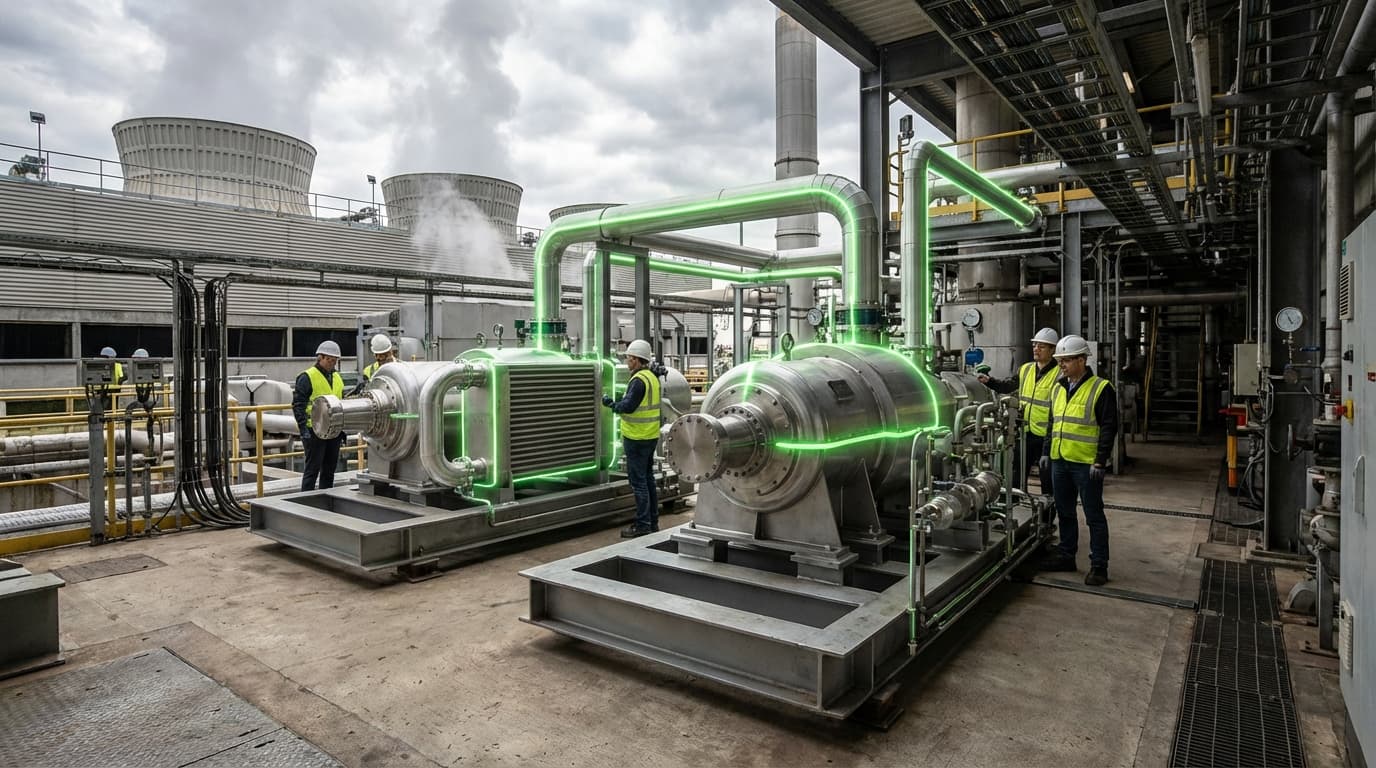
Supercritical CO₂ Turbines
Supercritical CO₂ (sCO₂) power cycles operate above the critical point of carbon dioxide, where the fluid behaves like both a liquid and gas, achieving high thermal efficiency in compact turbomachinery. Because sCO₂ has high density, turbines and heat exchangers can be 5–10× smaller than steam equivalents, reducing capital cost and enabling modular skid-mounted power blocks. These systems pair with concentrated solar power, nuclear SMRs, geothermal, and industrial waste-heat recovery, squeezing more electricity out of each unit of heat while needing less cooling water.
Companies like GE Vernova, Baker Hughes, Siemens Energy, Echogen, and net-zero startups (sCO₂ Flex, Wantcom) are building 10–100 MW pilots funded by DOE’s STEP program, ARPA‑E, and European Innovation Fund. CSP plants plan to swap steam Rankine cycles with sCO₂ to hit >50% thermal efficiency, while data centers and steel mills explore using sCO₂ bottoming cycles to harvest low-grade heat. The technology also pairs well with high-temperature reactors and solar thermal storage, offering dispatchable clean power.
sCO₂ turbines are TRL 5–6: materials must withstand 700 °C, sealing and bearings require new designs, and control systems need certification. Once reliability is proven, the ability to deliver high-efficiency, compact power blocks will make sCO₂ a go-to upgrade for revamping fossil plants, repowering CSP, and increasing the round-trip efficiency of energy-storage systems like thermal batteries.
Related Organizations
United States · Company
Commercializing the Allam-Fetvedt Cycle, which uses sCO2 as a working fluid to generate low-cost electricity with zero emissions.
United States · Research Lab
Hosts the Supercritical Transformational Electric Power (STEP) Demo pilot plant, a 10 MWe sCO2 facility.
United States · Company
The innovation firm that invented the Allam-Fetvedt Cycle used by NET Power.
United States · Company
Develops sCO2 heat-to-power systems for waste heat recovery and long-duration energy storage (PTES).
United States · Nonprofit
Leads the STEP Demo project in collaboration with SwRI and GE to demonstrate sCO2 power cycles.

A US Department of Energy lab actively researching adiabatic logic circuits and reversible computing to overcome thermodynamic limits in microelectronics.

Develops advanced turbomachinery, including sCO2 compressors and turbines for NET Power and other applications.
South Korea · Company
Developing sCO2 engines and integrally geared compressors for power generation and waste heat recovery.
Conducts extensive academic research on sCO2 cycle optimization and component design.
Supporting Evidence
Research this in Signals
Signals turns a topic into a sourced research record you can inspect and rerun. Your first scan is free, and this one starts with Supercritical CO₂ Turbines already loaded, so edit it or scan as is.