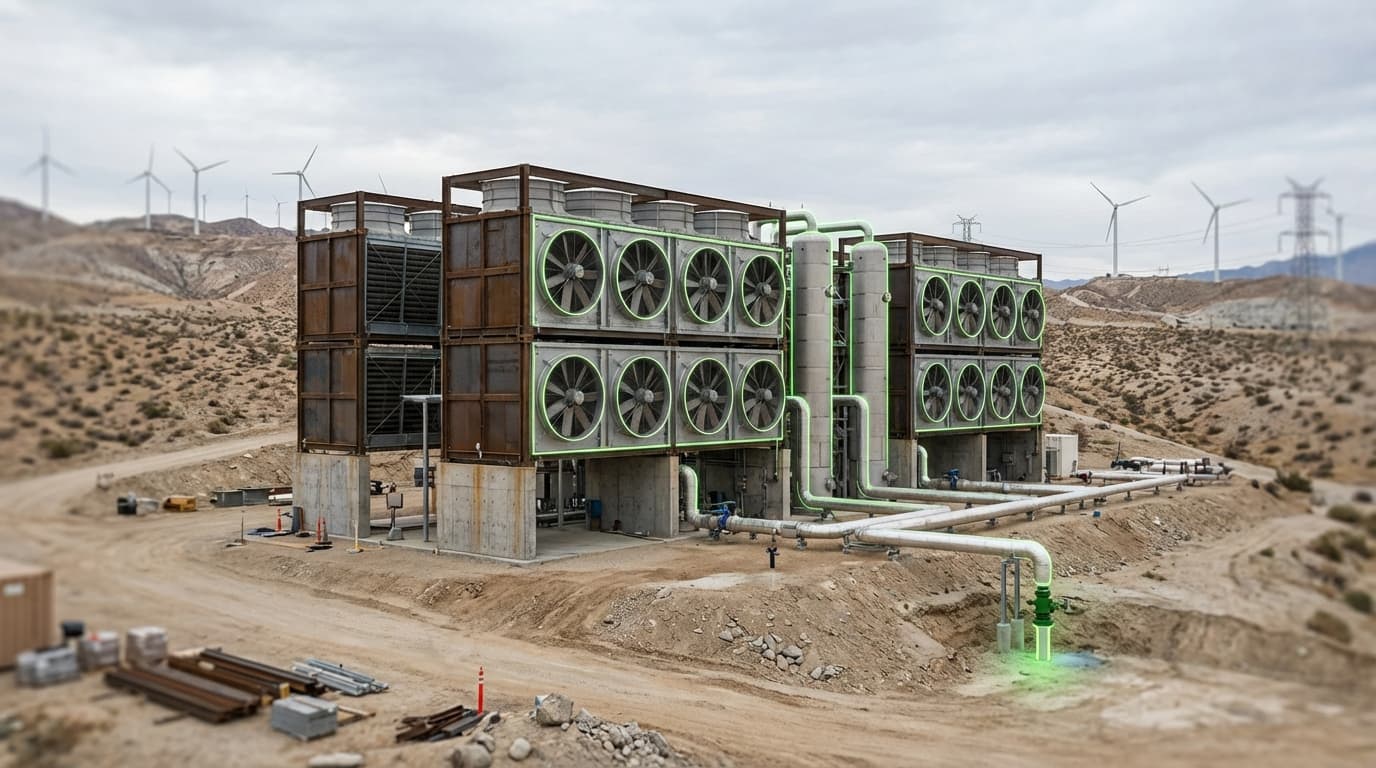
Direct Air Capture Plants
Commercial DAC hubs scale up contactor fields, regeneration trains, and CO₂ handling systems to capture millions of tonnes annually. Plants in Iceland (Orca/Mammoth), Texas (Stratos), and Kenya pair solid sorbents or liquid solvents with waste heat, renewable power, and on-site compression. Captured CO₂ is mineralized in basalt, injected into saline aquifers, or delivered via pipelines to Class VI wells for permanent storage. Developers integrate water recycling, heat recovery, and automation to cut operating costs.
Corporate buyers—tech, aviation, consumer brands—sign multi-year offtake agreements for high-durability removal credits, often through collectives like Frontier or NextGen. Governments provide tax credits (US 45Q), grants, and Contracts for Difference to underwrite early capacity. DAC hubs co-locate with hydrogen or synthetic-fuel plants to share infrastructure, and oilfield services firms supply drilling, monitoring, and permitting expertise.
Plants are TRL 7 but must overcome high capex/opex, supply-chain bottlenecks for sorbents, and community acceptance. Transparent MRV, environmental monitoring, and workforce development help secure permits. As learning curves drive costs below $300/ton and policy support expands, DAC plants will become a key pillar of hard-to-abate sector mitigation and negative emissions goals.
Related Organizations

A subsidiary of Occidental Petroleum dedicated to commercializing Carbon Engineering's DAC technology.

Operator of the world's largest commercial DAC plants (Orca, Mammoth) using solid sorbent technology.

Provides the geological storage solution for DAC plants by dissolving CO2 in water and injecting it into basaltic rock for mineralization.

Uses limestone (calcium carbonate) looping to capture CO2 from the air, aiming for low-cost, scalable removal.
United States · Startup
Developing modular DAC systems using solid sorbents (zeolites), with a major project (Project Bison) planned in Wyoming.

Global Thermostat
United States · Company
Develops amine-based solid sorbent DAC technology designed for modular deployment.

Developing Direct Air Capture technology in Kenya, leveraging the Great Rift Valley's geothermal energy and basalt formations.

Hybrid DAC technology that produces water as a byproduct rather than consuming it.

Uses an electrochemical process to separate CO2 from air, aiming for high energy efficiency.

Developing a passive sorbent DAC approach that uses a 'carbon orchard' model to reduce energy costs.
Supporting Evidence
Research this in Signals
Signals turns a topic into a sourced research record you can inspect and rerun. Your first scan is free, and this one starts with Direct Air Capture Plants already loaded, so edit it or scan as is.