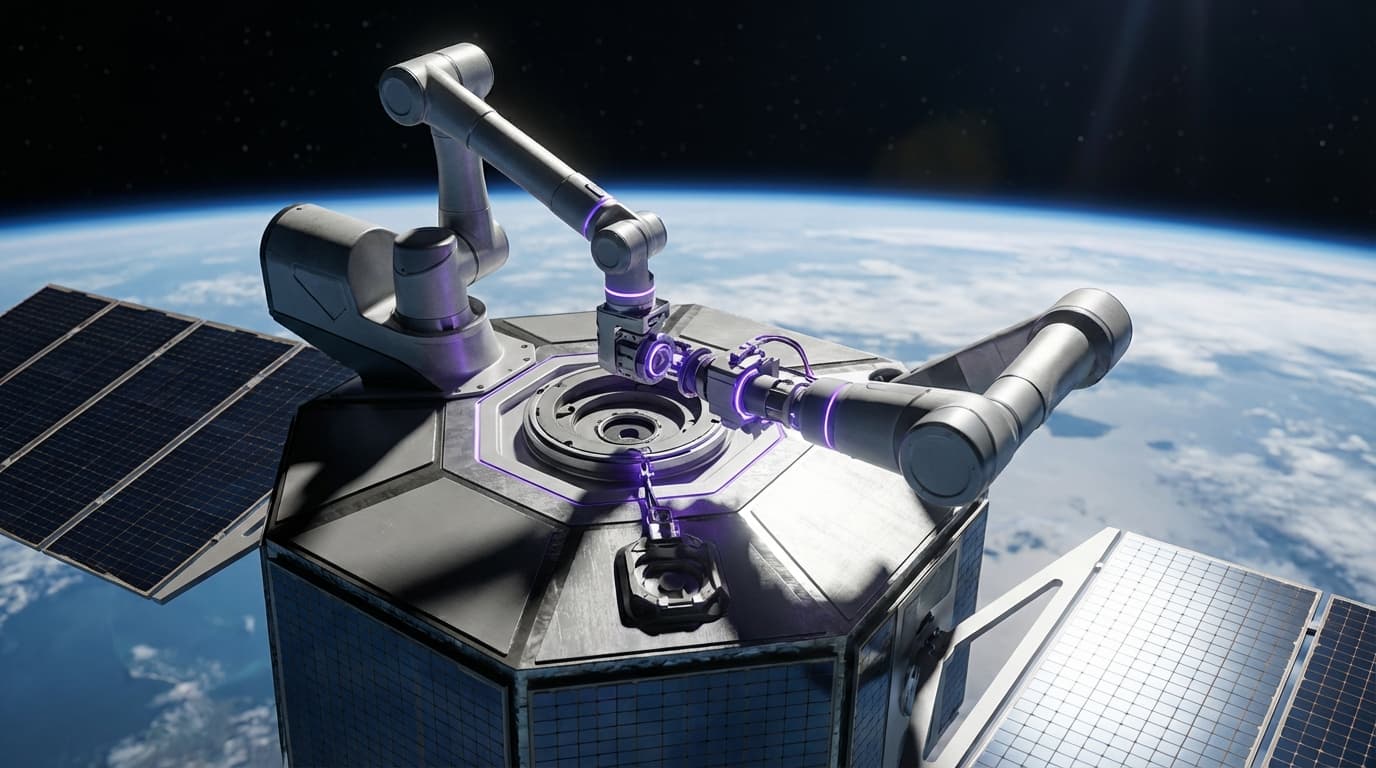
Satellite Servicing Robots
Satellite servicing robots are autonomous or teleoperated spacecraft that can dock with client satellites to perform maintenance, refueling, component replacement, or relocation operations. These systems use robotic arms, docking mechanisms, and specialized tools to extend satellite lifetimes, upgrade capabilities, or move satellites to different orbits or disposal orbits. Commercial companies like Northrop Grumman's Mission Extension Vehicle (MEV) and national space agencies are developing and deploying these capabilities.
This innovation addresses the traditional limitation where satellites are essentially disposable, with no ability to repair, refuel, or upgrade them after launch. By enabling on-orbit servicing, these systems can dramatically extend satellite lifetimes, reduce the need for replacement launches, and enable new business models. Insurance markets are beginning to factor servicing availability into mission pricing, recognizing the value of extending satellite operations.
The technology is transforming the satellite industry, enabling new business models where satellites can be maintained and upgraded rather than replaced. As servicing capabilities improve and become more common, they could fundamentally change how satellites are designed and operated, with satellites designed for serviceability from the start. The technology also enables new capabilities like on-orbit assembly, component upgrades, and active debris removal. However, ensuring safe docking, developing standardized interfaces, and creating viable business models remain challenges that must be addressed for widespread adoption.
Related Organizations

Market leader in satellite servicing and long-term orbital sustainability, known for the ELSA-d demonstration mission.

Swiss startup selected by ESA for the ClearSpace-1 mission to remove a Vega payload adapter from orbit.

Developing Canadarm3, the robotic system for the Lunar Gateway.

Major defense contractor developing Reciprocal Quantum Logic (RQL) for cryogenic computing.

A research and development agency of the United States Department of Defense.

Developing general-purpose space robots for on-orbit servicing and assembly.

Specializes in space-rated robotic arms and motion control systems for servicing missions (e.g., OSAM-1, Mars 2020).

Developing the Otter servicing vehicle for satellite life extension and transport.

Developing the 'Gas Stations in Space' architecture, including the RAFTI fueling port standard and fuel depots.

Building 'Orbots' equipped with AI to inspect, characterize, and eventually service or remove space assets.

Space logistics company offering decommissioning services and developing technology to remove satellites at end-of-life.

Developing Helios, a high-energy kick stage/tug for GEO and cislunar transfer.
Supporting Evidence
Research this in Signals
Signals turns a topic into a sourced research record you can inspect and rerun. Your first scan is free, and this one starts with Satellite Servicing Robots already loaded, so edit it or scan as is.