










Galactic Refueling Stations
In-Space Refueling Depots
Orbital fuel stations that store and transfer propellant between spacecraft in orbit
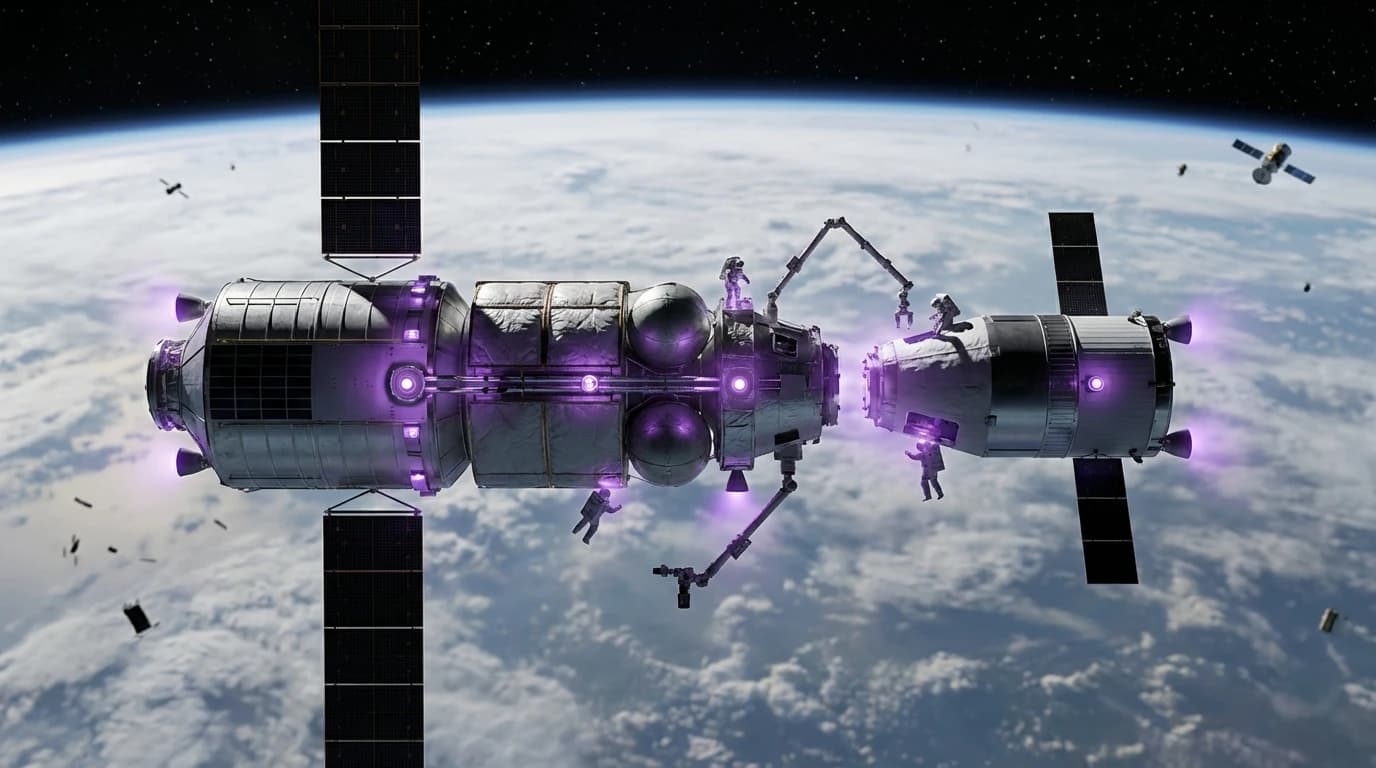
In-space refueling depots are networks of orbital propellant storage facilities and tanker vehicles that store cryogenic fuels (like liquid hydrogen and oxygen) and transfer them between spacecraft in orbit. By decoupling the launch phase from in-space propulsion requirements, these depots enable fully reusable spacecraft architectures, higher payload fractions (since spacecraft don't need to carry all their propellant from launch), and flexible mission profiles that can be refueled for extended operations or redirected to different destinations.
This innovation addresses the fundamental constraint where spacecraft must carry all their propellant from launch, limiting mission capabilities and requiring larger, more expensive launch vehicles. By enabling refueling in space, these depots allow spacecraft to be launched with minimal propellant, then refueled for their missions, dramatically increasing mission flexibility and enabling architectures that would be impossible otherwise. NASA and commercial companies are developing these capabilities for applications including lunar missions, Mars exploration, and satellite servicing.
The technology is essential for enabling sustainable deep-space exploration, where refueling depots can serve as logistics hubs supporting multiple missions. As reusable spacecraft become more common, refueling depots become critical infrastructure that enables new mission concepts and reduces overall mission costs. However, the technology faces challenges including long-term cryogenic storage, safe transfer operations, and the economics of maintaining depots. The technology represents a fundamental shift toward space logistics infrastructure, but requires significant development and demonstration before becoming operational. Success could transform space exploration by enabling more flexible, cost-effective mission architectures.
TRL
4/9Formative
Impact
5/5
Investment
4/5
Category
hardware
Related Organizations
Conducts advanced demonstrations like LCRD (Laser Communications Relay Demonstration) and DSOC (Deep Space Optical Comm).
Investor
Developing the 'Gas Stations in Space' architecture, including the RAFTI fueling port standard and fuel depots.
Developer
Specializes in Cryogenic Fluid Management (CFM) systems and is developing the LOXSAT propellant depot demonstrator.
Developer
Deploys optical inter-satellite links (lasers) on Starlink satellites to reduce latency and ground station dependence.
Developer

Blue Origin
United States · Company
Aerospace manufacturer developing the 'Blue Alchemist' technology to produce solar cells and transmission wire from lunar regolith simulants.
Developer
Developing the Otter servicing vehicle for satellite life extension and transport.
Developer
Market leader in satellite servicing and long-term orbital sustainability, known for the ELSA-d demonstration mission.
Developer
Major defense contractor developing Reciprocal Quantum Logic (RQL) for cryogenic computing.
Developer
Developing autonomous navigation solutions and servicing vehicles for GEO life extension.
Developer
Specializes in space situational awareness and autonomous navigation using onboard hardware.
Developer
Partnered with NASA to flight test LOFTID on an Atlas V rocket and studies engine recovery via inflatables.
Researcher
What was expected
Published forecasts about this technology, graded against what happened in Hindsight.
Supporting Evidence
Evidence data is not available for this technology yet.
Research this in Signals
Scan In-Space Refueling Depots for yourself.
Signals turns a topic into a sourced research record you can inspect and rerun. Your first scan is free, and this one starts with In-Space Refueling Depots already loaded, so edit it or scan as is.