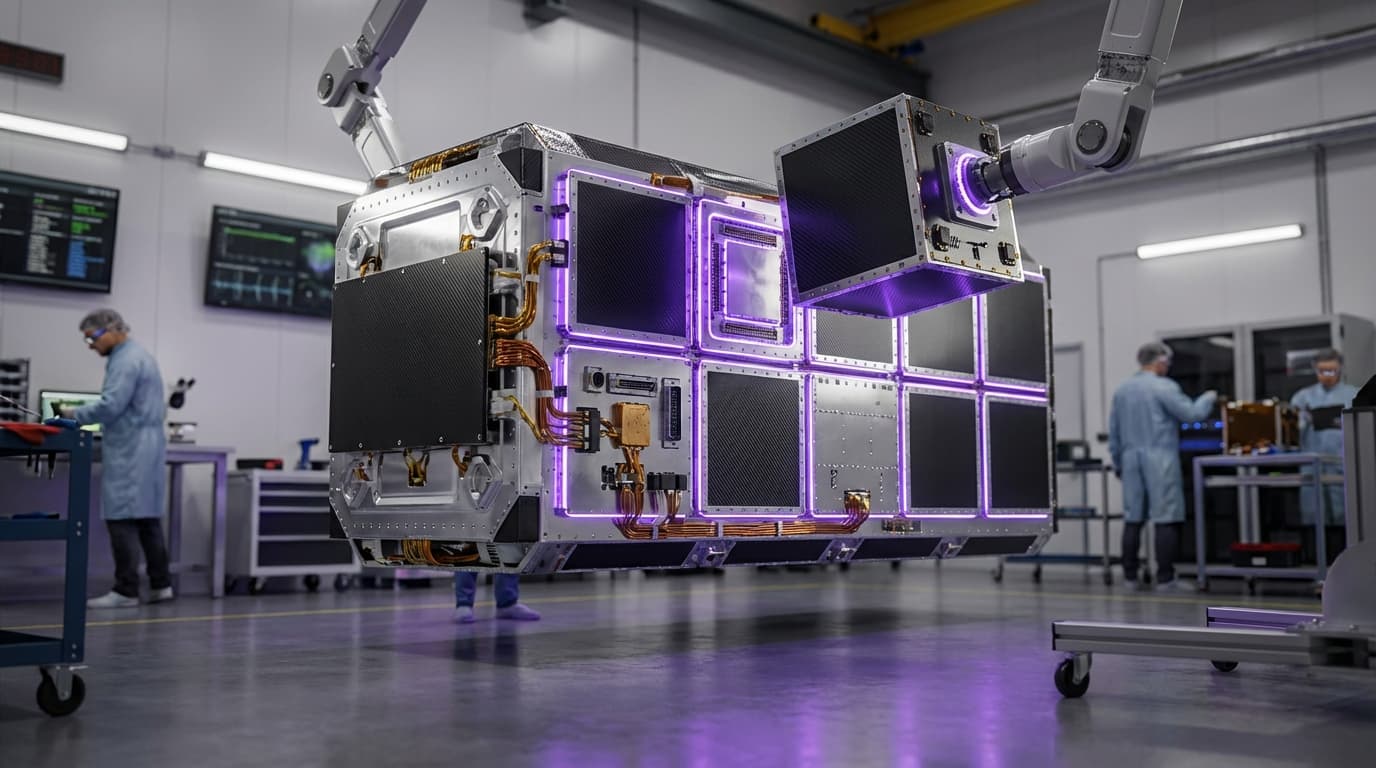
Modular Satellite Architectures
Modular satellite architectures use standardized bus designs with hot-swappable payload modules and standardized docking interfaces, enabling satellites to be rapidly reconfigured for different missions or upgraded on-orbit. These systems combine modular hardware with high-efficiency deployable solar arrays and lightweight thermal management systems, creating satellites that can be customized, serviced, and upgraded without requiring complete redesign or replacement.
This innovation addresses the traditional satellite model where each mission requires a custom design and satellites cannot be easily modified or upgraded after launch. By standardizing interfaces and enabling modularity, these architectures reduce development time and cost while enabling new capabilities like on-orbit servicing, mission reconfiguration, and technology upgrades. Companies and space agencies are developing these capabilities, with some modular satellites already in orbit.
The technology is particularly valuable for commercial satellite operators who need flexibility to adapt to changing market demands and for missions where technology refresh is important. As on-orbit servicing becomes more common, modular architectures enable satellites to be upgraded and maintained, extending their useful life and enabling new capabilities. The technology represents a shift toward more flexible, maintainable space systems that can evolve over time rather than being fixed at launch.
Related Organizations

Manufactures productized, standardized satellite buses (Aries) designed for rapid configuration.

Developed the Intelligent Space System Interface (iSSI) for plug-and-play modular satellite assembly.

The prime contractor for the European Robotic Arm (ERA) currently on the ISS.
CONFERS
United States · Consortium
Consortium for Execution of Rendezvous and Servicing Operations, setting standards for modular servicing.

Produces standardized nanosatellite buses with modular payload interfaces.

Produces the S-Class and LX-Class standardized satellite platforms.

Space logistics company offering decommissioning services and developing technology to remove satellites at end-of-life.

Developing massive, modular satellite buses optimized for heavy-lift launch vehicles.

Developing an open-source, modular microsatellite platform design.

Developing the 'Gas Stations in Space' architecture, including the RAFTI fueling port standard and fuel depots.
Supporting Evidence
Research this in Signals
Signals turns a topic into a sourced research record you can inspect and rerun. Your first scan is free, and this one starts with Modular Satellite Architectures already loaded, so edit it or scan as is.