Tethered Satellite Systems
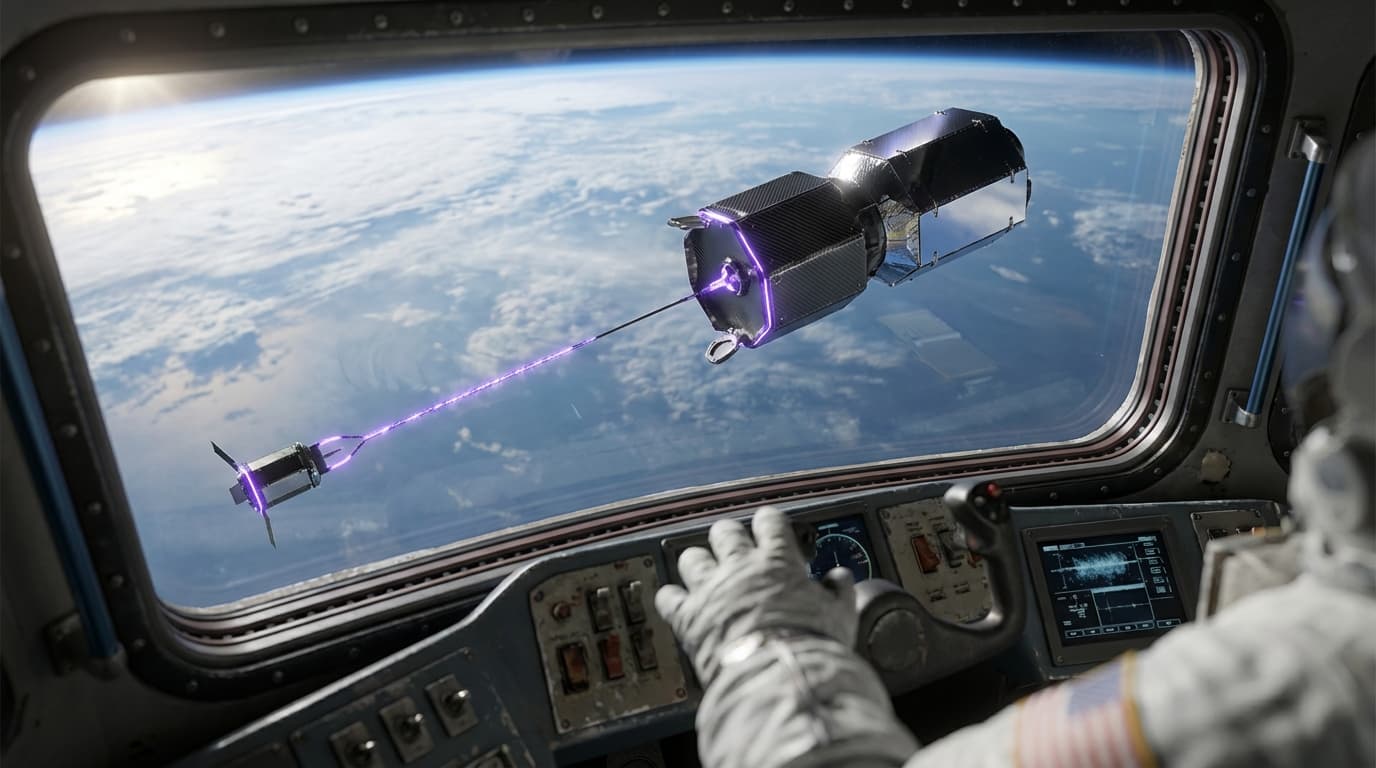
Tethered satellite systems use long, conductive tethers that interact with Earth's magnetic field to generate thrust or drag without consuming propellant. When current flows through the tether, it creates a force through the Lorentz effect, allowing satellites to raise or lower their orbits, maintain station, or deorbit at end-of-life—all without fuel. These systems can be kilometers long and provide a sustainable approach to orbital maneuvering.
This innovation addresses the propellant limitation that constrains satellite operations, where fuel is a finite resource that limits mission lifetime and capabilities. By providing propellant-free propulsion, tethered systems can extend satellite lifetimes indefinitely, enable new mission profiles, and provide a sustainable solution for debris removal. Space agencies and companies are testing these systems for applications including orbital transfer vehicles, constellation maintenance, and active debris removal.
The technology is particularly valuable for large satellite constellations where propellant management is a major operational challenge, and for debris removal missions where the ability to deorbit objects without fuel is essential. As space becomes more crowded and sustainability becomes a priority, tethered systems offer a pathway to more sustainable space operations. However, the technology faces challenges including deployment complexity, tether durability, and the need for reliable current control systems. As these challenges are addressed, tethered systems could become standard technology for sustainable space operations.
Related Organizations
Leading long-term research into SBSP, with plans to demonstrate power transmission from orbit by 2025.

Researching superconducting nanowire electronics for neuromorphic applications.

The corporate research laboratory for the United States Navy and Marine Corps.

A public research university in Dresden, Germany.
Provides low-cost access to space using stratospheric balloons.
Supporting Evidence
Research this in Signals
Signals turns a topic into a sourced research record you can inspect and rerun. Your first scan is free, and this one starts with Tethered Satellite Systems already loaded, so edit it or scan as is.