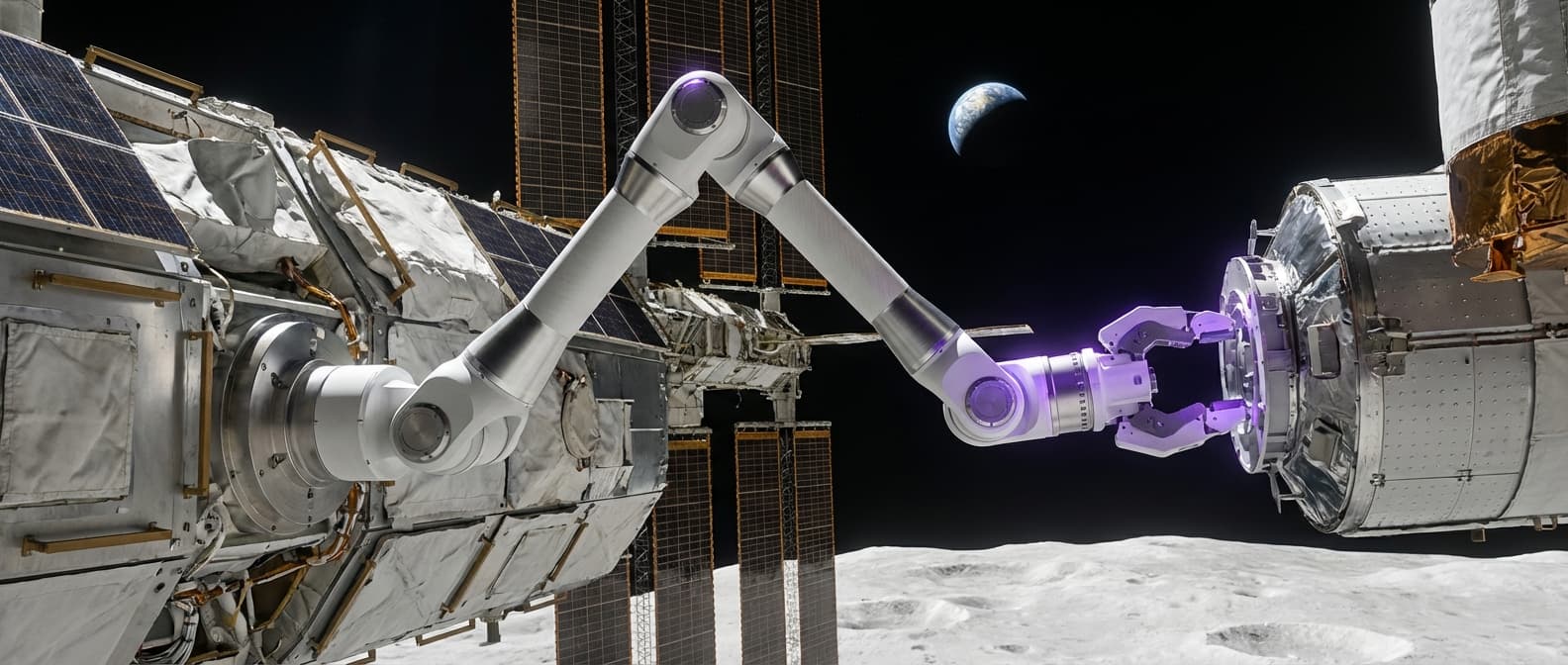
European Robotic Arms
European robotic arms, developed by ESA and building on heritage from the International Space Station's robotic systems, are evolving into sophisticated modular manipulators designed for Gateway, lunar bases, and satellite servicing vehicles. These systems combine precision control, dexterity, and the ability to operate under teleoperation or autonomously, enabling tasks including inspection, assembly, maintenance, and resource handling in space environments.
This innovation addresses the need for robotic capabilities in space operations, where human presence is limited and many tasks require precise manipulation. By developing advanced robotic arms, Europe has created important capabilities for future space infrastructure including the Lunar Gateway, lunar surface operations, and on-orbit servicing. The technology builds on decades of experience with space robotics, particularly from the ISS, and adapts it for new applications.
The technology is essential for enabling sustainable space operations where robots can perform tasks that would be difficult, dangerous, or impossible for humans. As space infrastructure expands and operations become more complex, advanced robotics becomes increasingly important. Europe's leadership in this area provides important capabilities for international space programs and demonstrates the value of building on existing expertise. The technology enables new mission concepts and operational capabilities that will be essential for long-term space exploration and utilization.
Related Organizations

Leads the EAGLE-1 mission and the SAGA program to build a European quantum communication infrastructure in space.

The prime contractor for the European Robotic Arm (ERA) currently on the ISS.

Developing robotic arms for the Mars Sample Return program and the Lunar Gateway.

The national aeronautics and space research center of Germany.

Polish company specializing in robotic grippers and arms for on-orbit servicing.

A major European satellite manufacturer leading the ASCEND feasibility study.

Develops the Hifly satellite control system and other ground segment automation software for major institutional and commercial missions.

Operates the BioFabrication Facility (BFF) on the ISS for printing human tissue.


Engineering firm specializing in mechanisms and harsh environment robotics.
Supporting Evidence
Research this in Signals
Signals turns a topic into a sourced research record you can inspect and rerun. Your first scan is free, and this one starts with European Robotic Arms already loaded, so edit it or scan as is.