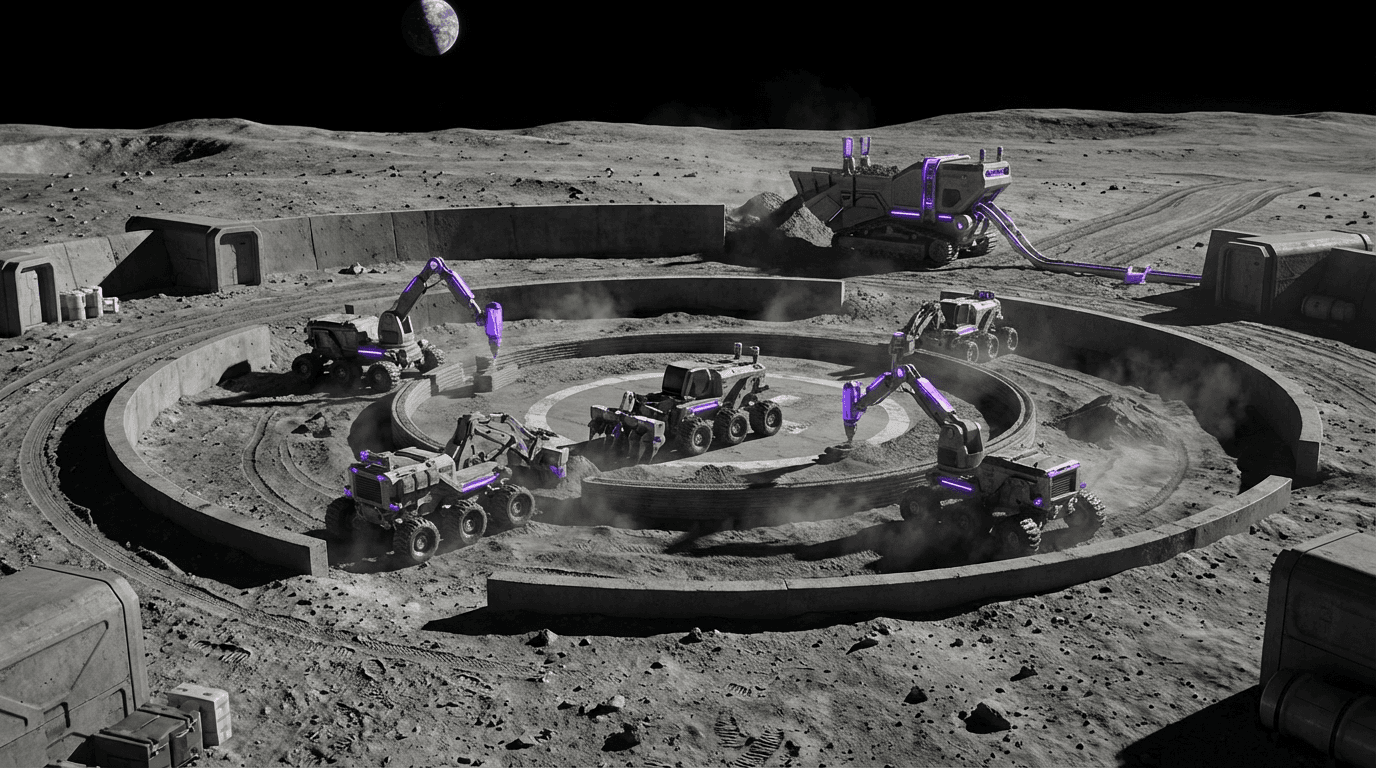
Lunar Surface Construction Robotics
Lunar surface construction robotics encompasses teleoperated and autonomous robotic systems designed to perform construction tasks on the Moon using local materials (regolith), including grading terrain, sintering regolith (heating it to form solid structures), and assembling structures. These systems are key enablers for permanent lunar bases, capable of building radiation berms, landing pads, roads, and other infrastructure without requiring construction materials to be transported from Earth, dramatically reducing the cost and complexity of establishing lunar presence.
This innovation addresses the enormous cost and difficulty of transporting construction materials from Earth to the Moon, where every kilogram costs thousands of dollars to launch. By using local regolith as construction material, these systems enable the construction of large-scale infrastructure that would be impractical if all materials had to come from Earth. The technology is essential for establishing sustainable lunar bases and serves as a model for construction on Mars and other destinations. NASA and commercial companies are developing these capabilities for Artemis and future lunar operations.
The technology is critical for enabling long-term human presence on the Moon, where infrastructure like landing pads, radiation protection, and habitation structures are essential. As lunar exploration expands, construction robotics becomes essential infrastructure. However, the technology faces challenges including operating in the harsh lunar environment, ensuring construction quality, and developing reliable autonomous systems. The technology represents an important capability for space settlement, but requires significant development and demonstration. Success could enable sustainable lunar bases and serve as a stepping stone for Mars settlement, demonstrating how to build infrastructure in space using local materials.
Related Organizations

Honeybee Robotics
United States · Company
Develops advanced robotic systems for planetary exploration, specifically drilling and sampling tools essential for extracting subsurface ice and regolith.

Construction technology company using 3D printing robotics, software, and advanced materials.

Develops lunar landers and rovers (CubeRover, Polaris) designed for excavation and surface operations.

Hosts the Center for Space Resources, a leading academic hub for ISRU research and education.
Develops autonomous lunar rovers designed for resource prospecting and environmental monitoring.

Developing a swarm of AI-powered industrial robots for mining on Earth, with the explicit goal of expanding to the Moon and Mars.

Architecture and technology firm that won NASA's 3D Printed Habitat Challenge with 'MARSHA', a vertical Martian habitat design.

Private lunar exploration company focusing on transportation and resource exploration to establish a lunar economy.

Major construction firm researching the 'Luna Ring' concept and robotic lunar construction methods.

Global architecture firm collaborating with ESA and NASA on lunar habitation concepts involving 3D printing with regolith.
Supporting Evidence
Research this in Signals
Signals turns a topic into a sourced research record you can inspect and rerun. Your first scan is free, and this one starts with Lunar Surface Construction Robotics already loaded, so edit it or scan as is.