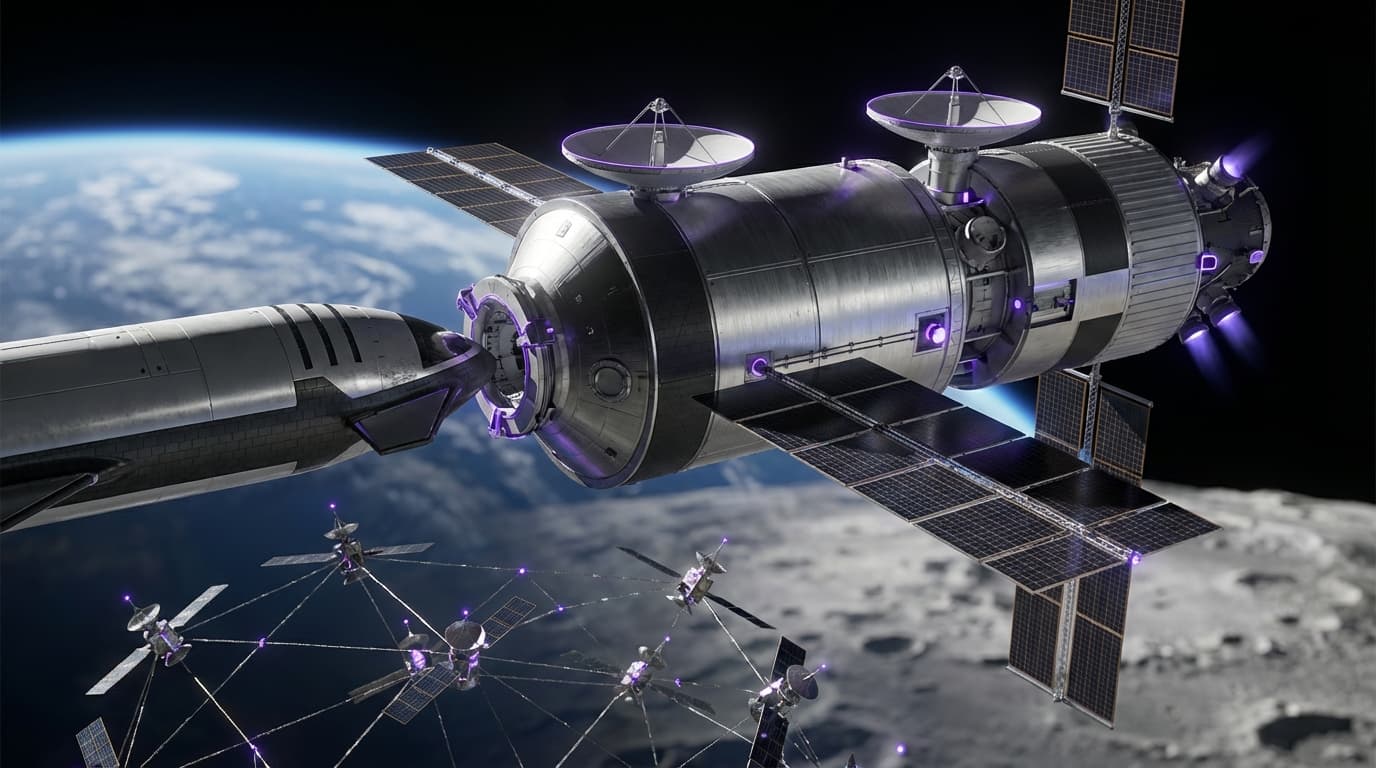
LEO & Lunar Infrastructure
LEO and lunar infrastructure encompasses the development of permanent facilities in Low Earth Orbit and cislunar space, including space stations, lunar communications and navigation constellations (like NASA's proposed LunaNet), and orbital platforms in various orbits including polar and halo orbits. These facilities serve as critical staging grounds for scientific research, logistics operations, technology demonstrations, and support for lunar surface missions and deeper space exploration.
This innovation addresses the need for permanent infrastructure in space to support sustained exploration and operations, rather than relying solely on one-off missions. By building permanent facilities, space agencies and commercial operators can create sustainable operations that support long-term exploration goals. The infrastructure enables new mission concepts, provides services like communications and navigation, and serves as testbeds for technologies needed for deeper space exploration.
The technology represents a shift toward sustainable space exploration, where permanent infrastructure enables ongoing operations rather than discrete missions. As this infrastructure is built and becomes operational, it will enable new capabilities and mission concepts that weren't possible with temporary missions. The infrastructure also creates opportunities for commercial services and international collaboration. However, building and maintaining this infrastructure requires significant investment and long-term commitment. The technology is essential for enabling the next phase of space exploration, where sustained presence in space becomes the norm rather than the exception.
Related Organizations


Provides lunar access, data transmission services, and surface infrastructure.

Major defense contractor developing Reciprocal Quantum Logic (RQL) for cryogenic computing.

Developing the Dream Chaser spaceplane and LIFE habitats to support commercial space activities including manufacturing.

Developing 'Starlab', a free-flying commercial space station.

A Lockheed Martin subsidiary developing 'Parsec', a cislunar communications and navigation network.

Develops lunar landers and rovers (CubeRover, Polaris) designed for excavation and surface operations.

Private lunar exploration company focusing on transportation and resource exploration to establish a lunar economy.
Provides high-resolution Earth imagery and geospatial analytics.

Industrial research lab with a history of fundamental research in condensed matter physics relevant to topological phases.

Developing Haven-1, a commercial space station designed for private astronaut missions.

Manufactures large-scale 'StarMax' space station modules.
Supporting Evidence
Research this in Signals
Signals turns a topic into a sourced research record you can inspect and rerun. Your first scan is free, and this one starts with LEO & Lunar Infrastructure already loaded, so edit it or scan as is.