Planetary Surface Habitats
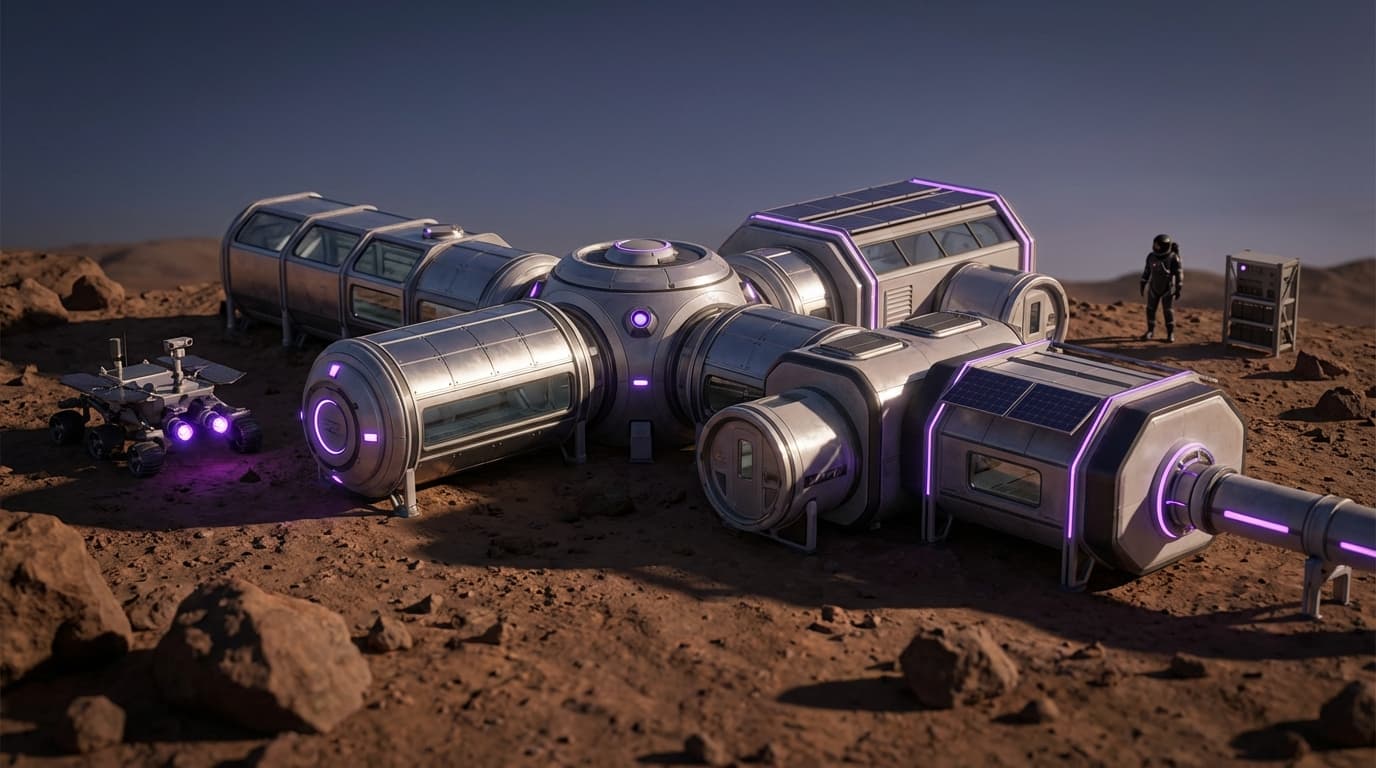
Planetary surface habitats are integrated systems designed for long-term human habitation on the Moon and Mars, combining pressurized living spaces, radiation shielding, thermal control, life support systems, and modular interior layouts. These habitats often integrate multiple approaches including using in-situ materials (like regolith) for construction and shielding, inflatable volumes for expandable living space, and buried or partially-buried structures for additional protection, creating scalable settlement architectures that can grow from initial outposts to larger communities.
This innovation addresses the fundamental challenge of creating safe, comfortable, and sustainable living environments on other worlds, where the harsh environment (radiation, temperature extremes, lack of atmosphere) makes habitation extremely challenging. By integrating multiple protection and life support systems, these habitats enable long-term human presence on the Moon and Mars. NASA and commercial companies are developing these systems for Artemis lunar missions and future Mars exploration.
The technology is essential for enabling long-term human presence on other worlds, where habitats become the foundation for exploration, research, and potentially settlement. As missions extend from days to months to years, habitat design becomes increasingly important for crew health, safety, and mission success. However, the technology faces challenges including the complexity of integrated systems, ensuring reliability over long periods, and the difficulty of construction in space environments. The technology represents a critical capability for human space exploration, but requires significant development and testing. Success could enable sustainable human presence on the Moon and Mars, serving as stepping stones for deeper space exploration and potentially space settlement. The development of effective planetary surface habitats is essential for the future of human space exploration.
Related Organizations

Construction technology company using 3D printing robotics, software, and advanced materials.

Architecture and technology firm that won NASA's 3D Printed Habitat Challenge with 'MARSHA', a vertical Martian habitat design.

Funding and coordinating the Multi-Purpose Habitat (MPH), the first permanent lunar surface module for the Artemis program.

A premier supplier of environmental control and life support systems (ECLSS).

Developing 'EuroHab', an inflatable lunar habitat designed to sit on a lander, providing secondary habitation for astronauts.

Developing the 'Lunar Cruiser' in partnership with JAXA, a pressurized rover that serves as a mobile habitat for astronauts.

Architecture firm partnering with ICON and NASA on Project Olympus to design the layout and structure of 3D printed lunar bases.

Global architecture firm collaborating with ESA and NASA on lunar habitation concepts involving 3D printing with regolith.

An international design practice that explicitly incorporates 'more than human' design principles into major urban infrastructure and landscape architecture projects.

A space architecture startup focused on human-centered design for extreme environments and planetary habitats.
Supporting Evidence
Research this in Signals
Signals turns a topic into a sourced research record you can inspect and rerun. Your first scan is free, and this one starts with Planetary Surface Habitats already loaded, so edit it or scan as is.