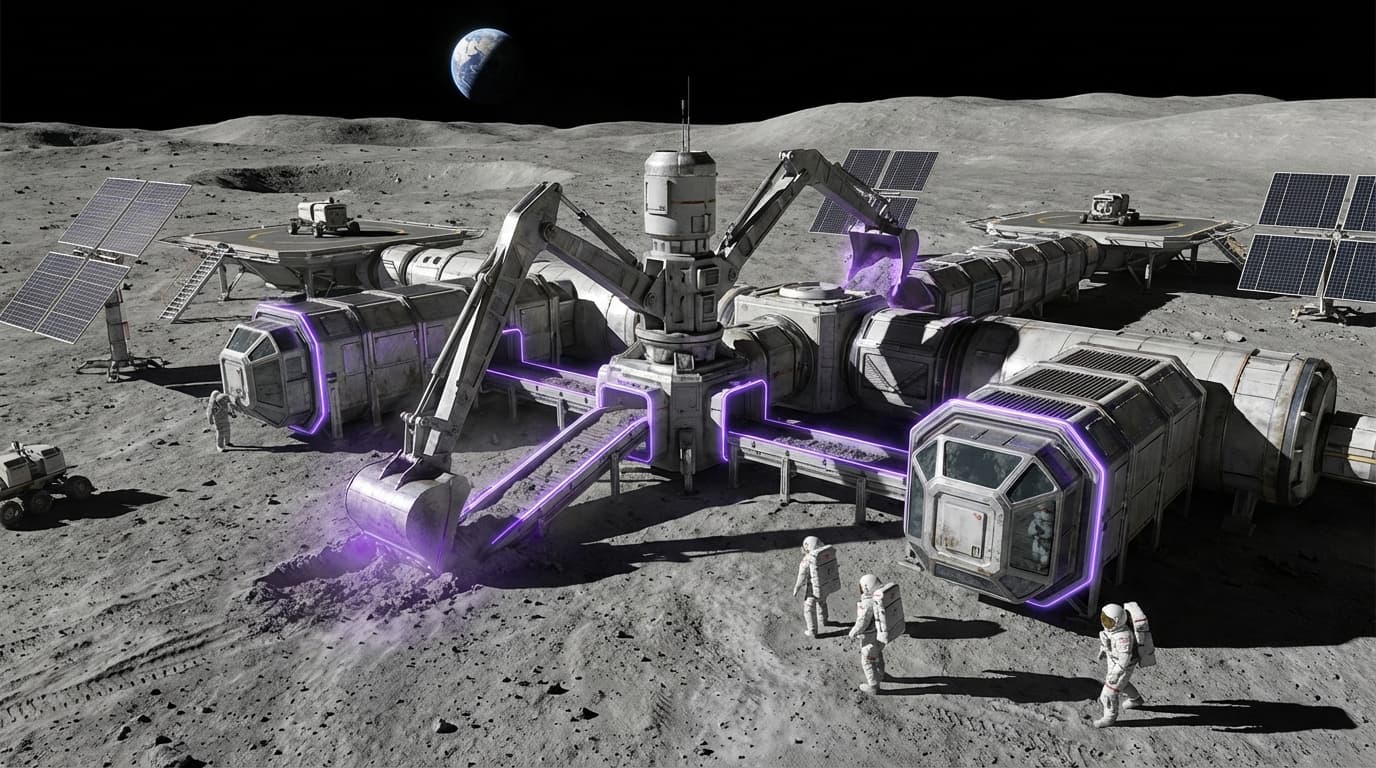
Lunar Regolith Processing Plants
Lunar regolith processing plants use in-situ resource utilization (ISRU) technologies to extract valuable materials from lunar soil, including oxygen for life support and rocket propellant, silicon for solar panels, and metals for construction. These systems use various processing methods including microwave sintering (heating regolith with microwaves), molten regolith electrolysis (passing electric current through melted regolith), and carbothermal reduction (using carbon to extract metals), creating a sustainable resource base on the Moon.
This innovation addresses the enormous cost of transporting materials from Earth to the Moon, where every kilogram costs thousands of dollars to launch. By manufacturing materials on the Moon, these systems can dramatically reduce the cost and complexity of lunar operations, enabling sustainable lunar bases and serving as a stepping stone for deeper space exploration. NASA and commercial companies are developing these technologies, with some pilot plants planned for early Artemis missions.
The technology is essential for establishing sustainable human presence on the Moon and enabling deeper space exploration, where the Moon can serve as a refueling and supply depot. As these systems mature, they could enable large-scale lunar operations, space-based manufacturing, and serve as a model for resource utilization on Mars and other destinations. The technology represents a fundamental shift toward using space resources rather than bringing everything from Earth, which is essential for long-term space exploration and settlement.
Related Organizations

Blue Origin
United States · Company
Aerospace manufacturer developing the 'Blue Alchemist' technology to produce solar cells and transmission wire from lunar regolith simulants.

Hosts the Center for Space Resources, a leading academic hub for ISRU research and education.

Developing technology to extract oxygen and metals from lunar regolith using a molten regolith electrolysis reactor.

Honeybee Robotics
United States · Company
Develops advanced robotic systems for planetary exploration, specifically drilling and sampling tools essential for extracting subsurface ice and regolith.

Developing technologies for on-orbit and lunar surface manufacturing, including extraction of metals from regolith.

Construction technology company using 3D printing robotics, software, and advanced materials.

Adapting their FFC electrochemical process to extract oxygen and metal powders from lunar regolith for ESA.

Operates the BioFabrication Facility (BFF) on the ISS for printing human tissue.

The prime contractor for the European Robotic Arm (ERA) currently on the ISS.

Developing a swarm of AI-powered industrial robots for mining on Earth, with the explicit goal of expanding to the Moon and Mars.

A major European satellite manufacturer leading the ASCEND feasibility study.
Supporting Evidence
Research this in Signals
Signals turns a topic into a sourced research record you can inspect and rerun. Your first scan is free, and this one starts with Lunar Regolith Processing Plants already loaded, so edit it or scan as is.