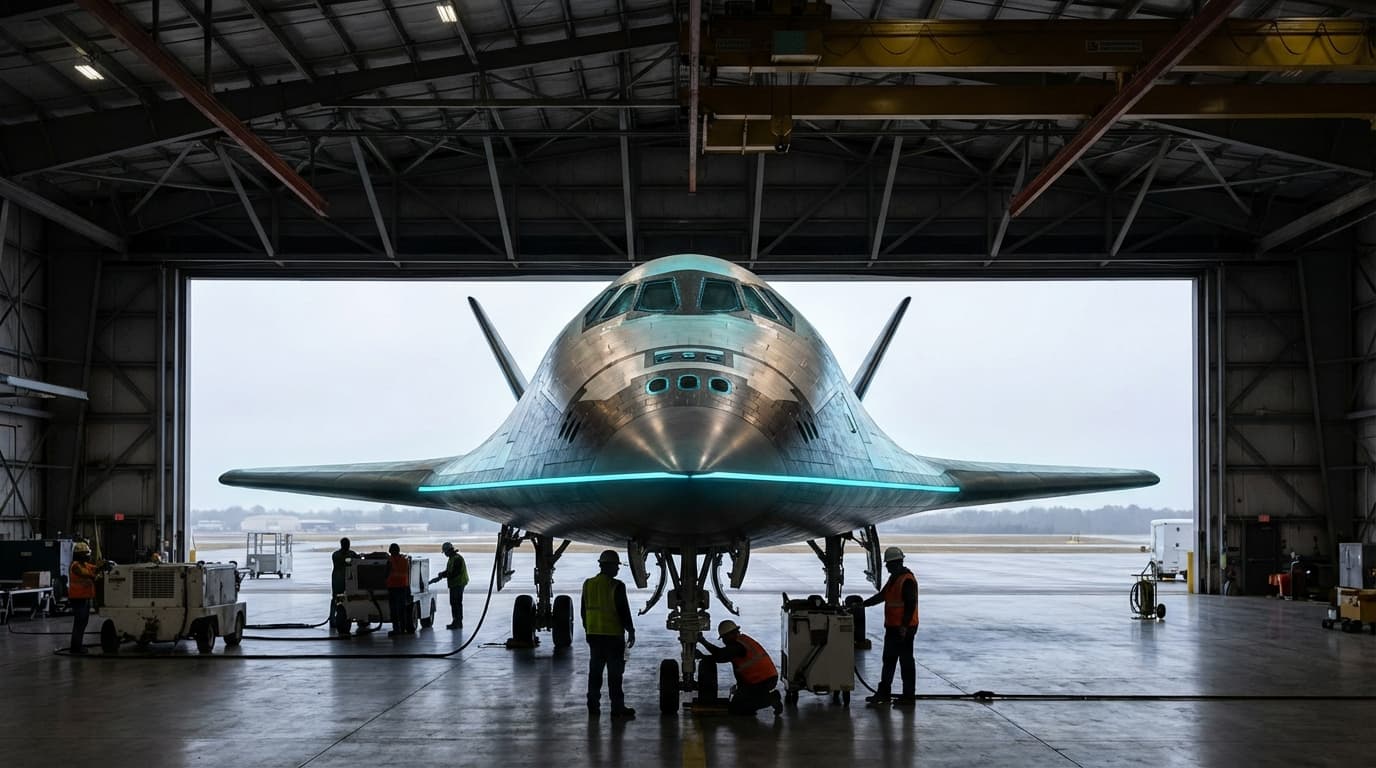
Hypersonic & Space Plane Vehicles
Hypersonic and space plane vehicles represent a new category of aerospace technology designed to operate at speeds exceeding Mach 5—five times the speed of sound—or to reach the edge of space and return. These aircraft rely on advanced propulsion systems fundamentally different from conventional jet engines. Scramjets, or supersonic combustion ramjets, compress incoming air at hypersonic speeds and burn fuel in a supersonic airflow, eliminating the need for heavy turbomachinery. Rocket-based combined-cycle systems integrate traditional rocket engines with airbreathing components, allowing vehicles to transition between atmospheric and exoatmospheric flight regimes. The technical challenge lies in managing extreme aerodynamic heating—surface temperatures can exceed 2,000 degrees Celsius—requiring novel thermal protection materials such as ultra-high-temperature ceramics and actively cooled structures. Propulsion integration demands precise control of airflow, combustion stability, and thrust vectoring across vastly different flight conditions, from subsonic takeoff to hypersonic cruise or suborbital trajectories.
The aviation industry faces persistent limitations in long-haul travel times and access-to-space costs that hypersonic vehicles could fundamentally address. Current subsonic aircraft require 15 to 18 hours for intercontinental routes like New York to Sydney, while orbital launch systems remain expensive and largely expendable. Hypersonic aircraft promise to reduce such journeys to under two hours, transforming global business travel, emergency response, and time-sensitive cargo delivery. Reusable space planes could lower the cost of satellite deployment and enable point-to-point suborbital passenger services, bypassing traditional air corridors entirely. However, significant obstacles remain: sonic booms generated at hypersonic speeds pose environmental and regulatory challenges, requiring flight path optimization or boom-mitigation technologies. Certification standards for vehicles operating in this unprecedented speed regime do not yet exist, and development costs run into billions of dollars, far exceeding conventional aircraft programs.
Research suggests that both military and commercial entities are pursuing parallel development paths, with defense applications driving much of the early investment in hypersonic technology. China and the United States have conducted numerous test flights of experimental hypersonic glide vehicles and scramjet-powered prototypes, while several aerospace startups are exploring commercial space plane concepts for passenger and cargo markets. Early deployments indicate that initial applications may focus on military reconnaissance, rapid global strike capabilities, and premium passenger services willing to pay substantial fares for drastically reduced travel times. The convergence of reusable rocket technology—demonstrated by recent advances in vertical landing systems—with airbreathing hypersonic propulsion could create hybrid vehicles capable of both atmospheric cruise and orbital insertion. As thermal protection materials mature and propulsion systems achieve greater reliability, hypersonic and space plane vehicles may transition from experimental prototypes to operational systems, potentially reshaping intercontinental travel and space access within the coming decades.
Related Organizations

Startup developing hypersonic aircraft capable of Mach 5 flight using a turbine-based combined cycle engine.

Company providing high-speed flight test services using the Roc carrier aircraft and Talon-A hypersonic vehicles.


Destinus
Switzerland · Startup
A European company developing hydrogen-powered hypersonic aircraft.

Australian aerospace engineering company developing scramjet engines and hypersonic vehicles.

Defense tech startup building hypersonic weapons systems with a focus on rapid iteration.

Developing the Dream Chaser spaceplane and LIFE habitats to support commercial space activities including manufacturing.

Startup developing hypersonic propulsion systems for unmanned aerial vehicles.

Leidos
United States · Company
Integrates digital engineering and digital twin frameworks for major defense programs.
PD Aerospace
Japan · Startup
Japanese space startup developing a reusable suborbital spaceplane with a proprietary pulse detonation engine.
Supporting Evidence
Research this in Signals
Signals turns a topic into a sourced research record you can inspect and rerun. Your first scan is free, and this one starts with Hypersonic & Space Plane Vehicles already loaded, so edit it or scan as is.