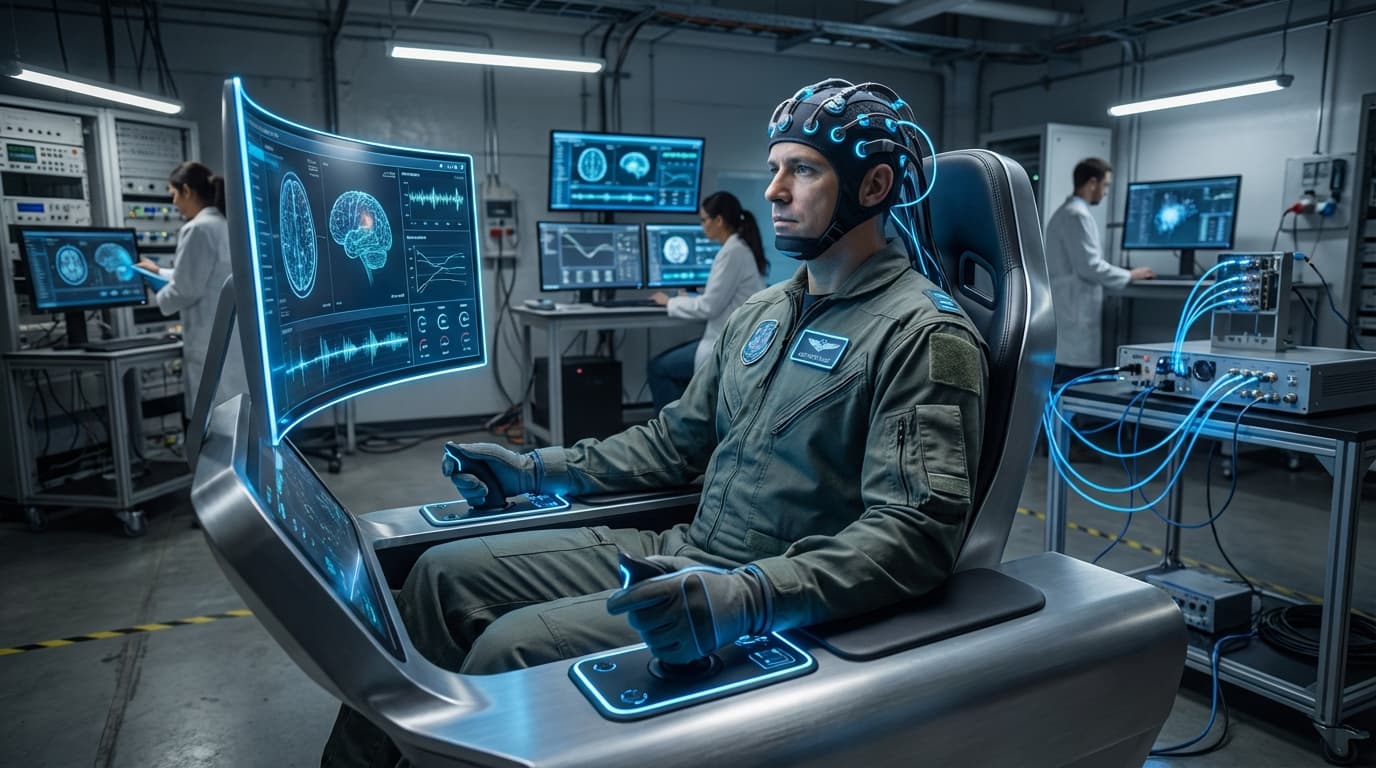
Brain-Computer Interface (BCI) Cockpits
Brain-Computer Interface (BCI) cockpits represent a paradigm shift in aviation human-machine interaction, moving beyond traditional physical controls to establish direct communication pathways between a pilot's neural activity and aircraft systems. These systems employ non-invasive sensors—typically electroencephalography (EEG) headsets integrated into helmets or headbands—to detect and interpret patterns of electrical brain activity. Advanced signal processing algorithms analyse these neural signatures to assess cognitive states such as workload levels, attention focus, fatigue onset, and decision-making processes. The technology operates by identifying specific brainwave patterns associated with different mental states: alpha waves indicating relaxation, beta waves reflecting active concentration, and theta waves suggesting drowsiness. This continuous neural monitoring enables the cockpit environment to function as an adaptive interface, automatically adjusting display complexity, redistributing tasks to automation systems, or issuing alerts when cognitive overload or diminished attention is detected.
The aviation industry faces persistent challenges related to pilot cognitive limitations during high-stress scenarios, extended flights, and information-dense operations. Traditional cockpit designs require pilots to process vast amounts of visual information while simultaneously manipulating physical controls, creating bottlenecks in reaction time and increasing susceptibility to human error during critical phases of flight. BCI technology addresses these constraints by creating a more intuitive control paradigm where intent can be translated into action without the intermediate step of physical manipulation. This capability proves particularly valuable in military aviation contexts, where split-second decisions can determine mission outcomes, and in commercial aviation's push toward single-pilot operations for certain aircraft categories. By providing objective, real-time data on pilot cognitive state, BCIs enable more intelligent automation handoffs, ensuring that aircraft systems assume control when human operators are approaching cognitive limits rather than relying solely on pilot self-assessment or arbitrary time-based protocols.
Research institutions and aerospace manufacturers are currently exploring BCI applications through simulator studies and limited flight testing, with military programs leading development efforts due to their tolerance for experimental technologies and access to specialised pilot populations. Early implementations focus on passive monitoring—using neural data to inform rather than control—while more ambitious direct control applications remain largely experimental. The technology aligns with broader aviation trends toward increasingly autonomous systems and human-machine teaming, where the pilot's role evolves from manual operator to cognitive supervisor. However, the path forward requires addressing substantial challenges beyond technical feasibility, including certification frameworks for neuro-responsive systems, standardisation of neural interface protocols, and resolution of concerns regarding neural data privacy, potential cognitive manipulation, and the psychological implications of systems that continuously monitor pilots' mental states. As these technologies mature, they promise to fundamentally reshape the relationship between human cognition and flight control, potentially enabling new categories of aircraft that leverage human decision-making while compensating for physiological limitations.
Related Organizations

Leading aerospace university with a specialized Neuroergonomics and Human Factors department.

A global leader in industrial technology and aerospace manufacturing.

A major European satellite manufacturer leading the ASCEND feasibility study.

Conducts military research on pilot state monitoring and neural interfaces.

The innovation center of Airbus in Silicon Valley, focusing on Wayfinder and autonomy projects.


Home to the Center for Functional Fabrics (CFF).

Provides advanced sensors and physiological monitoring equipment.

Produces EEG headsets and the BCI-OS platform, allowing developers to build applications that respond to cognitive stress and facial expressions.
Supporting Evidence
Research this in Signals
Signals turns a topic into a sourced research record you can inspect and rerun. Your first scan is free, and this one starts with Brain-Computer Interface (BCI) Cockpits already loaded, so edit it or scan as is.