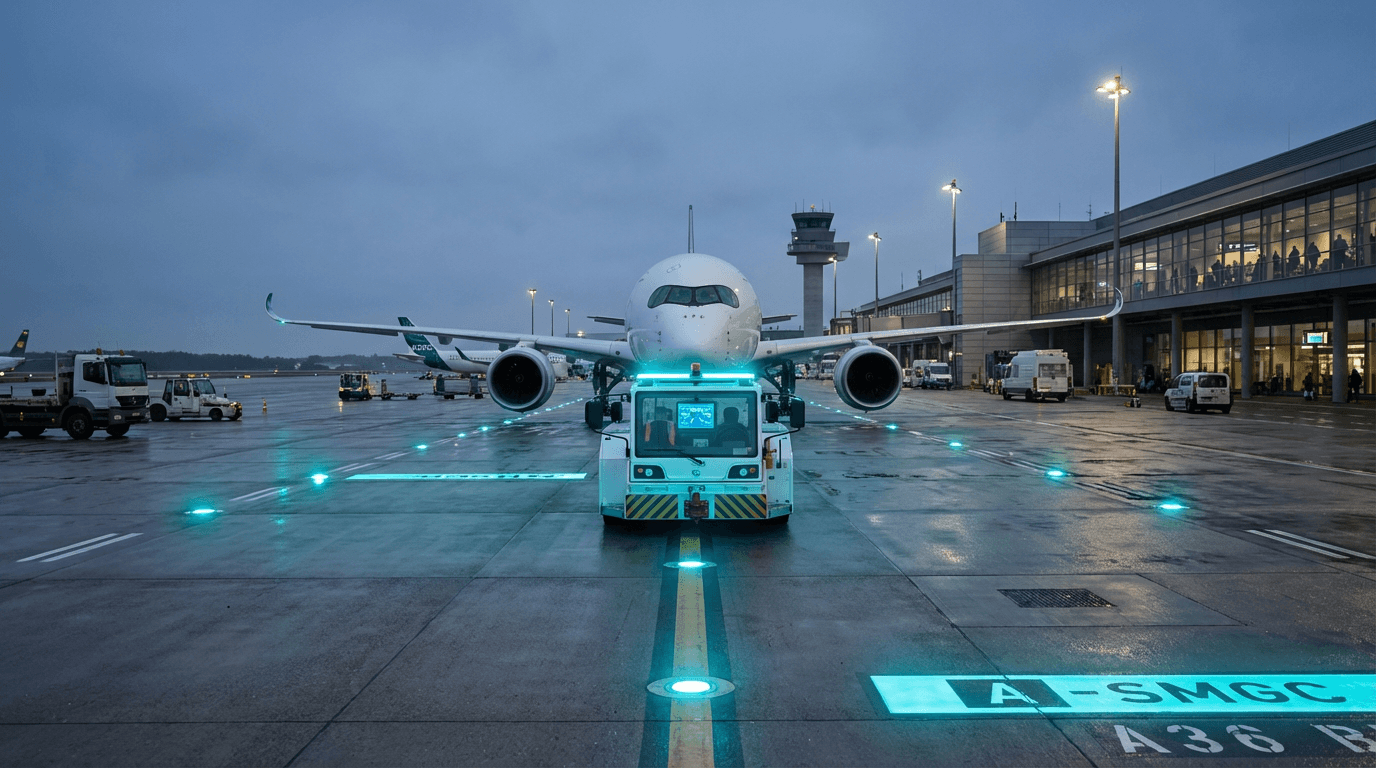
Autonomous Surface Movement & A-SMGCS
Airport surface operations represent one of aviation's most persistent challenges, where the complex choreography of aircraft, ground vehicles, and service equipment creates significant safety risks and operational inefficiencies. Runway incursions—where aircraft, vehicles, or personnel inadvertently enter active runways—remain a leading safety concern, while unpredictable taxi times contribute to fuel waste, passenger delays, and cascading schedule disruptions. Traditional surface management relies heavily on visual observation and radio communication between pilots and ground controllers, a system that becomes severely strained during periods of low visibility, high traffic density, or complex airport layouts. Advanced Surface Movement Guidance and Control Systems (A-SMGCS) address these limitations through integrated surveillance, routing, guidance, and control capabilities. These systems combine multiple data sources including surface movement radar, multilateration sensors, Automatic Dependent Surveillance-Broadcast (ADS-B) receivers, and airport lighting controls to create a comprehensive real-time picture of all surface traffic. The technology operates across four progressive levels, from basic surveillance to fully automated conflict detection and resolution, with higher levels incorporating predictive algorithms that anticipate potential conflicts before they develop.
The aviation industry faces mounting pressure to increase airport capacity without compromising safety, particularly as air traffic volumes continue to recover and grow beyond pre-pandemic levels. A-SMGCS directly addresses this challenge by enabling airports to maintain or even increase throughput during conditions that would traditionally require reduced operations. During low-visibility conditions such as fog or heavy precipitation, these systems allow airports to continue near-normal operations by providing controllers and pilots with precise position information and automated routing guidance. The technology also tackles the economic burden of inefficient surface operations, where aircraft spend excessive time taxiing with engines running, burning fuel and generating emissions. By optimising taxi routes and reducing holding times, A-SMGCS can significantly decrease fuel consumption and associated costs while supporting environmental sustainability goals. Furthermore, the system's conflict detection capabilities serve as a critical safety net, alerting controllers to potential runway incursions or taxiway conflicts seconds before they might occur, providing crucial time for intervention.
Major international airports have begun deploying various levels of A-SMGCS capability, with European airports generally leading adoption due to regulatory frameworks established by EUROCONTROL. These implementations demonstrate measurable improvements in surface operation efficiency and safety metrics, though full automation remains limited to specific operational scenarios. The technology is increasingly being integrated with broader airport collaborative decision-making systems and airline operations centres, creating a more holistic approach to surface management. As autonomous aircraft taxiing technologies mature and regulatory frameworks evolve, A-SMGCS is expected to serve as the foundational infrastructure enabling higher levels of automation on airport surfaces. This progression aligns with broader aviation industry trends toward data-driven operations and reduced human workload, positioning surface automation as a critical enabler for the next generation of airport capacity expansion without requiring extensive physical infrastructure development.
Research this in Signals
Signals turns a topic into a sourced research record you can inspect and rerun. Your first scan is free, and this one starts with Autonomous Surface Movement & A-SMGCS already loaded, so edit it or scan as is.