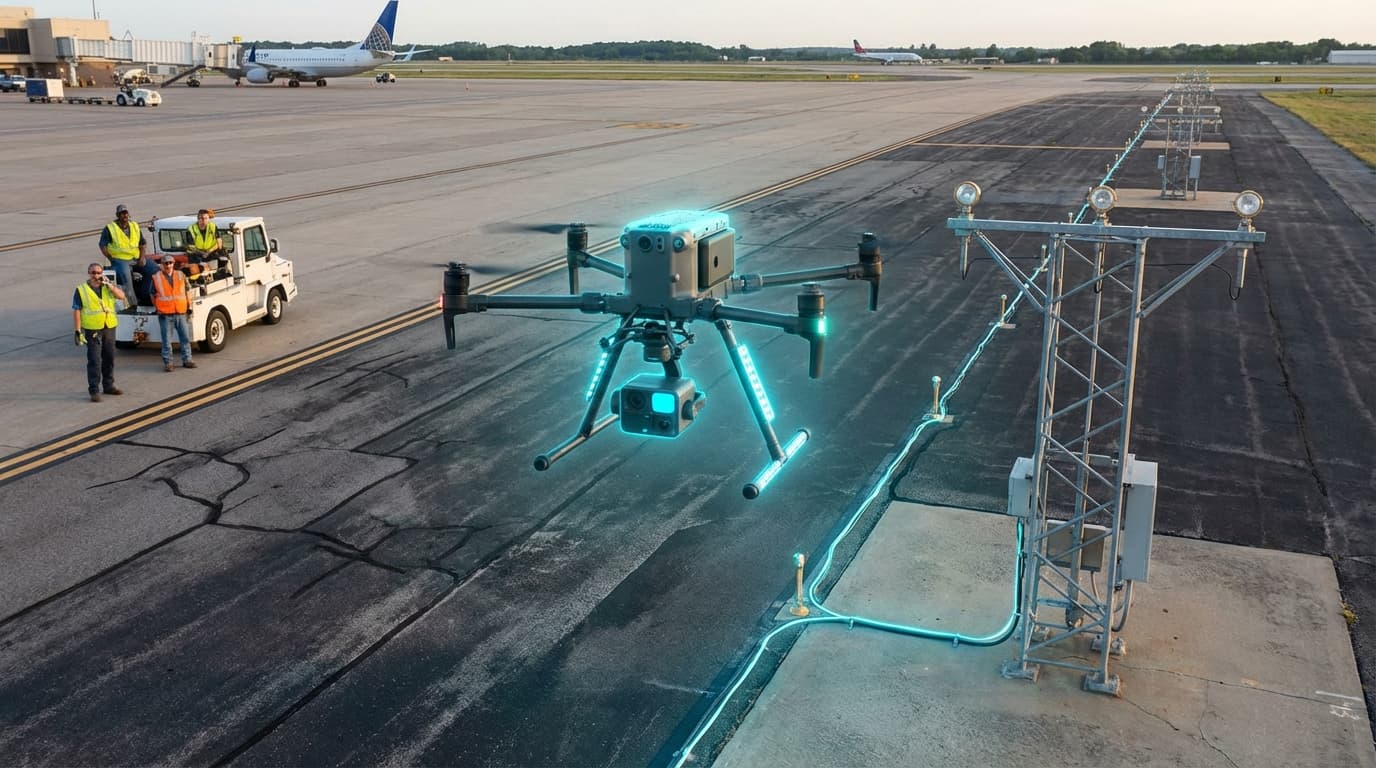
Drone-Based Airport & Infrastructure Inspection
Airport infrastructure demands constant vigilance to maintain safety standards and operational efficiency. Traditional inspection methods for runways, taxiways, lighting systems, perimeter fences, and aircraft exteriors typically require manual walkthroughs, cherry pickers, or even temporary facility closures—processes that are time-consuming, labour-intensive, and costly. Runway inspections alone can disrupt flight schedules, while aircraft exterior checks between flights create tight turnaround pressures for ground crews. Drone-based inspection systems address these challenges by deploying unmanned aerial systems (UAS) equipped with high-resolution cameras, thermal imaging sensors, LiDAR, and photogrammetry capabilities. These platforms can rapidly survey large areas, capturing detailed visual data and generating three-dimensional models of infrastructure. Thermal sensors detect subsurface anomalies in pavement, such as moisture intrusion or delamination, while optical systems identify surface cracks, foreign object debris (FOD), and lighting malfunctions that might escape human observation.
The aviation industry benefits from drone inspections through reduced downtime and enhanced defect detection accuracy. A runway survey that might take hours with ground vehicles can be completed in minutes with a drone, minimising disruption to flight operations and generating revenue losses. For aircraft exterior inspections, drones can examine hard-to-reach areas like tail sections and engine nacelles without requiring scaffolding or hangar repositioning, accelerating pre-flight checks and maintenance cycles. Bridge and taxiway assessments gain similar advantages, with drones accessing structural elements that would otherwise demand lane closures or specialised access equipment. Early deployments indicate that automated image analysis, powered by machine learning algorithms, can flag potential issues such as pavement deterioration or corrosion patterns more consistently than manual inspections, reducing the risk of overlooked defects.
Regulatory frameworks remain a critical factor in widespread adoption. Beyond visual line of sight (BVLOS) operations are essential for covering expansive airport grounds efficiently, yet aviation authorities in many jurisdictions still require case-by-case approvals due to airspace complexity and safety concerns near active runways. Secure communication protocols and geofencing technologies help mitigate risks around critical infrastructure, preventing unauthorised access or interference with manned aircraft. As regulatory pathways mature and integration with airport operations centres improves, drone-based inspection is positioned to become standard practice. The technology aligns with broader industry trends toward predictive maintenance and digital twin modelling, where continuous monitoring data feeds into asset management systems, enabling airports to transition from reactive repairs to proactive infrastructure stewardship.
Related Organizations

Specializes in using drones for the inspection and calibration of airport navigational aids (ILS, PAPI) and runway lights.

Develops automated drone systems for aircraft visual inspections, detecting lightning strikes and structural damage.

MRO provider offering AVIATAR, a digital platform for fleet management and predictive maintenance.

Provides autonomous outdoor drone inspections for aircraft, utilizing LiDAR and visual cameras.

Builds collision-tolerant drones for inspection of confined spaces (sewers, tunnels).

Korean Air
South Korea · Company
Developed a proprietary swarm drone system for inspecting aircraft fuselages, reducing inspection time significantly.

Near Earth Autonomy
United States · Startup
Develops autonomy stacks for drones enabling safe inspection of aircraft and infrastructure in GPS-denied environments.

Develops 'drone-in-a-box' solutions for autonomous industrial and urban monitoring.

US drone manufacturer specializing in autonomous flight and 3D scan software.

A global drone-based enterprise solutions provider, specializing in data-driven infrastructure inspection.
Supporting Evidence
Research this in Signals
Signals turns a topic into a sourced research record you can inspect and rerun. Your first scan is free, and this one starts with Drone-Based Airport & Infrastructure Inspection already loaded, so edit it or scan as is.