Airport Robotics & Turnaround Automation
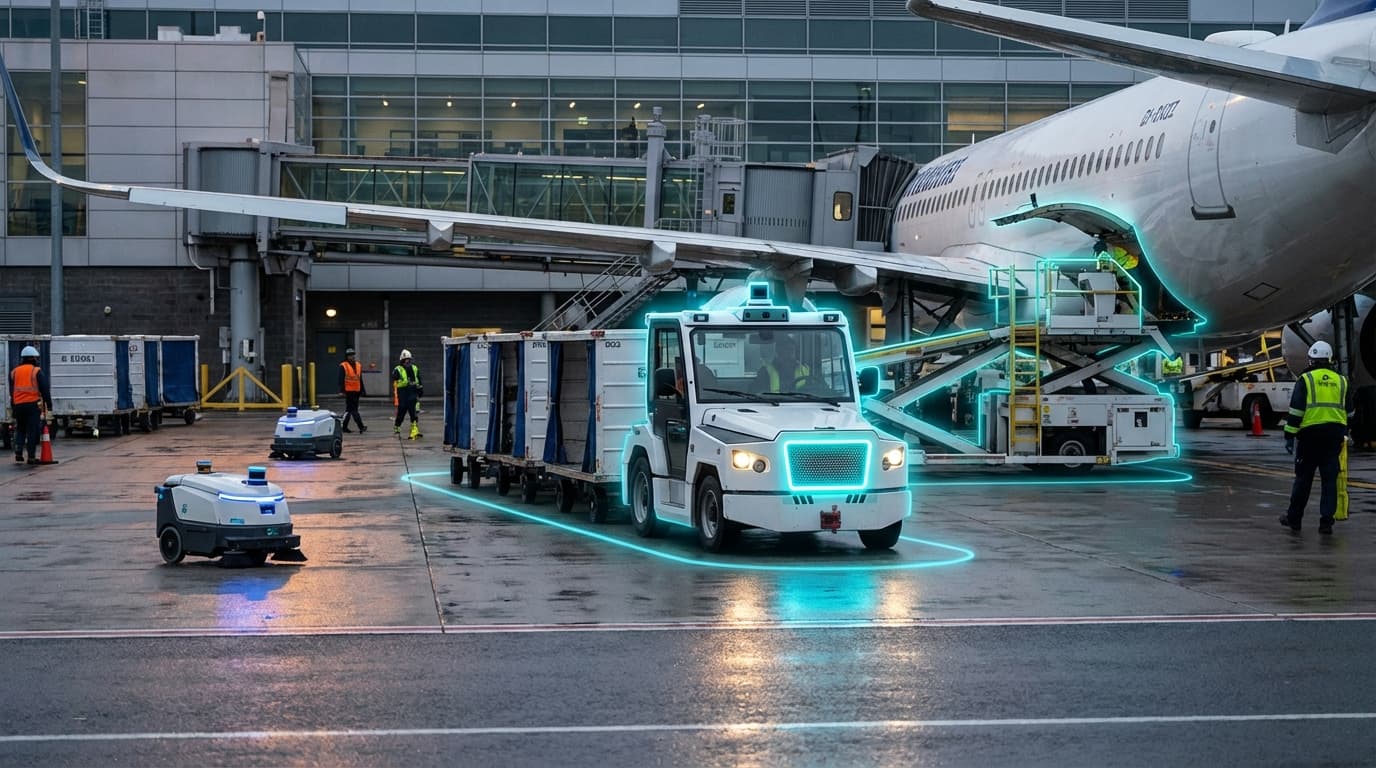
Airport turnaround operations—the complex choreography of servicing an aircraft between flights—represent one of the most time-sensitive and labor-intensive processes in commercial aviation. Traditional ground handling relies heavily on manual labor for tasks ranging from baggage loading and cargo handling to cabin cleaning, aircraft inspection, and refueling coordination. These operations are not only physically demanding but also prone to human error and injury, with ground crew members facing risks from heavy lifting, equipment operation in confined spaces, and working in all weather conditions around active aircraft. The introduction of robotics and automation into this domain addresses these challenges through a combination of autonomous mobile robots, automated guided vehicles (AGVs), robotic arms for cargo manipulation, and sensor-equipped inspection drones. These systems leverage computer vision, machine learning algorithms, and real-time data integration to perform repetitive tasks with greater consistency and speed than human crews alone.
The economic imperative driving airport robotics adoption is substantial. Every minute an aircraft remains on the ground represents lost revenue opportunity for airlines operating on razor-thin profit margins. Delays cascade through networks, affecting dozens of subsequent flights and generating costs in crew overtime, passenger compensation, and missed connections. Robotics solutions promise to compress turnaround windows by executing parallel tasks simultaneously—autonomous cleaning robots can sanitize cabins while baggage handling systems load cargo holds, and inspection drones can conduct visual checks of aircraft exteriors without requiring scaffolding or manual walkarounds. Beyond speed improvements, automation standardizes processes that previously varied with crew experience and fatigue levels, reducing the variability that leads to operational disruptions. The technology also addresses persistent labor shortages in ground handling, an industry struggling with high turnover rates and physically demanding working conditions. By automating the most strenuous tasks, airports can redeploy human workers to supervisory roles and exception handling, improving both safety records and job satisfaction.
Early deployments of airport robotics are already visible at major international hubs, where autonomous floor-cleaning machines navigate terminal concourses during off-peak hours and semi-automated baggage systems reduce manual handling points. Some airports are piloting robotic tugs that can position aircraft at gates with centimeter-level precision, eliminating the need for human marshals in potentially hazardous positions near jet engines. Cargo facilities are experimenting with robotic palletizers and automated storage and retrieval systems that integrate directly with airline operations control centers, enabling dynamic load planning based on real-time weight and balance calculations. The trajectory of this technology points toward fully orchestrated turnaround operations where ground support equipment communicates autonomously, coordinating movements to minimize aircraft downtime while maintaining safety margins. As airports face growing passenger volumes and pressure to increase gate utilization without expanding physical infrastructure, robotics and automation emerge as essential enablers of operational density. The integration of these systems with broader airport management platforms—linking stand planning, gate allocation, fuel scheduling, and crew rostering—represents a fundamental shift toward treating airport operations as a unified, data-driven system rather than a collection of independent manual processes.
Related Organizations

Develops autonomous baggage and passenger transport vehicles specifically for aviation environments.

A global market leader for value-added logistic process automation at airports and in the parcel market.

Uses computer vision and AI to monitor and optimize turnaround operations in real-time.

A high-tech company specializing in driverless technology and smart mobility solutions, famous for the EZ10 autonomous shuttle.

Building the operating system for automated ground handling, orchestrating crew and autonomous equipment.
ADB SAFEGATE
Belgium · Company
Provides automated docking guidance systems and apron management solutions.

Develops automated drone systems for aircraft visual inspections, detecting lightning strikes and structural damage.

Provides autonomous outdoor drone inspections for aircraft, utilizing LiDAR and visual cameras.

ThorDrive
United States · Startup
Developing autonomous driving technology specifically for aviation ground support equipment.

Supporting Evidence
Research this in Signals
Signals turns a topic into a sourced research record you can inspect and rerun. Your first scan is free, and this one starts with Airport Robotics & Turnaround Automation already loaded, so edit it or scan as is.