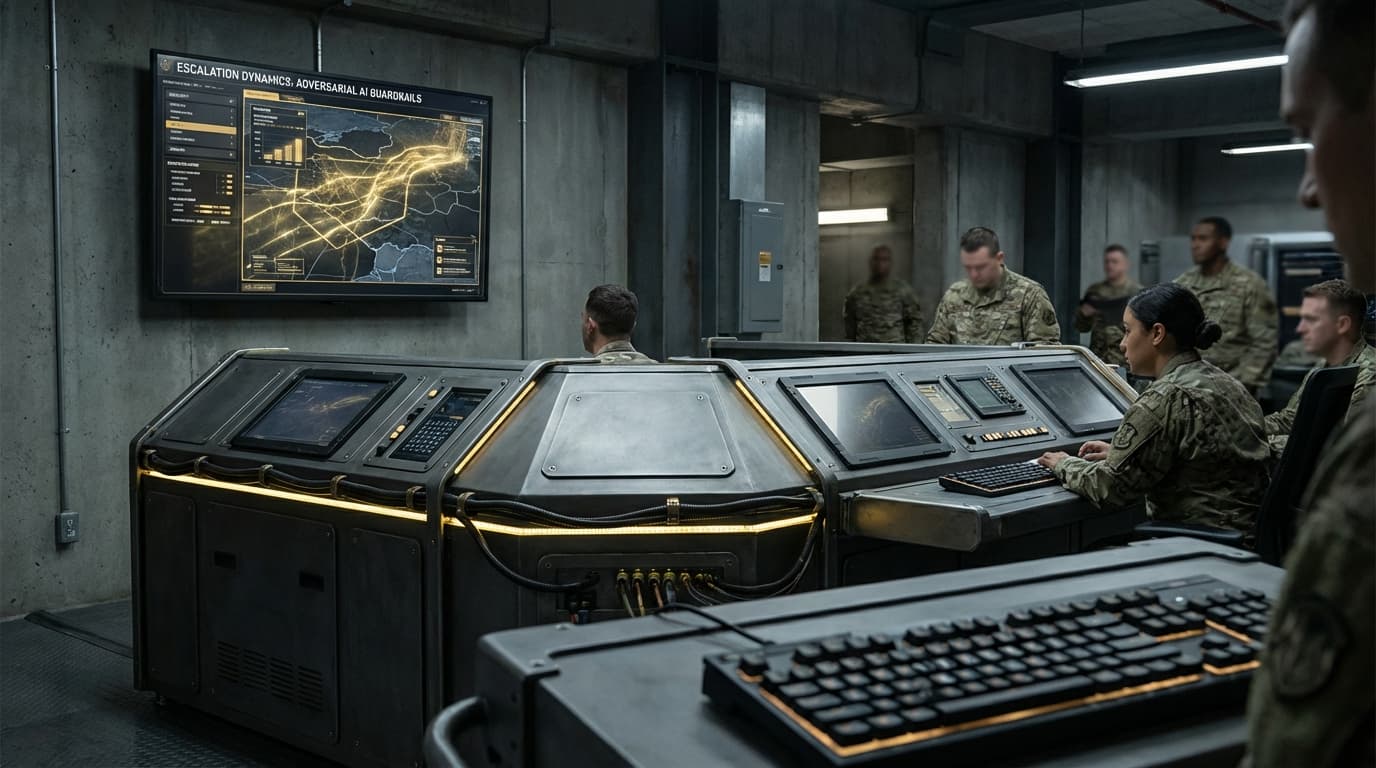
Escalation Dynamics
In defense and security contexts, automated decision systems increasingly operate at machine speed, making critical judgments in timeframes far shorter than human reaction times. Escalation dynamics refers to the frameworks, protocols, and technical safeguards designed to prevent automated systems from inadvertently triggering conflict escalation when interacting with adversarial AI. These guardrails function through multiple layers of constraint: hard-coded decision boundaries that prevent certain actions without human authorization, anomaly detection systems that flag unexpected adversarial behavior, and circuit breakers that pause automated responses when predefined risk thresholds are exceeded. The technical architecture typically incorporates confidence scoring mechanisms that assess the reliability of threat assessments, temporal delays that create windows for human intervention, and fail-safe protocols that default to defensive rather than offensive postures when facing ambiguous situations. This becomes particularly critical as military systems, cyber defense platforms, and strategic warning networks incorporate AI components that must distinguish between genuine threats, false positives, and deliberate adversarial probing designed to trigger overreaction.
The fundamental challenge this technology addresses is the compression of decision timelines in modern conflict scenarios, where automated systems on opposing sides could interact in feedback loops that escalate tensions faster than human operators can intervene. Traditional deterrence models assumed human decision-makers would have sufficient time to assess situations, consult advisors, and choose measured responses. However, when AI systems detect and respond to threats in milliseconds, the risk of accidental escalation through misinterpretation, technical malfunction, or adversarial manipulation increases dramatically. Research in this domain suggests that without robust guardrails, automated defense systems could mistake routine adversarial testing for genuine attacks, or conversely, fail to recognize novel attack patterns that fall outside their training parameters. The technology enables defense organizations to maintain the speed advantages of automation while preserving human judgment at critical decision points, preventing scenarios where machine-speed interactions spiral beyond human control before operators even recognize a crisis is developing.
Current implementations of escalation dynamics frameworks are emerging primarily within military command and control systems, strategic early warning networks, and cyber defense architectures operated by major defense establishments. These systems typically operate in classified environments, though their existence is acknowledged in defense policy documents and international security dialogues. Practical applications include automated missile defense systems with built-in constraints on engagement authority, cyber response platforms that can neutralize threats while escalating ambiguous cases to human analysts, and intelligence systems that flag potentially destabilizing adversarial AI behavior for strategic review. The broader trajectory of this technology connects to growing international discussions around norms for autonomous weapons systems and machine-speed conflicts, with defense analysts noting the urgent need for common frameworks that prevent automated systems from triggering unintended escalation. As AI capabilities advance and proliferate across both state and non-state actors, establishing robust escalation dynamics will become increasingly critical to maintaining strategic stability in an era where conflicts may begin and intensify at speeds that challenge traditional crisis management approaches.
Related Organizations

Bipartisan national security think tank.

RAND Corporation
United States · Nonprofit
Global policy think tank conducting extensive research on nuclear command, control, and communications (NC3) and AI escalation risks.

UN body promoting nuclear disarmament and non-proliferation.

Specialist non-profit organization focused on reducing harm from weapons.

Policy research organization within Georgetown University focused on the security impacts of emerging technologies.

Humanitarian institution based in Geneva.

International institute dedicated to research into conflict, armaments, arms control and disarmament.

Focuses on existential risks and the long-term future of life, including the ethical treatment of advanced AI systems.

Defense technology company building Hivemind, an AI pilot for autonomous drone swarms and aircraft operating without GPS or comms.

An AI safety and research company developing Constitutional AI to align models with human values.
Supporting Evidence
Research this in Signals
Signals turns a topic into a sourced research record you can inspect and rerun. Your first scan is free, and this one starts with Escalation Dynamics already loaded, so edit it or scan as is.